Summer Reading 2011
Each year Ken and I together with our listeners, previous guests, and special guests, come…

Each year Ken and I together with our listeners, previous guests, and special guests, come…

Suppose I say an adult is someone who’s 18 years or older, unless the issue is drinking legally, in which case an adult is someone 21 years or older. That’s a start. But we’re not so much interested in legal definitions, as changing conceptions, of what an adult is. You could argue that unless we know what an adult is, we don’t really know what a person is or what a human being is.

The basic idea is that the internet changes the shape of friendship. People with common interests, but little chance of seeing each other, can become good friends. The sorts of high-bandwdith communications, that used to be possible only with people close by, can now be conducted with people all around the world. How can this not be a good thing? But what kind of friendships are these? I like to eat lunch, have a beer, shoot pool with my friends. You can’t do that on the internet.
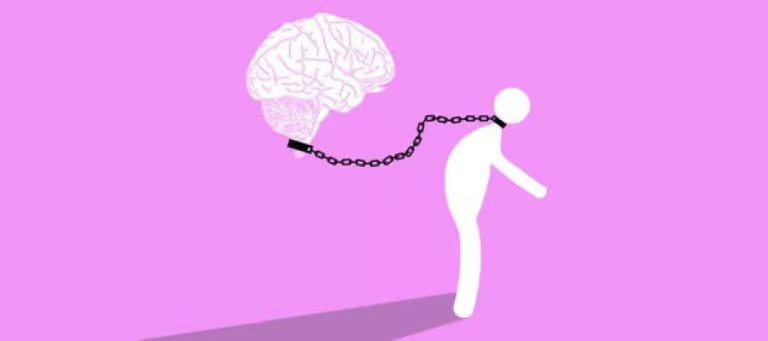
There’s a long history of philosophers worrying about whether we’re really free. One of the first worries was whether we can be free, given God’s alleged omniscience, which seems to mean He knows what we are going to do before we do it. Take yourself back to the time when God expelled Adam and Eve from the Garden of Eden, for disobeying him and eating from the apple tree. Suppose you travel back in time, and offer your services to Adam and Eve as a defense attorney. What would you say?

In America, the 17th century British philosopher, John Locke is probably best known as…

This week we talk about procrastination. Now I am not only an expert practitioner…

Cultural Psychologists claim that people in different cultures have different selves. They have a lot of…

We need to distinguish two questions in considering abortion: Why is abortion morally objectionable, if it is? Is it because we violate the rights of the fetus? Or is it some other reason, like that it expresses a cavalier attitude towards human life? if we interfere with a woman’s choice to have an abortion, have we wronged the woman? Do we, or does government, have the right to interfere with the exercise of that choice?

While licking a pot, six-year-old Tim asks: “Papa, how can we be sure that everything…

Isn’t it a bit odd that philosophers disagree? Consider Ken and I. We’re both a reasonably well-educated, fairly intelligent, pretty perceptive, not overly neurotic philosophers. Why shouldn’t we agree about everything? We need to distinguish between apparent and real disagreements. Suppose Ken says lima beans taste good, and I say that he’s wrong, lima beans taste bad. It seems there is no real disagreement here, just differing tastes. We only have real disagreement when two people hold opinions that cannot both be true.
Civil disobedience is a great tradition. Particularly in America, where we have Thoreau, who refused to pay a poll tax, because the money supported the Mexican War and the Fugitive Slave Law. Then, there’s Rosa Parks and Martin Luther King. And the Viet-Nam War protester. But then, as philosophers, we must ask, what exactly is civil disobedience?

If you think about it, reality comes in many levels, each level involving different kinds of things, having different kinds of properties. Perhaps most people would think of things like dirt at the bottom level, then us at the next level, and the sky at the highest level. But philosophers have a different, more abstract concept of levels of reality.
I’m really happy universities exist, and that they support philosophy departments, and seem to think…
The title of our show, “Bargaining with the devil,” is supposed to bring to mind the issues of bargaining and compromise. These are good things, involved in virtually all cooperative and productive behavior. Everyone has to bargain. Even dictators need to bargain with other dictators and heads of state. But there are times when we shouldn’t compromise because basic principles are involved; and there are issues that we shouldn’t bargain about. Or so it seems.
A digital self isn’t really a person made out of numbers or fingers. It’s a computerized representation of a person. It can be a “VRS”—a virtual representation of yourself. Or a VRO — a virtual representation of another person. So, important distinction: we’ve got me, the real person. And then there are representations of me: My name in the paper, my image in a mirror, the picture of me on our website, even my idea of myself in my own head, and your idea of me.
The title of this week’s program makes at least three assumptions that deserve to brought into the light of critical reflection: that death is terror-inducing; that being terrified of death is a bad thing; and that overcoming the terror of death would be a good thing. One can take issue with each of them.