Author: John Perry

  • The Problem of Other Minds

    The philosophical problem of other minds goes like this. I know that I have a mind, that is, feelings, sensations, thoughts and the like, in a very direct way. I am directly aware of what goes on in my own mind. But how do I know that something like this goes on in other people?


  • The Reality of Time

    Nothing seems more basic or real than time. Yet many philosophers, like Zeno of Elea, find it deeply puzzling. Some, like McTaggart, even claim time is unreal. Of course, philosophers often find reasons to doubt the existence of things we take for granted. But with time, it’s not just philosophers. It’s physicists, too. Like Stephen Hawking, to name just one.

  • Risk and Rationality

    The world is a risky place where all sorts of nasty things could happen. So, how do we decide what to do when there are risks at every turn? Luckily, there’s a widely accepted theory that tells me when it’s rational to take a risk. It says that a rational person is someone who maximizes expected utility. The basic idea is that an agent does something and, depending on circumstances, it may have several outcomes we can rationally assess.

  • Weapons of Mass Destruction

      This week we’re thinking about the ethics of Weapons of Mass Destruction — a…

  • Acting Together

    The great English philosopher Thomas Hobbes famously said that in the state of nature, life is solitary, brutish and short — as if nature designed people to act alone, rather than together. But acting together, this week’s topic, is one of the most natural things in the world. If we never acted together, there would be no families, no teams, no countries. But what exactly is it to act together?

  • Moral Luck

    Suppose Ken and I buy tickets for the California Lottery. We go to the same 7-11, pay the same amount, push the same button to get a ticket with randomly generated numbers. Ken, lucky fellow, plays the winning number and collect $10 million. (This is a fictional example!). I play a losing number, and get nothing.

  • Diogenes the Cynic

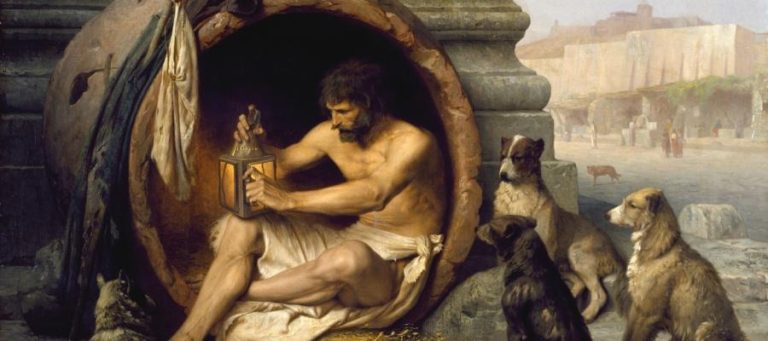
    Diogenes was born about 413 BCE and died in 323 BCE, the same year, and, at least according to legend, the same day as Alexander the Great, who had an unrequited admiration for Diogenes. Cynicism was a School of Philosophy that was founded in Athens by Antisthenes (455—366 BCE), a student of Socrates. The School lasted about 800 years after Diogenes, and was a major influence on Stoicism. Our modern words “cynic” and “cynicism” are historically connected to this School, but their meanings are only tangentially related to Diogenes views.

  • The Self

       What is a self? Here’s is a really simple answer.  I’m a self, namely, myself….

  • Economics: Cult or Science?

    Why the suspicions about economics, expressed in our question for the show? Because there is so much basic, public, disagreement among economists — way more than in most sciences. You’ve got the Chicago School of economics, supply-side economics, Keynsian economics, and on and on. Beyond the basic law of supply and demand, is there really much that they agree on?

  • Mind Reading

    Before people think we’ve gone off the deep end, we should explain that by Mind…

  • On Being Normal

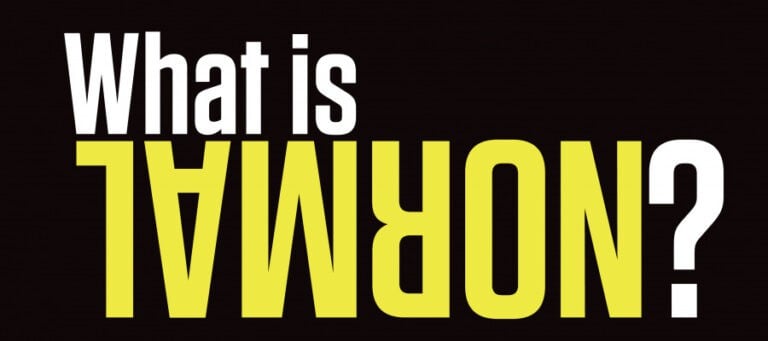
    There seem to be two related senses or uses of `normal’. There’s what we might call the statistical sense: here normal is the average, the mean, or perhaps the median, or the typical. Then there’s the normative sense of normal. Normative means that what’s normal is what lives up to the norms, the standards. But which norms? There’re lots of norms, that it’s not normal to live up to.

  • The 2012 Dionysus Awards

    I saw a number of movies I liked this year, some of which have gone on to be nominated for Academy Awards. Films like The Artist, which I loved, Moneyball, War Horse and The Help. Some of these touched on philosophical themes, but that wasn’t what they were about. Fine for the Oscars, but not for Dionysus Awards.

  • The Right to Privacy

    This is one of those times when we need to start by disentangling concepts. We use ‘private’ and ‘privacy’ in several different ways. Both words derive from ‘privus’ in Latin which means `single’ or `individual’. Being private is usually opposed to being public; privacy means withdrawn in one way or another from the public. In philosophy, we often say that one’s inner mental life is private, which means only you can know what you are thinking and feeling. Other people don’t have the same kind of direct access to your thoughts and feelings as you do.

  • Philosophy in Fiction

    Some famous and not-so-famous pieces of philosophy are, strictly speaking, fiction: the Dialogues of Plato,…

  • Is Democracy a Universal Value?

    Democracy can take many forms. But is democracy itself – as opposed to this or that form of democracy – an inherently good thing? Smart people have differed on this issues. The great philosopher and statesman, Winston Churchill, noted, “democracy is the worst form of government except all those other forms that have been tried from time to time.” Plato was a better philosopher, and he disagreed. He thought democracy was the worst possible form of government. He favored an aristocracy run by philosopher kings.

  • Nihilism and Meaning

    ‘Nihilism’ is based on the Latin word for `nothing’: nihil.  Nihilism is used for a…