Why not buy and sell kidneys?
Commerce in certain bodily parts is allowed, at least if we define `bodily part’…


Commerce in certain bodily parts is allowed, at least if we define `bodily part’…

My father, grandfather and uncle were lawyers, in the small firm then called “Perry & Perry” in Lincoln, Nebraska, and my cousin and his son continue in that firm, now known as “Perry, Guthery, Haase & Gessford”. If the Danforth Foundation hadn’t kindly offered me a fellowship to pursue a Ph.D. in philosophy at Cornell, I would have followed the family tradition. It never occurred to me, as I was growing up, the law was anything but the most honorable of professions.

Augustine’s mother, Saint Monica, was a Christian, and wanted him to become one. When he got an involuntary erection as a teenager in the public baths, she was mortified. His father wasn’t Christian, and took pride in his son’s precocious erection. So Augustine started life somewhat conflicted.

Our topic today is science and censorship. The case of smallpox provides an interesting case-study. Smallpox, once a main scourge of mankind, was eradicated through the efforts of the World Health Organization and others. Stocks of the virus were retained by the U.S. The U.S. and the Soviet Union retained stocks of the virus in Atlanta and Siberia. Now, however, the smallpox genome has been sequenced and is on the web.

David Hume died in August, 1776, at the age of 65 — rather young, by…

A distinction worth making, I think, is between cases in which the truth is important because the subject matter involved is itself important, independently of whether people know or care about it, and cases in which the truth is only derivatively important, because philosophers or others care about it, and if we get something wrong we will be in some sort of trouble with these people.
Like any philosophical “ism,” pragmatism lends itself to easily-refuted straw-man characterizations; and in any case, no doubt, there are inferior (short-sighted, self-serving, hard-nosed, unprincipled) forms of pragmatism. But the various views of Peirce, James, Dewey, Mead, and others are more sophisticated than one might think after reviewing such shallow characterizations.

Children certainly pose a lot of problems — but are they philosophical? Coincidentally I gave a few lectures on John Stuart Mill’s great little book On Liberty recently to Stanford frosh. In thinking about that book one philosophical problem about children comes up, for Mill thinks the central principle of liberty he argues for in the book does not apply to children.

Why do birds fly? Because they don’t like to walk. That was a joke made up by my granddaughter Erin when she was three. She had learned the form of one kind of joke, without quite mastering the part about being funny. She made up jokes non-stop for about three hours, most of them even less funny than the above, regaling those trapped in the car with her, while turning blue from laughing so hard at them herself.

We all carry around two self-conceptions. Imagine having amnesia. The amnesiac knows whose mouth he has to put food in to relieve his hunger; he knows that things detected visually are things that he sees; he knows that the aches he feels belong to his body. So, in one sense, he knows who he is; his most basic self-concept, as the person whose pains he feel, whose hunger he can relieve by eating, whose environment he learn about by the deliverance of sense, remains.

Traditionally, in philosophy, the question of intelligent design is connected to the “Argument from Design.” This is mentioned by many philosophers, including Saint Thomas, but the two discussions that are the most famous are William Paley’s and David Hume’s. I’ve been discussing Hume’s Dialogues on Natural Relgion, where he discusses the argument from design and the problem of evil, in classes for about forty years, so I guess I am in favor of mentioning and discussing the theory of intelligent design in classrooms — but not biology classrooms, unless the biology teacher wants to.

The journal Topoi has asked a number of philosophers to write essays on the current…
I read somewhere that when the boat with the latest installment of The Old Curiosity Shop arrived in New York, there was a crowd a block deep waiting to find out what happened to Little Nell. Those closest to the boat found out that she had died, and as the message filtered back through the crowd a visible wave of horror and despair followed, with people breaking down in tears.

Following the attacks of September 11, 2001, the New York Times did its best to run an informative obituary of each of the victims, those at the World Trade Center, the Pentagon, and in the airplanes that were hijacked. So there were in the neighborhood of 2000 of these obituaries. Reading them, day after day, made a very deep impression.
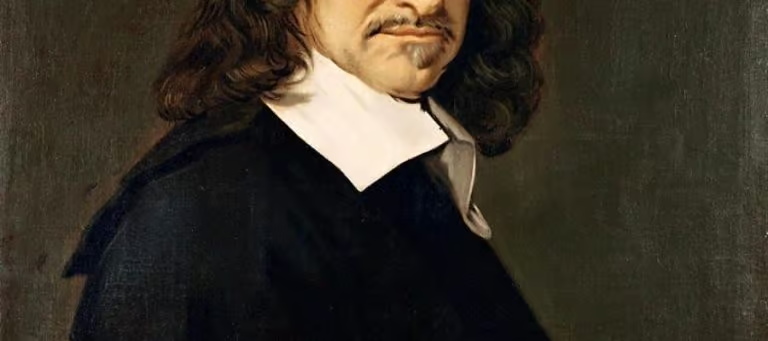
For almost forty years I have taught Descartes’ Meditations in my Introduction to Philosophy Class. The skeptical problem which he poses bring up a host of interesting problems which occupy us for the rest of the course: the external world, the self, God, and the relation between mind and body.
I agree with Nussbaum that how we think of future possibilities has a lot to do with our emotions. If I think that X is going to have a root canal, I am filled with sympathy. Well, not filled, but I have some sympathy for X. If I realize that X is me, a whole different set of emotions rise in my breast, or brain, or heart, or wherever emotions are taken to arise these days.