Author: John Perry

  • Humanism

    Here are the fifteen points of the original AHA Manifesto — for later revisions, see their website. FIRST: Religious humanists regard the universe as self-existing and not created. SECOND: Humanism believes that man is a part of nature and that he has emerged as a result of a continuous process. THIRD: Holding an organic view of life, humanists find that the traditional dualism of mind and body must be rejected.

  • William James

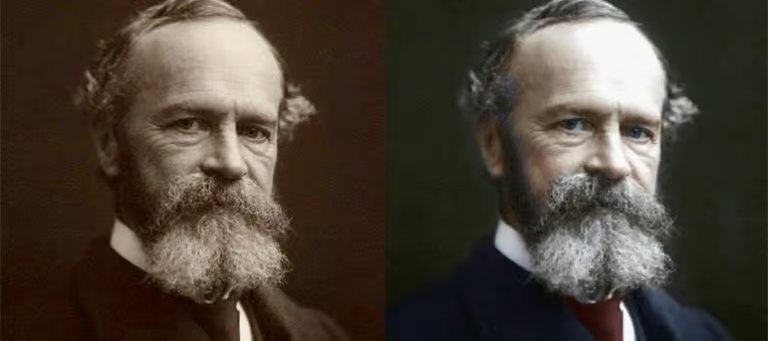
    James was a precursor to contemporary philosophers, in that he was really a cognitive scientist / philosopher. He was in both departments at Harvard. His two-volume PRINCIPLES OF PSYCHOLOGY was the bible of psychologists at the time. It still makes fascinating and rewarding reading. His book THE VARIETIES OF RELIGIOUS EXPERIENCE, which is a combination of philosophy, psychology and sociology, virtually originated the serious study of the psychology of religion.

  • Rawls on Justice

    One of the most influential political philosophers of the 20th century, John Rawls articulated a vision of a liberal state, focused on justice. Continuing the ideas of Locke and others, Rawls maintains the best way to think of the state is as the result of a social contract.

  • Democracy and the Press

    Freedom of the Press was important to the Founding Fathers; it’s right there in the first amendment: “Congress shall make no law respecting an establishment of religion, or prohibiting the free exercise thereof; or abridging the freedom of speech, or of the press; or the right of the people peaceably to assemble, and to petition the Government for a redress of grievances.” Still, the founding fathers had a lot of ideas.

  • Corporations as Persons

    Groups of people, and corporations too, can do a number of things that people do. They can make promises, tell lies, incur debt, and the like. Perhaps the concept of corporations and other collections of human beings as fictional persons simply recognizes that fact. Groups of people were issuing statements, true and untrue, buying and renting buildings, going into debt, and stuff like that long before the law or Supreme Court came into it.

  • Hannah Arendt

    All the philosophers we talk about have interesting thoughts. But many of them have relatively dull lives. Hannah Arendt is not one of them. She led a very interesting life, and the events in her life had a lot to do with her philosophy.

  • Apologies

    When one hears the word “apology” in a philosophical context, one naturally thinks of Plato’s famous Socratic dialogue, “The Apology”. And then it strikes one that Socrates doesn’t sound all that apologetic. Historically, “apology” often meant “reasoned argument or writing in justification of something”. Nowadays it mostly means “a regretful acknowledgment of an offense or failure”. It’s in this latter sense we are interested in apologies, including apologies in the political sphere, whether sincere or self-serving statements pretending to be expressions of regret.

  • Faces, Feelings and Lies

    How can we know what a person is feeling by looking at their face, and in particular can we know if they are lying? There is clearly both a psychological side to this and an epistemological side. Our guest is famous for his work on the psychological side, with a positive result: we can know what a person is feeling, and whether they are lying; at least the information is often there in the face. But it’s not always so easy.

  • The Ethics of Torture

    Is water-boarding torture? If it is, does that make it wrong? Always? Usually? What is torture, and why is it always, usually, or sometimes wrong? Almost every dictionary gives two definitions of torture: a narrow one… inflicting great pain. And a broad one… severe mental anxiety and suffering. Water-boarding clearly counts as torture by the second definition, perhaps the issue isn’t clear given the first definition. But sure if our topic is the ethics, or morality, of torture, we need the more inclusive definition – severe mental anxiety and suffering.

  • On Being a Wife

    What is a wife?  From a philosophical point of view, it looks like the word…

  • What is Normal

    According to the OED, the usual sense of `normal’ is: 2. a. Constituting or conforming…

  • Am I a Postmodernist

    The term “postmodern” came into use as a description of certain trends in architecture, art, and literature in the 1970’s, although the trends it describes reach back earlier in the twentieth century, to Joyce and Finnegan’s Wake in the case of literature, and to the 1950’s at least in the case of architecture. But what counts as postmodern philosophy?

  • Torture

    Although we have not had, and don’t have scheduled in the near future, a program…

  • Philosophy and history

    It seems likely that an important part of the evolution of language (and thought and…

  • Rawls

      When I was in graduate school at Cornell from 1964 until 1968, and for…