Philosophers’ Corner

  • Controversy About Climate Denial

    Research shows both that increasing people’s knowledge of climate science does not increase acceptance of human-caused climate change, but teaching the mechanisms of how global warming works does strengthen acceptance. Is there a way to reconcile these seemingly conflicting results?

  • Immigration and Multiculturalism

    Should immigrants assimilate into their new society? Or should society adapt to make room for different cultures? Aren’t there some foreign customs we should never accept? This week, we’re thinking about immigration and multiculturalism.

  • There’s Taste… Then There’s Taste

    Lots of us have tastes in music, movies, stories, or art—and we generally know what they are. But what explains why we like what we do? Is it just a subjective reaction to something we recognize or identify with? Or are we responding to its objective aesthetic value?

  • Mind the Gaps!

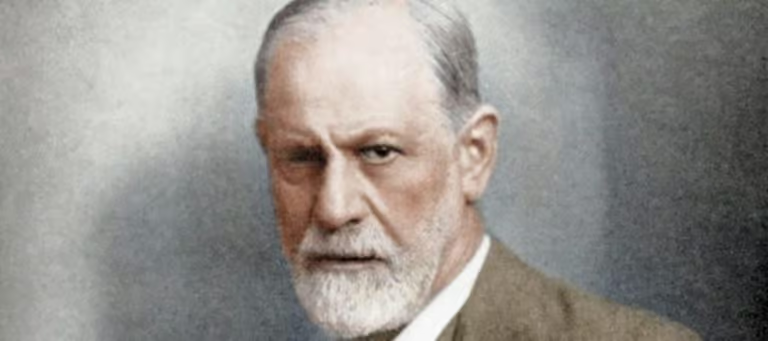
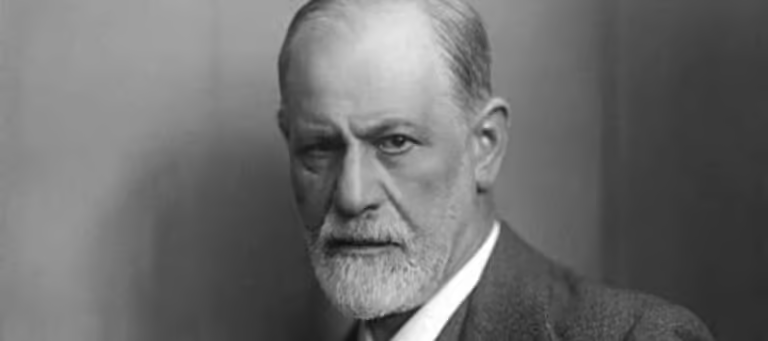
    In this installment of my series on Freud as a philosopher, I explain how Freud arrived at the view that mental states are brain states, that mental processes are unconscious, that we have only indirect access to our own minds, and that introspection is an inadequate tool for exploring the mind.

  • #FrancisOnFilm: Minding the Gap

    What are friends for? Should friends be supportive and non-judgmental? Should they attempt to improve one another? Or should friendship wane with the recognition that the friend has harmed another? Minding the Gap suggests that these questions do not have simple “yes” or “no” answers.

  • Five Types of Climate Change Deniers

    Why do people deny climate change? A common view is that such people reject science. But in most cases, it’s not all science they reject. After all, most climate deniers believe in electricity and that the earth goes around the sun. So what is going on? As I see it, there are at least five types of climate denier.

  • Finding Yourself in a Virtual Fiction

    Last week I went to the Night of Philosophy and Ideas at the Brooklyn Public Library. One of the experiences on offer was a short CGI virtual-reality film called BattleScar. What is most compelling about BattleScar is the way it plays with your perspective. You are, as a viewer, implicated in the same physical space as the characters in the film.

  • What Do We Owe Future Generations?

    Exactly how much should we care about future generations? It seems obviously wrong to say that we shouldn’t care about them at all. It also seems wrong to say that we should care about them as much as we do about ourselves. After all, they don’t even exist—at least not yet.

  • #FrancisOnFilm: Aquaman

    Can an action flick like Aquaman be philosophically interesting? Could it, for example, contribute to environmental preservation by actually motivating people to do something about oceanic pollution? Answering this question requires theorizing about moral motivation.

  • The Puzzle of the Unconscious

    Most of Freud’s contemporaries believed that the human mind was all conscious. Historians of ideas who write about the development of psychology often get Freud’s original contribution wrong because they don’t attend carefully enough to what was meant by terms like “subconscious mind” and “unconscious states.”

  • Is Envy Always a Vice?

    At first glance, it seems hard to find anything positive in the phenomenon of envy. But upon deeper reflection, we can recognize that while envy is often demoralizing, antisocial, and even planet-destroying, there’s also a good kind of envy—one that motivates us to raise our game.

  • #FrancisOnFilm: Brexit

    Do makers of films that fictionalize real events have obligations not to misrepresent in the interests of telling a good story, particularly when they aim to make a political point? Is it permissible to fill gaps in a story with fictionalized accounts of events?

  • Getting Clear on the Replication Crisis

    Ever since the replication crisis broke in 2011, a number of causes have been identified for why a psychological experiment might not replicate. I want to suggest a possible reason why a study might fail to replicate, one that seems to have been mostly overlooked, namely: lack of conceptual clarity about the phenomenon being measured.

  • How (Not) to Fall Asleep

    Why can falling asleep be so difficult? I’m not looking for a third-personal story of the causal factors that adversely affect sleep. I’m asking a slightly different question: what explains that truly infuriating first-personal experience of trying desperately and yet failing miserably to fall asleep?

  • Freud’s Philosophical Challenges

    Last month, I started a new series of essays on Freud as a philosopher. This month, I want to lay out some of the perplexing philosophical issues that Freud and his intellectual community were confronted with towards the end of the nineteenth century, and how they grappled with them.