Maimonides and the Goodness of the World
September 13, 2026
Listen


Moses Maimonides (also known as the Rambam) was a 12th-century rabbi and scholar, most famous as the author of The Guide for the Perplexed. He thought that understanding the world through science and logic would lead you to knowledge, and that this in turn would lead you to love God. “When a man studies all these created beings,” he wrote, “and realizes the divine wisdom manifested in them all, his love for God will increase.” But is the world in fact something lovable? What do we do with all the pain and suffering? And is faith something you can prove using reason? Josh and guest co-host Yonah Schiller get in good with Ross Brann from Cornell University, author of Moses Maimonides: A Very Short Introduction.
Part of the Jewish Thinkers series.
Josh Landy
What’s so important about reason?
Yonah Schiller
If we use it properly, will we come to see the world as a beautiful place?
Josh Landy
Is your intellect a mystical tool?
Yonah Schiller
Welcome to Philosophy Talk, a program that questions everything…
Josh Landy
…except your intelligence. I’m Josh Landy.
Yonah Schiller
and I’m Yonah Schiller. We’re coming to you via the studios at KALW San Francisco Bay Area.
Josh Landy
Continuing conversations that begin at Philosopher’s Corner on the Stanford campus, where I teach philosophy.
Yonah Schiller
And at Common Era, where I run an R&D lab for finding and lifting up new talent and ideas.
Josh Landy
Today’s episode is actually the first in a series generously sponsored by Common Era, and we are asking about Moses Maimonides and the goodness of the world.
Yonah Schiller
Oh yeah, Maimonides, one of my favorite thinkers of all time. He’s a 12th-century theologian who wrote the Guide for the Perplexed.
Josh Landy
Yeah, he’s one of my favorites too. Partly because he thought that the life of the mind is the best life for human beings, and he meant all human beings, not just Jewish folks. Not only the tribe of Levi, he said, but also each and every individual whose knowledge gives them understanding, everybody has the opportunity to live a good life and get a reward from God, just as long as they use their reason.
Yonah Schiller
Well, no wonder you like that idea, Josh. Here you are hosting a radio show about philosophy, that tracks. But is it really the best life for everybody?
Josh Landy
Well, Maimonides thought so. He said, “If you use your reason properly, you’ll come to appreciate how great the world is, and that’ll bring you closer to God.
Yonah Schiller
Wait a minute, logic, God-that’s like concrete and coffee beans. How on earth are they supposed to go together?
Josh Landy
Here’s the idea, as I understand it: if you really think about the world, you’ll come to see it’s an amazing place full of bees, butterflies, bountiful beauty, and all kinds of other things beginning with B. And once you’ve seen that, you’ll be grateful to whoever created it, and we all know who that
Yonah Schiller
is. Okay, what are you talking about? Bees, butterflies, and beauty. The world is disease, death, and disaster. You can still believe in God, but a lot of theologians think you have to look beyond the world to do that. Even within the Jewish tradition, you’ve got mystics who tell us to rise above the physical if you want to find God.
Josh Landy
Yona, you’re reminding me of an old joke. There’s two philosophers talking, and one asks, “Why is there something rather than nothing? And the other one says, “Gee, even if there was nothing, you’d still complain.
Yonah Schiller
Very funny. But what is your point, Josh?
Josh Landy
Well, the point is we shouldn’t complain so much. Suffering does exist, but according to Maimonides, the bad is outweighed by the good. Once we shift our perspective and start seeing everything as a totality, Maimonides says we will realize the divine wisdom manifested in everything, and our love for God will increase.
Yonah Schiller
Okay, first of all, I don’t buy that argument. But second, even if it worked, would we really want that? Think of what the philosopher Kierkegaard says: believing in the higher power is all about a leap of faith. If you’re just being logical, you’re getting it all wrong.
Josh Landy
Maybe Kierkegaard just had too narrow an understanding of reason. I mean, if you can use your reason to understand the universe and see how miraculously everything hangs together, you’ll end up in a vision that takes you beyond the everyday. In fact, a lot of scientists talk that way. Reason isn’t just test tubes and calculators; it’s deep sea submarines and James Webb telescopes. Reason is enchanting.
Yonah Schiller
I just don’t agree that thinking, on its own, is what makes for a flourishing human life. What about our other capacities? About mystery, or creative pursuits, or love?
Josh Landy
Yeah, you know that’s a tough one, Yona, because I gotta say I myself am a big fan of creative pursuits and definitely a big fan of love, and I gotta admit you kind of have me stumped. But maybe our guests can help us. It’s Ross Brand from Cornell University, author of Moses Maimonides: A Very Short Introduction.
Yonah Schiller
But first, Maimonides was born in Cordoba, Spain, one of the most cosmopolitan cities in medieval Europe, known as the ornament of the world, we sent our roving philosophical reporter Cheryl Kaskowitz to find out how growing up in that mix of cultures shaped who he would become. She files this report
Maimonides ad
from Fifth Avenue to Ocean Parkway, from your deli guy to your auntie to your neighbors down the block, from your heart to your smile, from checkups and MRIs to everything you got planned.
Sheryl Kaskowitz
You may be wondering how this TV ad from last summer could possibly relate to a 12th-century Jewish philosopher.
Maimonides ad
Because Maimonides is from Brooklyn and for Brooklyn.
Sheryl Kaskowitz
They’re talking about the hospital in Brooklyn that’s named for Maimonides. Of course, he was born in medieval Spain, not a borough in New York City, but it was a vibrant, diverse place. Maybe not so different from Brooklyn for its time, and that had a big impact on his philosophy.
Leonard Nimoy
I was born in Cordoba, Spain, in 1135. My father was Rabbi Maimon.
Sheryl Kaskowitz
That’s Leonard Nimoy as the voice of Maimonides in an animated film about his life. No disrespect to Mr. Spock, but other sources say he was born in 1138, and it’s pronounced COR-doba. But anyway.
Leonard Nimoy
Cordoba was a beautiful city with fine architecture and lush gardens. The streets were always filled with people. The atmosphere was at peace. Tolerance, culture, and refinement prevailed, and for us, the Jews, life was comfortable and secure.
Sheryl Kaskowitz
It was a unique place back then.
Ken Seeskin
At that point, Córdoba is under Islamic rule. It’s one of the wealthiest, largest, and most intellectually active cities in all of Europe.
Sheryl Kaskowitz
Ken Seaskin is a professor of Jewish civilization at Northwestern and an expert on Maimonides. Córdoba was a capital of what historians call the convivencia (Spanish for coexistence) That’s when Muslims, Christians, and Jews basically all got along, living next to each other in medieval Spanish cities. But things changed in Córdoba when Maimonides was about 10 years old..
Speaker 1
The Almohads! The Almohads are coming!
Leonard Nimoy
In 1147, the fanatic Muslim Almohads, determined to conquer and convert Spain, advanced on Córdoba. Life for all of us, especially Christians and Jews, unfortunately, was never the same.
Sheryl Kaskowitz
Jews were given a choice: convert, leave, or die. So Maimonides’ family fled, but his roots in that diverse intellectual world stayed with him. Here’s Ken Seeskin again.
Ken Seeskin
You have to remember he’s in a culture where the language of science, astronomy, medicine, linguistics, mathematics is Arabic. He is fluent in Arabic and Hebrew. In fact, much of his technical writing in philosophy and medicine is in Arabic. It’s called Judeo-Arabic, which is basically Arabic written in Hebrew letters.
Sheryl Kaskowitz
And it wasn’t just the language.
Ken Seeskin
We actually have a letter from Maimonides where he describes himself in many ways as a disciple of Al-Farabi, who was an Islamic thinker, a predecessor.
Devon Strolovitch
As a general rule, I may tell you, study only the works on logic composed by the learned Abu Nasr Al-Farabi, for everything he has written is as fine flour.
Sheryl Kaskowitz
In this letter to his translator, Maimonides actually mentioned another Muslim philosopher as well.
Devon Strolovitch
So also Abu Bakr al-Sa’igh was a great philosopher. All his writings are plain to him that understand, and write to them that find knowledge.
Ken Seeskin
This is something that he insists on all the time. He was willing to pursue truth from whatever source it may come. If it comes from Aristotle, fine. If it comes from the Torah, fine. If it comes from an Islamic thinker, fine. If it comes from a Christian thinker, fine.
Sheryl Kaskowitz
And it worked the other way too. Maimonides had an influence on at least one important Christian philosopher.
Ken Seeskin
The Guide to the Perplexed translated into Latin very quickly, and Thomas Aquinas is a reader and a commenter, and Thomas Aquinas is with Maimonides on a lot of these issues, not all of them, but a lot of the issues I think he’s been educated by reading Maimonides and goes along with it. What’s beautiful about this? You have a Jewish writer writing in Arabic, suddenly translated into Latin, read and very much appreciated by somebody who became sated by the besieged church. It’s beautiful. I wish we could return to that. It’d be wonderful.
Sheryl Kaskowitz
So even after people from different cultures weren’t allowed to live next to each other in Cordoba, this exchange of ideas kept that spirit of convivencia alive.
Leonard Nimoy
Knowledge is the key to belief and growing closer to God.
Sheryl Kaskowitz
For philosophy talk, I’m Sheryl Kaskowitz.
Josh Landy
Thanks for that great report, Cheryl. Super interesting stuff about Maimonides’ life and times. I’m Josh Laddie. With me is my fellow philosopher Yonah, and today we’re thinking about Maimonides and the goodness of the world.
Yonah Schiller
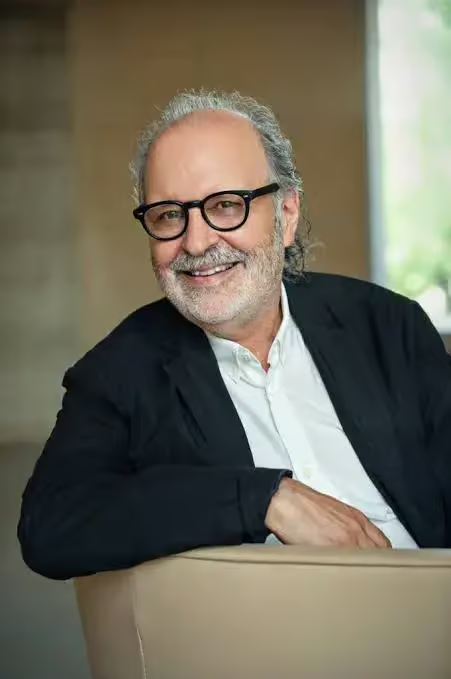
We’re joined now by Ross Brann. He’s professor of Judaic Islamic Studies at Cornell University, an author most recently of “Moses Maimonides: A Very Short Introduction.” Ross, welcome to Philosophy Talk.
Ross Brann
Thank you so much for having me, and congratulations to both of you for obviously studying Maimonides in preparation for our talk today.
Josh Landy
We do what we can, Ross, and I want. Not just how Maimonides shows up in your academic work, which you know you’ve written such a beautiful book and many articles about Maimonides, but also how he shows up in your everyday life.
Ross Brann
Where does Maimonides not show up in my everyday life? When I think about the state of the world, injustice, inequality, climate change, the invention of AI, and how it’s dominating what everyone is concerned about on virtually every level. These are things for which Maimonides has some answers and solutions. He’s constantly with me in my teaching. I was also recently asked by a campus rabbi, to if I would participate in a session that she’s offering not for credit on the challenges of AI and humanity, and I told her as long as I can relate this to Maimonides’ philosophy, I’m game, and she accepted that.
Yonah Schiller
Russ earlier, Josh and we were arguing going on and on about how good the world actually is. I think the world is good, but he was saying it’s all bees and butterflies. I was saying there’s also a huge amount of suffering. Who’s right, according to Maimonides?
Ross Brann
Well, you’re both right, but it’s a question of what we focus on, and Maimonides’ view, which we can find in his extensive discourse on the Book of Job from the Hebrew Bible, is that we need to focus our attention on the good, the beautiful, the extraordinary, and the physical infirmities that all of us will feel, including death and disease, are will will sort of they don’t go away, they don’t evaporate, but they kind of leave our consciousness in a way that it’s sort of protective. This kind of focus entirely on what is transcendent and eternal, and the source of wisdom, can take us out of this focus that we have as human beings on what’s gone wrong.
Josh Landy
So one of the lines I I love in Maimonides is when he says, “When a man study, when a person studies all these created beings and realizes the divine wisdom manifested in them all. That person’s love for God will increase. So how how does he tackle those difficult topics like the ones we’re just mentioning? People getting ill, people dying, our our friends and relatives passing away. Where’s the divine wisdom manifested even in the negative aspects of experience.
Ross Brann
So we are following Aristotle, which Maimonides does. We are, as human beings, matter and form, and the physical aspect of our existence is part of a world where there is disease and decay and natural disasters, we need to sort of set those aside by focusing on what is wise, eternal, beyond the normal way in which we conduct ourselves in daily life. And when we do so, we’re protected from this feeling of everything is falling apart or everything is in a place of disaster. Now, this also presupposes living according to Maimonides in a society that’s well regulated, that is just, that is fair, where people take care of one another, and and so on. Has this society existed? Not to my knowledge, not to my knowledge. But for Maimonides, the blueprint for that society is what he calls the law, Jewish law, the Torah, in the widest sense of the term. That it’s a divine blueprint for regulating the life of the individual towards perfection and regulating the life of society towards perfection. Maimonides does not dismiss the effect of contingent travails and troubles and disease and all of that, but if we orient ourselves away from that, we can end up in a very different place.
Yonah Schiller
Does Maimonides think that the intellectual pursuit is the pathway to spirituality, or does spirituality play a different role than the kind of divine realization through logic that he seems to espouse?
Ross Brann
I think the two are the same for him. Clearly, others would define spirituality in a different way and praxis to engage in spirituality or to to become familiar with what is called spiritual in that sense. But for Maimonides, what many people would call spiritual is entirely intellectual. How do we know this? We know that because following Aristotle and Alfarabi and others in Aristotle’s wake, Maimonides asks, “What is the unique virtue of humanity, of being a human? What differentiates us as a species from everything else that’s alive on Earth, and what differentiates us, what’s our unique virtue, is our intellectual capacity, our curiosity, our ability to ask questions, to seek answers, to test hypotheses, to use reason.
Josh Landy
You’re listening to Philosophy Talk today. We’re thinking about Maimonides with Ross Brann from Cornell University.
Yonah Schiller
Do you logic your way through life, or do you tap into other non-intellectual superpowers to make sense of things? Do we even need to make sense of them at all?
Josh Landy
Think it, drink it, or just go on a hike, along with your comments and questions when philosophy talk continues.
Bill Withers
Lovely day, lovely day.
Josh Landy
Can reason make every day a lovely day? I’m Josh Landy, and this is Philosophy Talk, the program that questions everything…
Yonah Schiller
…except your intelligence. I’m Yonah Schiller, and we’re asking about the 12th-century theologian Moses Maimonides with Ross Brann from Cornell University, author of “Moses Maimonides: A Very Short Introduction.”
Josh Landy
Today’s episode is generously sponsored by Common Era, an R&D platform building new Jewish futures for the common good.
Yonah Schiller
Feeling perplexed by Maimonides? Email us at comments at philosophytalk.org, or you can comment on our website. And while you’re there, you can subscribe to our free podcast and guide yourself through our library of more than 600 episodes.
Josh Landy
So, Ross, before the break, you were telling us about Maimonides’ drawing on Aristotle and Aristotle’s reception in Alfarabi, and this, for me, is one of the most fascinating aspects of Maimonides as an intellectual historical figure, yeah, I remember being amazed by his story. He’s a Jewish philosopher, but he’s an expert in Aristotle. He’s tapped into Islamic thought. He’s writing a bunch of his books in Arabic. He’s chief doctor to the Sultan. Oh, and a bunch of his fellow Jews kind of didn’t like his writing. Some of them burned his books, and so it’s not necessarily none of this is sort of the first thing you think of when you think of a major Jewish theological figure. Was all of this kind of special to Maimonides, or was there something in the air at that time and in that place?
Ross Brann
Well, Maimonides certainly represents the culmination of this entire period. That’s characterized by some people call it a symbiosis, the interface, the deep structural interaction between Jewish culture and Islamic culture in the medieval Mediterranean, Christian culture too. Maimonides exemplifies that living in a very very complex world in some ways not unlike ours, because I’d remind us all that in addition to the very impressive list of things that you mentioned, Josh, he was also the most important Jewish legal authority for sacred law of the age. So he’s wearing lots of. Hats in the way in which we we talk about it, and is comfortable equally comfortable in all of these domains. And I think it goes back to his training early in life as a scientist, mathematics and astronomy, medicine, logic and philosophy. So from an intellectual point of view, his world could not have been richer than it was, and how he lived and how he wrote. And the Arabic language here that you mentioned is key because Maimonides wrote everything, virtually everything, in the Arabic language. This was his mother tongue, his most important work of rabbinic scholarship, 14 volume code of Jewish law, was written in Hebrew for a wider Jewish world audience. But everything else is in Arabic. So this means, what was he reading? What was he talking with other physicians about during this time and place? Elites, intellectual elites, has to be admitted. This is not everyone living this kind of life. Are feeling free to talk with one another. It begins in medical practice, but it extends to all of the sciences, which are not understood to be the provenance and property of any one religious community. So Christian scholars don’t own them. Islamic Muslim scholars don’t own them. Jewish scholars don’t own them. It’s a shared smorgasbord of ideas and books and ways of thinking about the world, which then can be applied to one’s own religious tradition, and that’s Maimonides.
Yonah Schiller
He sounds like such a progressive intellectual, maybe well ahead of his time. I’m curious. Do you think that his intellectual pursuits that were not religious informed his religious perspectives, or do you think it was vice versa? I’m curious about the the collision between him being very much in the world, being a physician, having these communities that have nothing to do with the religious community finds himself in. At the same time, he’s pioneering in the religious community in all sorts of new ways. I can’t help but think the interaction between those two things is somehow defining his uniqueness.
Ross Brann
So scholars debate the answers to your questions. Is Maimonides a philosopher pretending to be a rabbi? Is he a rabbi pretending to be a philosopher? I don’t see it that way, and I’m almost certain that Maimonides wouldn’t see it that way. These ways of thinking and experiencing life, and his practice of living in a very complex world, a multicultural kind of universe. Again, he wouldn’t understand that word, but this is the world he lives in. It just came naturally to him because of his pursuit of truth and wisdom. In a Jewish text, it is written in Arabic, but it’s a Jewish text written for other Jews. He says, “Heed the truth, whoever spoke it.” Itdoesn’t matter if someone has discovered a truth according to scientific inquiry and philosophical inquiry about the world. Then that has a validity that transcends its origins, its source.
Josh Landy
So that’s it’s very interesting, at least from a contemporary standpoint. You know, we might have assumed that someone living in that place in time who felt very strongly that the Hebrew Bible is the source of truth would have rejected, you know, so-called pagan philosophers like Aristotle might have rejected Islamic thought, and yet here he is telling a correspondent to read Aristotle and Ibn Rushd in order to understand his book. Jewish thought for him is not at all incompatible with Christian thought, Muslim thought, any you know Greek thought, and similarly, science is not incompatible with religion. He says he says the study and acquisition of medicine are preeminently important religious activities, which is astonishing. But it brings up a question to me, which Yonah was asking earlier, to do with the crucial importance of reason within a religious practice. I mean, I totally take your point, Ross, about this Aristotelian strand in Maimonides, that you know reason is essential to human nature, and so we should you know in order to flourish, we should lean all the way in to our reason. But that’s flourishing. Why think that it’s also sort of the way to live a religious life, why not think yes? Maximize your use of your reason, but also have faith, have epiphanies, right? Have experiences that lead you to a vision of the transcendent. Why does he seem to be, or is he ruling out those other things? What’s going on there?
Ross Brann
Well, he’s ruling them out for most. People for Maimonides, the prophets had those visions, so they spoke to their community in parables and with images. Moses stands out from among the prophets in not speaking that way. So Moses’ Torah, the first five books of the Bible, the Hebrew Bible, are primarily narratives and legal material, and as I said before, the laws guide one towards a proper path, a proper orientation. The narrative material is more along the lines of parable, the way Maimonides understands it. So he would say that whatever is in the Hebrew Bible that does not accord with reason, as he understands it, and science must be reinterpreted, must be read in a way to be consonant with reason. Now this is not a traditional view. Obviously he was innovating, but he gives all of those parts of the Bible that would not, on the face of it, appear to seem to be rational, he reads them metaphorically or as parables of one sort or another to bring everything together in a kind of a harmony.
Josh Landy
You’re listening to Philosophy Talk today. We’re thinking about Moses Maimonides with Ross Brann from Cornell University.
Yonah Schiller
Ross, I have a question. Just you know, I always like a good philosophical drama. I mean, so when a philosopher is hated, that’s always exciting. So I have some ideas and thoughts that you know maybe he was hated because he consolidated a lot of work that typically is more democratized, and so he created some a canonized version of the truth. What was behind that? Why did he do that? Were there other reasons he was hated? What can you say about that?
Ross Brann
I would say there are three reasons. One is professional jealousy, particularly in the Middle Eastern setting. He struggled with some authorities in Baghdad. He resided in Cairo in the Jewish community there. Those struggles had the air of being ideological, and I don’t want to dismiss that, but they were also matters of jealousy. Who is who speaks for the Jewish world? Who speaks for the Jewish community in Islamic lands? So that would be number one. Number two, and I think both you and Josh Yona reference this in in one form or another in his Code of Jewish Law, this 14-volume magnum opus written in Hebrew for all of the Jewish world. Maimonides was responding to what he thought was an urgent necessity on the part of the state of the Jewish world, as he saw it, a kind of ignorance in general, an ignorance of science philosophy, but also an inability to access Jewish tradition. So he wanted to produce a work that would provide that for average Jews to be able to access the truth of the Torah on their own, without necessarily having a rabbinic authority standing by. Clearly, some rabbinic authorities took exception to this. In their mind, it was haughty, and also here the more practical side, it might have had the effect of putting them out of business as legal authorities in their own right, even if they agreed, which they did for the most part, with Maimonides’ judgments about the Torah, they did not take kindly to the idea that he was deciding all of these matters for once and for all for everyone. So, and then three, some questions arose again. Some of it on the basis of jealousy, but some questions arose about what Maimonides’ true beliefs were, whether they were in full accordance with rabbinic tradition. So, on each of those accounts, he made some enemies, and of course, his defenders and his son Abraham engaged in a battle royale with these enemies, diatribes, excommunications, burning of books. You have
Josh Landy
it. Yeah, that’s drama. We we have a couple of comments from listeners. CM on Blue Sky writes, “Mimonides was super cool. I agree with that. Thank you for featuring him. We definitely need more medieval philosophy in the mainstream. And Isabel sent an email. Isabel wonders whether we can use reason to understand how individual believers get to faith. Maybe some of them are driven by personal experiences, like what she calls moments of profound conviction or gnawing doubt. But maybe others have epiphanies or come to see meaning and patterns observed in nature. So, what would Maimonides say about this, Russ? Can we use reason not just to get to faith, but also to understand faith?
Ross Brann
Again, the key question here for interpreting Maimonides is he he uses the Arabic and Hebrew equivalents of the word faith, but I think in. Contemporary English faith has overtones that are really unique to the Christian tradition of thinking, and far less important in Maimonidean ways of understanding the world. So, if you proceed along the lines that Maimonides advises, philosophically, scientifically, and train your thought properly, and observe all of the ordinances of the Torah as laid out in Jewish tradition, and which he canonized. Then you are on the right path. You will you will have he wouldn’t use the word epiphany, but maybe we could call it and using a word from Eastern Islamic philosophy, illumination. You will you will begin to connect to the wisdom which is at the basis of everything that Maimonides is reaching for intellectually.
Josh Landy
So that’s interesting. This question about illumination. This question about what belief comes to for Maimonides, because on the one end, as you were saying a moment ago, he reads a lot of what we see in the Hebrew Bible as metaphorical. So, any time God is described as sort of moving around or having emotions or something like that, that’s not really how it is. That’s just metaphor. He quotes this line: “The Torah speaks in the language of men. In other words, you know, it’s you know tell these stories for the average believer to to grab onto, but it’s not real. So that seems like it’s sort of a little bit demystifying, right? The certain kind of I don’t know supernatural occurrences in the Bible. He’s ready to say it’s just a figure of speech. On the other hand, he has a very interesting and perhaps almost mystical picture of what God is. That God is something infinitely beyond our understanding. So, is there this kind of you know mystical side to Maimonides where he’s actually interested in us ultimately through the use of a reason, coming to this, I don’t know. I want to call it very spiritual experience of a God that we cannot fully know.
Ross Brann
So again, our vocabulary that we use to discuss these very very esoteric matters is helpful because we don’t have any other way of talking about them. But they also get us into kind of conundrums, as far as Maimonides is concerned, certainly that process of perfecting the intellect, to some ways of looking at it, it does have a mystical air to it. I mean, Maimonides is is advising us to try to connect with that which is so far transcendent, so far beyond us, but nevertheless, it’s possible to grasp a great deal of it through training and focus. And I think, on some level, looking at it just from the history of religions, he’s ending up in the same place as the mystics. So, my modernity science focuses on the physical universe, which is complex and has its secrets, and one needs to master those before one can move on to metaphysical secrets, which are much much harder to attain, but are possible for some. Moses is the exemplar par excellence of a human being that very nearly ceased to be a human being in the normal sense.
Josh Landy
You’re listening to Philosophy Talk. Today we’re thinking about Maimonides and the goodness of the world with Ross Brann from Cornell University. He’s the author of “Moses Maimonides: A Very Short Introduction.”
Yonah Schiller
How can Maimonides help us live better lives in the modern world? What does he have to tell us about being good to one another? Did he even have useful health tips?
Josh Landy
Moses Maimonides for our modern moment, plus commentary from Ian Shoales the Sixty-Second Philosopher, when philosophy talk continues.
They Might Be Giants
The sun is a mass of incandescent gas, a gigantic nuclear furnace where hydrogen is built into helium at a temperature of millions of degrees.
Josh Landy
Thank God for that mass of incandescent gas that makes life on Earth possible. I’m Josh Landy, and this is Philosophy Talk, the program that questions everything…
Yonah Schiller
…except your intelligence. I’m Jona Schiller. Our guest is Ross Brann from Cornell University, and we’re thinking about Moses, Maimonides, and the goodness of the world.
Josh Landy
Today’s episode is generously sponsored by Common Era, an R&D platform building new Jewish futures for the common good.
Yonah Schiller
So, Ross, before the break, we were talking about ways to and ways not to talk about God. Can you just unpack that a little bit more?
Ross Brann
This is one of the things of extreme importance to Maimonides, and he thinks that most of the Jewish community in his world is in grave theological error. He wants to demystify Judaism, remove all superstitious thoughts and images and practices. But even more than that, he wants to take seriously and reflect philosophically in a way that all Jews should be able to understand. But it is asking a lot to think about God’s oneness. So what does that mean? It means that one cannot talk about God having attributes. One cannot say that God is wise, or that God is generous, or that God is bountiful, merciful, and so on, because any language that we use, as in the Hebrew Bible, where God is described as having a body part, this is the easiest thing I think to to understand is is an impossibility, because if God has a body, well, then God does God have reproductive organs or other organs that human beings have that we need for other purposes? God forbid. So it’s kind of easy to see that, and yet many people are comforted by the idea of a deity who’s kind of just a bigger-than-life human being? This is idolatry, as far as my modernity is concerned. It is imagining God in a way that is so far removed from God’s absolute perfection and oneness that it can’t be what the Hebrew Bible actually is teaching.
Yonah Schiller
So safe to say the Bible is guilty of us all having the image of the big white guy with a beard up in the sky. So my question would: so when when Maimonides closes his eyes, what is the God he sees?
Ross Brann
Well, he doesn’t see. This is this is Jewishness as a what’s been called a philosophical religion, he trains his intellect on absolute oneness, on absolute perfection, and tries to, with all of his scientific knowledge of the world and all of the wisdom that he’s acquired, connect with the divine wisdom which overflows to human beings if they’re capable of receiving it-that’s what he’s focusing on. So one might ask then, what is prayer, which is mandated in all of the monotheistic religions? God does not require or need human prayer, and it’s Maimonides says the the most perfect form of prayer is absolute silence. So that goes together with your image of Maimonides closing his eyes and focusing on this absolute wisdom.
Josh Landy
So if I understand correctly, you have to follow the commandments that God has laid down, so that you will make proper use of your reason, so that you will understand, so that you will come to love the world and love God. But surely there’s a further step here, which is doing good, being a good person. What does ethics look like for Maimonides? What are we? How are we supposed to relate to each other?
Ross Brann
Right. So he he divides the the whole platform of Torah and his whole regimen into three parts, which are care for the body, all of the things that a physician would. For people to care for the body, since it is the vessel of our soul and our intellect, while we’re here as living, breathing human beings. Second step is ethical behavior, and here is where all of the legislation of the Torah comes in. It guides the Jew on a path towards ethical behavior towards all of one’s fellows and care for everyone. Again, you can hear the physician talking here too in in both cases. So you know his devotion to taking care of individuals, and as the most important rabbi in Cairo during his lifetime, he’s also taken on the responsibility of caring for his community at great expense. Why? Because as he tells us in a bunch of letters, it takes his time away from the contemplation of wisdom and intellect that he really wants to be doing so. Like lots of philosophers, he’s he’s kind of sort of in between Plato and Aristotle in this respect, in that he’d prefer to withdraw, but he he can’t because he is leading what he takes to be a fully ethical life, and then when he has time left over, he’s closing his eyes and doing what someone else might call meditation.
Yonah Schiller
You know, it’s funny. I’m starting to soften on the Rambam.
Ross Brann
goodness for that.
Yonah Schiller
an intellectual you know monster. Everything has to have a logic, and if it and if it doesn’t, then it sort of becomes irrelevant, but at the same time, hearing you speak, it sounds like when you take it and you apply it to humanity, there’s sort of a. It feels like there’s an intersection between the softness of humanity with logical approaches to being human, and it feels like there might be something there that’s not as cold-hearted logic that I that I might I might have initially associated with.
Ross Brann
religious humanism. Now, as a person, he also you know he has quirks. He in many of his writings is extremely dismissive of people who think more highly of themselves than their intellectual achievement warrants. So some of those rabbis that he was clashing with would would be an example. He uses I wouldn’t say dirty words, but fairly nasty put downs when talking about them. He’s also very cognizant of the fact that there is the multitude. This word doesn’t sound very good in modern English, but the vulgar and the limitations of those who do not have the benefit of the kind of education that Maimonides is talking about. But he’s nevertheless determined to try to bring to them to package for them what can better their lives as much as possible, both in terms of the bodily, the ethical, and even the intellectual orientation.
Josh Landy
So yeah, you know, there’s so much to love in Maimonides, and one of the things for me is this Aristotelian strand to his ethical thinking, the idea that the you know the virtues are somewhere in the middle between two extremes, and also the the idea that virtues are habits that you have to cultivate again a very Aristotelian idea. I think that’s just lovely, and of course this general idea that we should be doctors to one another, metaphorically speaking. We should tend to our fellow human beings. Where does that leave Maimonides today? What what can a contemporary listener take from Maimonides? What would be the main thing that you would want them to come away with?
Ross Brann
I would love it if people studied Maimonides and then shared his shock. I would hope not despair about how things have turned out in terms of our rejection of science, our increasing illiteracy as a society. Just talking now about the United States, our rejection Of expertise, these things would be completely inimical to Maimonides’ way of thinking and and his his habits and his his way of life. He would also there is a place in the first part of those that triad that I mentioned of care for the body, it’s okay to engage in permitted physical pleasures, which would include material welfare and benefit, but only up to a point. If it becomes unjust for others in society, then you’ve you’ve lost that mean. You’ve lost the Aristotelian mean. So, in every respect, seeing us today, both the Jewish world in a lot of respects, but the world more generally, he would, as he always does, as a physician and scientist, he examines a problem, he diagnoses the problem, and then he prescribes a remedy for the problem. He would be writing lots of prescriptions for us today.
Yonah Schiller
And what might those prescriptions be? I mean, you know, I assume he would not be doing TikTok videos, but at the same time, he probably would recognize that that we’re living in this modern world where the channels of distribution of knowledge and and inter interaction is obviously radically changed, and he, being the the consummate person of society that he is, would not hide from that. So I’m curious, how might you imagine him jumping into the mess of modern society as it today?
Ross Brann
Well, first of all, he would love to be a guest on Philosophy Talk. That would be number one. Well, two answers for the Jewish world: he would insist on full and complete obedience to the Torah as he understands it. But Maimonides’ religious humanism has a place for non-Jews, so long as they ascribe to what he calls the commandments given to the prophet Noah in the biblical world, which are all ethical in nature-the seven Noahide commandments for living an ethical life. Those people also, for Maimonides, would attain a place in the hereafter. He has a lot of complex thoughts about what that means, but this is in no way restricted to Jews. There’s plenty of space for Jews and non-Jews alike.
Josh Landy
Well, Ross, I feel and hope that Maimonides would approve of the conversation we’ve had today, we’ve been using our reason to understand the world, and I feel like I love it a bit more. So thank you so much for joining us.
Ross Brann
I hope I didn’t sound too much like a preacher trying to convey Maimonides’ thought. I always have to say this to my students in class: I’m not necessarily advocating for everyone to, you know, adopt a Maimonidean perspective, but give it a look anyway and study it. You’re doing something good if you engage in that prospect.
Josh Landy
Our guest has been Ross Brand, professor of Judeo-Islamic studies at Cornell University, and author of “Moses Maimonides: A Very Short Introduction.” So Yonah what are you thinking now?
Yonah Schiller
You know, my thinking right now brings me to the world that we live in doesn’t always feel like it’s being driven by logic, or rational thoughts, or really strong intention. And when I think about Maimonides, I think he was somebody who modeled that, lived that way, and in many ways, you know, had long-standing position in as a philosopher because of that, and I wonder what the role is, what we can learn from that, how we might plug that into how we see society moving, and I think there’s some there’s some space there to think about the role that that can play. That’s that’s where I’m left thinking.
Josh Landy
I certainly wouldn’t mind it if we were led by people who believed in reason. We’ll put links to everything we’ve mentioned today on our website, philosophytalk.org. And while you’re there, you can subscribe to our free podcast and question everything in our library of more than 600 episodes.
Yonah Schiller
Now, I’m definitely perplexed when this guy starts talking. It’s Ian Shoales the Sixty-Second Philosopher.
Ian Shoales
Ian Shoales… 12th-century thinker of Maimonides, was a really smart guy with a photographic memory and deep faith, which helps a lot when you’re making an index to Jewish law. His magnum opus, Mishneh Torah, 14 books, 1000 pages. This index to the massive, sprawling Talmud is also massive, but more user-friendly, as we say today. Critics at the time accused him of wanting his work to replace the Talmud. It does seem to say you can read the Talmud if you want to, but I kind of read it for you, kind of like the internet after Google. Judaism is pretty darn complicated, I must say. There’s a lot to follow. There’s an admonition, for instance, well known against saying or writing the actual name of God, Yahweh, Jehovah. This is something I never quite understood, but there are all kinds of workarounds which I also don’t quite understand. Spelling God G-D, for example, is that supposed to fool anybody? There’s also the Hebrew word Hashem, which means the name. There’s also Adonai and Elohim, which means lords, plural, to fool God and thinking we’re not talking about just Him. I don’t know. And there’s Ein Sof, the endless one. This is the name of God in Kabbalah before creation, a boundless God, completely transcendent, beyond human thought, with no traits, no actions, preceding all form and structure. According to Kabbalah, creation began when the Insuf withdrew its infinite light to leave an empty space where a finite universe could exist. And like it says in Isaiah, God did not create a waste; it was formed to be inhabited by us after a time, and that’s why God gave us rules. Later in life, as a kind of guidebook for one of his students, Maimonides wrote Guide for. Perplexed, and then released it into the world. One of the main perplexings in Mammonide’s mind, though he himself, I suspect, was never perplexed by anything, was this notion of not saying God’s name. Well, this came about, he explains, because of the commandment not to take the Lord’s name in vain. Because we are foolish mortals, even in praise, we can blaspheme inadvertently, or even verdantly. I mean, who do we think we’re talking to? We think of God as all-powerful with a white beard, so we’ll do what He says. But God is not corporeal. God doesn’t get angry at sinners. We don’t know what He does. We know nothing about God. God cannot be compared to anything. He doesn’t have a body because God is perfect. To name is to diminish. It turns God into a small g God, and therefore to name God can be considered idolatry, a cardinal sin in Judaism up there with murder and incest. The trouble is, Mammonides claimed, is what he called the vulgar imagination. Applied to theology, the vulgar imagination produces anthropomorphism, the false belief that God has a physical body or emotions. When the Bible tells us that God is hiding His face, this is metaphorical. God sitting on His throne means He’s unchangeable. God rising up means a promise is being kept. Judaism is imperfect beings with imperfect understandings wading their way through hundreds of commandments as best they can. Also, a Jew is prohibited from any direct public teaching of the Torah secrets. Only allowed private teaching to students of proven competence. And here is Maimonides writing a book about it. How public can you get? Philosopher Leo Strauss, in his introduction to Guides for the Perplexed, tells that Maimonides avoided censure by straddling a fine line between advice about observance and philosophical explication, which is where Maimonides liked to dwell. I suspect he’s a doctor. He was a real doctor. He’s a philosopher. He’s a teacher. He’s a tzaddik or righteous one. He’s a mensch. Well, there was a kind of superciliousness, critics said. But you know, from his point of view, I would think he was more than right. He was correct. I gotta go.
Yonah Schiller
Philosophy Talk is a presentation of KALW San Francisco Bay Area and the trustees of Leland Stanford Junior University, Copyright 2026.
Josh Landy
Our executive producer is James Cass. The senior producer is Devon Strollovich. Special thanks to Merle Kessler, Angela Johnston, Karen Ajluni, Steve Choy, and Linda Fagan.
Yonah Schiller
Support for Philosophy Talk comes from various groups at Stanford University and from the members of KALW Local Public Radio San Francisco, where our program originates.
Josh Landy
Support for this episode comes from Common Era, an R&D platform building new Jewish futures for the common good.
Yonah Schiller
The views expressed (or mis-expressed) on this program do not necessarily represent the opinions of Stanford University or our other funders.
Josh Landy
Not even when they’re true and reasonable. The conversation continues on our website philosophytalk.org, where you can question everything in our library of more than 600 episodes. I’m Josh Landing,
Yonah Schiller
And I’m Yonah Schiller. Thank you for listening.
Josh Landy
And thank you for thinking.
A Price Above Rubies
All I hear at the yeshiva these days is Mendel said this, Mendel said that, like the Rambam came to learn by them
Guest
Related Blogs
-
September 9, 2026
Related Resources
- Brann, Ross (2010). Power in the Portrayal Representations of Jews and Muslims in Eleventh- And Twelfth-Century Islamic Spain.
- Brann, Ross (2021). Iberian Moorings Al-Andalus, Sefarad, and the Tropes of Exceptionalism.
- Brann, Ross (2025). Moses Maimonides: A Very Short Introduction.
- Halbertal, Moshe (2013). Maimonides: Life and Thought.
- Maimonides, Moses (1963). The Guide of the Perplexed: Complete in One Volume.
- Maimonides, Moses (2024). The Guide to the Perplexed: A New Translation.
Get Philosophy Talk

Leave a Reply
You must be logged in to post a comment.