Hildegard von Bingen
September 20, 2026
First Aired: August 25, 2024
Listen


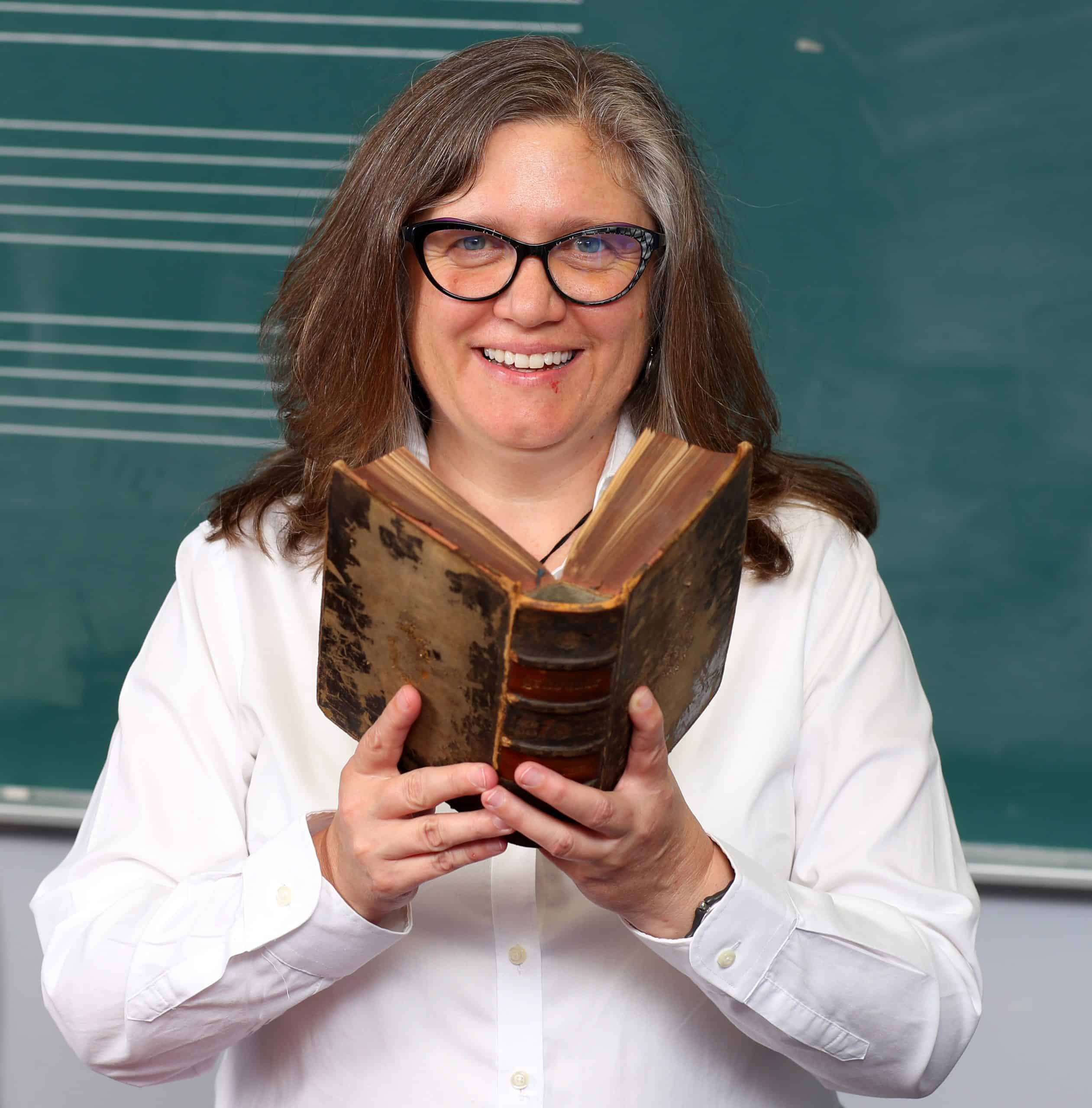
Hildegard von Bingen was a 12th century mystic, polymath, and composer whose work spanned visionary theology, philosophy, cosmology, medicine, botany, and music. Her extraordinary intellectual accomplishments belie her humble claim to be “just a woman”. Was her humility justified in the face of the divine, internalizing misogynistic stereotypes, or a strategic decision to get her voice heard? What can mystical experience teach us about the world? And how can we understand ourselves in relation to the divine? Josh and Ray explore her life and thought with Jennifer Bain from Dalhousie University, editor of The Cambridge Companion to Hildegard of Bingen.
Part of our series Wise Women, generously funded by the National Endowment for the Humanities.
Josh and Ray begin discussing Elisabeth’s famous objection to Descartes’ idea that mind and body are two different substances. Josh asks how do these two things interact? Ray brings out Elisabeth’s criticisms regarding to opacity of explanations about how the mind moves the body. Josh reminds Ray how dualism is still wildly debated today, and that a lot people believe that we have souls that are somewhat separate from our bodies.
The hosts are joined by Lisa Shapiro, Professor of philosophy at McGill University and editor of Elisabeth’s correspondence with Descartes. Josh and Ray begin discussing the intimacy and intellectual respect showed in those epistolary exchanges. Lisa offers some examples that show the trust the grew between them, but also the criticisms that Elisabeth raises against Descartes not only on his dualism, but also against his ethical views. Lisa also discusses aspects of Elisabeth’s public life and public philosophy, by considering what she called the lack of an infinite science and the responsibility of taking decisions that affect other people. And the hosts conclude this aspect of her thought by talking about her interest as a political leader in reading Machiavelli.
In the last segment of the show, Josh, Ray and Lisa take the discussion to how regret, or more generally the notion of sentiments shaped and captured Elisabeth’s curiosity. Lisa mentions how Elisabeth and Descartes were very aligned on the theme of the passions, even if each saw things differently. Moreover, Lisa explains to Ray that Elisabeth is interested in the philosophical questions themselves, even if she didn’t write a tract, and could only continue her philosophical explorations by understanding these challenges about human experience in conversations with other philosopher, with a spirit that was less interested in scoring points and more invested in a common search, with Descartes and other women of her life.
Roving Philosophical Report (seek to 5:35) → Holly J. McDede interviews, Sarah Hutton a visiting professor at the University of York, about the life and times of the Princess of Elisabeth of Bohemia, and her formidable upbringing. And Erik-Jan Bos, editor-in-chief of the new edition of Descartes’ correspondence, about the 30 Years War, and how this shaped her character as a political leader. And Sabrina Ebbersmeyer, a professor of philosophy at the University of Copenhagen, about her last days in Herford, as an abbess in a massive convent.
Sixty-Second Philosopher (seek to 46:40) → Ian Shoales discusses how Elisabeth was smart enough to hold her own with Rene Descartes (the secular pope of day, of sorts), and highlights how she holds her own throughout without sacrificing her identity and her dependence on her body.
Josh Landy
What if you thought God was talking directly to you?
Ray Briggs
How did Hildegard turn her visions into musical inspiration?
Josh Landy
What resistance did she meet with as a 12th century woman?
Ray Briggs
Welcome to Philosophy Talk, the program that questions everything…
Josh Landy
…except your intelligence. I’m Josh Landy.
Ray Briggs
And I’m Ray Briggs. We’re coming to you from the studios of KALW San Francisco Bay Area.
Josh Landy
Continuing conversations that begin at philosophers’ corner on the Stanford campus where Ray and I teach philosophy.
Ray Briggs
Today, It’s the next episode in our series wise women, supported by a grant from the National Endowment for the Humanities. We’re talking about the life and thought of Hildegard of Bingen, the medieval polymath and mystic.
Josh Landy
So a lot of people know Hildegard for her musical compositions, which were really innovative for the 12th century, and they’re still being performed today. Actually, in the 1990s an electronic version of them reached number one in the charts.
Ray Briggs
Yeah, she did that, but she kind of did everything, botany, medicine, theology, philosophy, hey, she even wrote a play. It’s an allegorical drama where a soul gets tempted by the devil on one side and encouraged by a host of virtues on the other. The virtues sing beautifully, but the devil doesn’t get to sing. He can only shout.
Josh Landy
Yeah, I love that so much. And don’t forget, there’s something symbolic about the gender of all these characters. The virtues are women, and the devil’s a man, and Hildegard is clearly on the side of the women.
Ray Briggs
Yeah, that’s not the only time Hildegard takes the side of women. In the 12th century, the dominant position was that women are inferior, designed by God to serve men, and definitely not allowed to preach. But what does Hildegard do? Well, she goes on speaking tours. She says that men were also designed to serve women, and she insisted on the equal importance of both genders.
Josh Landy
And not only that, but she claimed that God spoke directly to her. She said she started getting these powerful visions at a very young age, and didn’t quite know what to make of them, until finally, in her 40s, she realized they must be from God.
Ray Briggs
Wait, didn’t Oliver Sacks say that those visions sounded a little like scintillating scotoma, a kind of migraine. What made her believe that they were mystical instead of medical?
Josh Landy
Well, I mean, it’s hard to say from our 21st century vantage point, but one way of thinking about it is she felt she had some really important things to tell her community, things about morality, society, gender, religion and the vision seemed to back those ideas up.
Ray Briggs
Okay, but doesn’t that just sound a little bit convenient? I totally buy that she experienced those unusual mental states, but why interpret them as the word of God, why not see them as hallucinations or deceptions by an evil demon?
Josh Landy
Well, first you have to believe in the possibility of divine revelation, and Hildegard clearly did. And it helps to have a picture of truth where truth comes in a sudden flash of inspiration. Not you know the slow and painful slog you and I have to make when we’re preparing classes and writing books.
Ray Briggs
Isn’t it kind of arrogant to think that God is talking to you, though? Whatever happened to the Christian virtue of humility?
Josh Landy
Well, Hildegard had something to say about that. I mean, yeah, it’s true that she talked about God speaking to her, but she also kept insisting that she wasn’t that special. She even called herself a foolish and uneducated woman.
Ray Briggs
Did she really believe that, though, or was it a rhetorical trick? After all, she also says that anyone who doubts her Revelations is going straight to hell. She writes, let no man be so bold as to add anything to the words of this book, nor to delete anything, lest he be deleted from the book of life.
Josh Landy
Snap! I take your point, Ray, but I’m not sure that those two things are necessarily contradictory. Look, maybe she saw herself as an unimportant vessel for God to speak through. It was all about God, not about her.
Ray Briggs
Yeah, but if God chooses you to speak to, isn’t it just a teeny tiny bit about you?
Josh Landy
Well, it’s a good question. I bet our guests will have smart things to say about it, whether divinely inspired or not. It’s Jennifer Bain, editor of The Cambridge Companion to Hildegard of Bingen.
Ray Briggs
There’s lots of great stuff in that book, all about Hildegard’s vision, her theology and her music.
Josh Landy
That music has inspired a legion of modern-day fans. So we sent our roving philosophical reporter, Holly J McDede to talk to some of them. She files this report.
Holly McDede
It was December 2018 and Jenny Giering had been sick for three years. Jenny, who writes music for theater, had early-stage breast cancer.
Jenny Giering
I had developed breast implant illness, and some people recover from that, and some people don’t, and I’m one of the unlucky ones who is not going to recover. So it took down my immune system and my central nervous system.
Holly McDede
Jenny was on an enormous amount of steroids to control the pain, and that winter, she set out to take her son to a hockey game. The roads were icy, and then came the out of body experience.
Jenny Giering
Oh my gosh, I had gotten a glint of sun, and I thought it’s maybe it’s sunblindness, maybe it’s some sort of crazy migraine, because I have had those my whole life, and they were worse at this when I got sick, they got worse, and I just kept trying to figure out what it was, and it was something completely beyond my control, and it lasted for about eight hours.
Holly McDede
That was just the beginning. Those kinds of spells began happening every day, sometimes multiple times a day. Jenny wanted to speak with Hildegard of Bingen.
Jenny Giering
I just started to think about her and her crazy migraines and how they upended her life and affected her music. And in that moment, it was such a source of comfort to me that somebody else who is an artist was going through something crazy like this.
Holly McDede
It was like a nearly 1000-year gap had closed between them. Hildegard also lived with chronic illness and was still deft at many things.
Jenny Giering
I just imagined this incredible kinship between people who are disabled but still trying to be productive in the world.
Holly McDede
So with her husband, Jenny, wrote the piece “Hildegard and Me.”
Hildegard and Me
I had my first vision some 900 years ago. It struck me like lighting, cleaving my brain, what we call a vision you call a migraine.
Jenny Giering
She’s such a badass—can I say that?
Hildegard and Me
We went to the doctor, where else could we go?
Honey Meconi
There were times when people thought, This is it, she’s gonna die, and she rallied and kept going.
Holly McDede
Honey Meconi is a musicologist and author of Hildegard of Bingen, a book about this renaissance woman before the Renaissance phase. Hildegard founded and led a noted women’s religious community. In addition to composer, she was also a nun, a poet, a spiritual leader, a philosopher, a naturalist, a medical writer, a linguist, on and on. She had been a sickly child who started seeing things when she was a toddler.
Honey Meconi
She always stressed, this isn’t me. This is the Holy Spirit speaking through me. She was very clear about that, but she also kept saying, I’m unlearned. I never knew how to write down music. I only knew the Bible, that sort of stuff.
Holly McDede
Honey has been performing Hildegard music since 1982 she was one of the first people in the United States to do so.
Honey Meconi
What certainly helped Hildegard was the, what we often call second wave feminism in the 1960s 1970s, 1980s people start getting interested and wait. Were there women composers? Were there women musicians, you know? And started digging around.
Holly McDede
From there, she says, people just kept clamoring for her music.
Honey Meconi
We can all use a moment where we step back from the hassles of today and the hurly burly and the many things that stress this out and just pause and stop and listen, and even if we don’t understand what she’s saying, that the message of the beauty, I think, is going to come across to us.
Holly McDede
As honey tells her students…
Honey Meconi
When she gets the most important vision, where the Holy Spirit says, I’ve been sending you vision. Entire life, she’s in her 40s,
Holly McDede
and Hildegard continued to write in her 70s.
Honey Meconi
I like to think of her as the patron saint of late bloomers.
Holly McDede
For Philosophy Talk, I’m Holly J McDede.
Josh Landy
Thanks for that harmonious report, Holly. I’m Josh Landy, with me is my Stanford colleague Ray Briggs, and today we’re thinking about Hildegard of Bingen.
Ray Briggs
We’re joined now by Jennifer Bain. She’s professor of musicology and of Gender and Women’s Studies at Dalhousie University. She’s also editor of The Cambridge companion to Hildegard of Bingen. Jennifer, welcome to Philosophy Talk.
Jennifer Bain
Thanks so much for having me. I’m delighted to be here.
Josh Landy
So Jennifer Hildegard is such a fascinating figure, and as we just heard, she has a huge impact on listeners even today. What thoughts got you interested in her?
Jennifer Bain
Well, when I first heard her music, I didn’t actually know it was her music that I was listening to. I was volunteering in a bookstore on the island of Iona in Scotland, and we had this cassette that was playing music from the monks of the abbey of Glenstal, with a folk singer singing along with them. And Hildegard, a couple of her pieces were on this recording. And I loved the recording. It seemed very atmospheric. And it was about a year later when I finally learned who she was and that she was a medieval composer. I thought maybe they were she was a 20th century composer who was writing in the style of medieval music.
Ray Briggs
That brings me to a puzzle about Hildegard, who was so accomplished, she did not only do music, but also philosophy and theology. She studied botany, she wrote medical treatises, she wrote a play, she did visual art, and yet she claimed to be, quote, just a woman. What do you make of that?
Jennifer Bain
Well, I think she it was something, first of all, that she had to do, like doing all of the writing that she wanted to do and that she was engaging in, wasn’t really an acceptable activity for women in the 12th century. So, kind of diminishing her importance and acknowledging her status in the social hierarchy of the time gave her the ability to be able to have that voice. It allowed her to do things that she maybe couldn’t have done.
Josh Landy
Okay, so that’s one aspect of her modesty, or semi feigned modesty, or something like that. There’s another one she claims, not just sometimes she says, I’m a foolish woman, but sometimes she also says, I’m an uneducated woman. I’m not taught to write as the philosophers do. She says, at one point, I understood the writings of the prophets, the Gospels and philosophers without any human instruction. So, is that a humble brag? What’s going on? Was she really uninstructed? What was the situation?
Jennifer Bain
Yeah, we don’t know a lot about how she was instructed, except that in the life of Hildegard, it says that she learned to read from the Psalter. And so, the Psalter is the book of Psalms that was the standard way that nuns and monks would learn to read in a monastic setting. So, you know, we don’t have that evidence about how she learned, but we can see in her writings that she’s quoting lots of people, and clearly very knowledgeable. So again, it was partly, I think, you know, she was trying to serve the role of somebody who was very low in the social hierarchy. I mean, not in terms of her sort of family status, so just as a woman, she was low in the social hierarchy.
Ray Briggs
So one thing I’m kind of curious about is how Hildegard circumstances as a nun affected her ability to sort of do all of this kind of stuff, this like writing music and making art. So, on the one hand, like, it seems like nuns had a lot of time to do things. On the other hand, it seemed like the sort of role of a nun involved really serious isolation, and that Hildegard was cloistered. Like, how did she kind of balance that?
Jennifer Bain
So she as a cloistered nun. I mean, they had time, but not actually a ton of time, because they had to participate in the divine office. So, they were like, reading prayers and singing many, many, many hours a day, but learning to read Latin, reading religious texts, having those texts read to you, and performing in the Divine Office. So, singing the liturgy, she was singing in Latin on a daily basis from the age of 14. So, it was part of. The whole environment.
Josh Landy
You’re listening to Philosophy Talk, today we’re thinking about Hildegard of Bingen with Jennifer Bain from Dalhousie University.
Ray Briggs
Have you ever felt inspired by a higher source? Can moments of insight help us see things more clearly? Are they sometimes revelations or always hallucinations?
Josh Landy
Philosophy, theology and inspiration—along with your comments and questions when Philosophy Talk continues.
Hildegard’s “Kyrie”—the composition that sparked our guest’s interest in her music. I’m Josh Landy, and this is Philosophy Talk, the program that questions everything…
Ray Briggs
…except your intelligence. I’m Ray Briggs, and we’re thinking about Hildegard of Bingen with Jennifer Bain, editor of The Cambridge Companion to Hildegard of Bingen. It’s the next episode in our “Wise Women” series, which is supported by a grant from the National Endowment for the Humanities.
Josh Landy
Got questions about Hildegard, her visions and her music? Email us comments@philosophytalk.org, or comment on our website. And while you’re there, you can also become a subscriber and find the wisdom in our library of nearly 600 episodes.
Ray Briggs
So Jennifer, Hildegard is most famous today for her contributions to music, but she also wrote about theology and philosophy and ethics. Is there any connection between her music and her philosophical ideas?
Jennifer Bain
There is, for sure, I think, probably the biggest connection is in her first big visionary work called Scivias. And there are three books in that work. And the very last vision in the whole of Scivias is all about music.
Ray Briggs
So what happens in that vision?
Jennifer Bain
Well, Scivias tells the story of creation and the history of salvation. And the very end of Scivias is really very post-apocalyptic. So, you have the end of the world. You’ve got fires and floods and crashing lightning, and then the world ends, and everything becomes calm. The seas are calm. There are no winds, and this, all that remains is light. And so, this description of this, it’s just light all the time. There’s no darkness. And out of this light, Hildegard hears music.
Josh Landy
And what’s this music like? I mean, is the music that she composed a kind of harbinger of the beautiful music that we’re going to hear at the end of the world, when everything is light and everything is beauty, is it supposed to kind of symbolize a perfect realm, a perfect way of being?
Jennifer Bain
I think so it’s the so the music that she’s hearing is they are her chants. And so, there’s a group of 14 chants that she lists, and that these later on, show up in the music sections of the manuscripts, where her music is, is transmitted. And you know, the idea is that in heaven, the only thing you have there is heavenly music, music that is going to praise God. And so, the end of the world is essentially heaven on earth. And so, you then have this heavenly music.
Josh Landy
So okay, how do we get there? That’ll be my next question, right? So, we want somehow to get from the world we’re currently living in, which clearly is imperfect in all kinds of ways, some of which Hildegard herself was keen to point out. How do we get from here to there? What kinds of reform did Hildegard think were most pressing, most important to implement, so that we could, you know, hasten our journey towards a better world.
Jennifer Bain
She was very critical of the church and of the sinfulness of priests and of the church as a whole. And I think felt that the church was too worldly, in a way, that the monasteries and church clergy needed to be more focused on God rather than on their worldly environments.
Ray Briggs
Right, so one of the things that Hildegard butted heads with her contemporaries about was sort of moving her Abbey from one location to another. Can you tell us sort of more about that and what was at stake for her and why it was it was so important.
Jennifer Bain
Yeah. So, when Hildegard joined the church. She was 14 years old, and she joined with her mentor, whose name was Jutta, and another girl her own age, who also was named Jutta, and they were attached to a monastery of men at a place called Disibodenberg. The elder Jutta had really, she was widely known for her piety, and so a number of other women had come to join them and live with them. There at dizzy Disibodenberg, after Jutta died, Hildegard was voted in as the leader of that community, and so she was called the Magistra and I think the place that she moved to, that she took the nuns to, is actually much more of a central location Disibodenberg, and I think that was one of the big incentives for her. That’s one of the things that really motivated her. But I’m sure also just being able to have more independence and control.
Ray Briggs
She seemed to want that kind of a lot for herself. So, I know that another, another thing that she was very adamant about was getting recognition from the Pope. So, the pope sent her some kind of letter, like with an acknowledgement. It sounds like it wasn’t quite in the letter, and that was important to her. That seems kind of related to her ambition to be connected to the world. A bit more can tell us about that?
Jennifer Bain
Yeah, I think so. Part of that is, maybe, you know, recognition, but part of it is about permission, right, that. And this goes back to the earlier question about positioning herself as, you know, just a woman, or as a, you know, uneducated woman, ensuring that she had the kind of the blessing of the Pope to keep going and to keep writing out her visions, so that she had that kind of that backing, you know, that assurance that what she was doing, that everybody was agreeing that what she was doing and what she was hearing was coming from God and not from the devil, right? That would be bad for her if people thought her visions were coming from the devil.
Josh Landy
You’re listening to Philosophy Talk today. We’re thinking about Hildegard of Bingen with Jennifer Bain from Dalhousie University. And Jennifer we have a listener question that she fits very nicely with what we were just talking about. And Leif in San Jose asks, How does some women in very difficult circumstances like the 12th century manage both to survive and then to articulate wisdom for the world that persists? What do you think, Jennifer?
Jennifer Bain
Well, I do think that, you know, there were many convents of women. In the 12th century was a time of, sort of the broadening of monastic culture in Europe, and particularly, I think, in German speaking lands, and in the 13th century. So during this period there is, there’s kind of a growth, and for women being in that setting, that was a place where, you know, you could read and learn and write, and it was kind of an acceptable practice within that setting, as far as the sort of the persistence, and you know, our knowledge Today, of what Hildegard wrote, she certainly was keen to collect her own writings. And also, I think, in the 13th century, the nuns there put in a bid for her to be canonized. And so, it wasn’t just Hildegard, it was also that community that ensured that she would be remembered and that her works would be remembered. So, I think that’s really critical to remember.
Ray Briggs
So I wanted to ask a question about Hildegard’s visions and about the status of these visions. So, we’ve been talking a little bit about them, like she says that God came to her as light very often, and you were saying, she has to believe that these are divine revelation and not the devil. Where does she get the confidence to do that? And like, how do you tell whether it’s God or the devil talking to you?
Jennifer Bain
Well, I don’t know how somebody today would tell that. You know, I think she says that she heard God telling her that, you know, he selected her to do this work and to write down these visions, and she believed that it was from him. I mean, she also talks about being suffused with light. And so, I think that’s probably related that that. Like God, rather than something evil like the devil.
Josh Landy
I mean, that’s an interesting and important move, especially if you have somewhat controversial views, right, which I assume some of her views about men and women would have been, right? The claim that women can teach or either implicit or explicit claim about that. I mean, you know, in First Timothy, it’s pretty clear there’s an injunction against women teaching in the church, and the notion of equality with men, and the notion of, you know, not just women are made to serve men, but men are made to serve women as well. How well accepted were these positions that she articulated? Did she need to get people on board first by somehow convincing everybody, yes, she’s actually divinely inspired and then sort of gradually, she could allow some of these, you know, perhaps more controversial views to percolate out. How was she able to get these sort of innovative positions accepted?
Jennifer Bain
I’m not sure that she really made a strong argument for women in general. She made the argument that she was selected by God to write out these visions and talk about what she had seen and heard, and she became very well known, people wrote to her and asked her for advice, and she would write letters in reply. So, there was an acknowledgement from the outside that she did have this direct link to God. And so, people wanted to know, you know, well, did God mention me? And what you know, what do you think I should do in this particular situation that, I mean, some of it was kind of practical, and some of it was more about interpreting the scriptures.
Ray Briggs
I want to kind of pivot to, sort of the imagery from her visions. Do you have like, a favorite musical image, like the image of the devil only being able to shout rather than sing? Or maybe, like, I don’t know, like, maybe, maybe there’s like a musical image of light that you can get from, like, all these, like lovely voices.
Jennifer Bain
Yeah, so I mean, interestingly, when in the sections of the manuscripts that transmit her music, there are no illustrations with the music, so the illustrations are just with the visionary texts. But she does have these, you know, images that are sort of roundels, or actually these egg shapes that kind of capture the cosmos. And Margot Fassler recently published a book about this with really interesting reproductions of illustrations, both of Hildegard’s illustrations, but or of Hildegard’s directed illustrations. We don’t know if she did them herself, but also of illustrations that were in scientific treatises at the time. And so those are, those are really interesting to see, just like the planets kind of all lined up. But she does include, there’s sort of the choir of angels and of the saint’s chorus that it’s just really like little heads and things. So, you don’t there’s no picture of somebody singing, but those Cosmos images I think I find really fascinating.
Josh Landy
Something else about images that people talk about has to do with the gender of some of the images that she produces. So, in the morality play, the musical morality play, the order of the virtues you have a soul, anima, female, surrounded by a host of virtues, all female. She also talks a lot about viriditas, greenness or vitality. Another feminine noun is that, I mean, because you were saying earlier, I think very convincingly, that, you know, she’s not some kind of 21st century feminist going out there and, you know, sort of sounding the trumpet of gender equality. But could there be a sort of very subtle implication from the gender of the imagery that she uses the gender of the characters in the play that she writes something about the images that she describes, could there be some, at least subtle indication there that she’s thinking a lot about the place of women in society, the proper place of women in society?
Jennifer Bain
I think so. So, the play is, it’s all female characters, except for the devil. And it really seems that, I mean, part of the reason for having the female characters would be that, probably it was performed in her own institution, right, with the nuns. Jim Ginther, who had an essay in the Cambridge companion talked a lot about Hildegard’s writings as being partly like instructional documents for her own community that she was overseeing as Magistra she was the one who was leading them and teaching them, and that was part of her responsibility to help bring them to salvation. So, I think that was a very deliberate choice on her part, and not so subtle. But also, when we look at her music, and her music, most of it is written for the Divine Office, and it’s celebrating particular saints to celebrate their feast day, and that none of them are complete offices like if you wanted to have all the music you needed for a single day of a major feast, you would need, I don’t know anywhere between say, 25 and 30 chants, and none of them have that Many, but she wrote a lot of chants celebrating Mary. And so, Mary, the mother of Jesus, is really important as a figure for nuns, right? That’s who they’re, because the nuns are supposed to be virgins. Mary was a virgin. And so, Mary’s this role model. She also the next largest group of chants that she wrote for a particular Saint are for Saint Ursula and the 11,000 virgins. So again, I think you know those two, those groupings, and that emphasis on female saints is, again, I think, very deliberate on her part, selecting people who were or saints who were probably important to her but also really important for her community.
Ray Briggs
So who would have played the devil with this liturgy?
Jennifer Bain
I think the person who we assume it was Volmar, who was, who had been at Disibodenberg and was Hildegard’s sort of closest confidant at Disibodenberg. She would have needed, they would have had to have a priest there to perform mass. And so that was, we think, Volmar and and he would have played the devil.
Josh Landy
He would have done all the shouting. You’re listening to Philosophy Talk. Today we’re thinking about Hildegard of Bingen with Jennifer Bain from Dalhousie University. She’s the editor of The Cambridge Companion to Hildegard of Bingen.
Ray Briggs
What can today’s feminist learn from a 12th century mystic? Is Hildegard a good role model for women raising their voices in a male dominated world? And can organized religion ever achieve true gender equality?
Josh Landy
From medieval mysticism to modern mores—plus commentary from Ian Shoales the Sixty-Second Philosopher when, Philosophy Talk continues.
More music composed by Hildegard of Bingen: ‘O Nobilisima Viriditas’— most noble greenness. I’m Josh Landy, and this is Philosophy Talk, the program that questions everything…
Ray Briggs
…except your intelligence. I’m Ray Briggs. Our guest is Jennifer Bain from Dalhousie University, and we’re thinking about Hildegard of Bingen as part of our series “Wise Women,” supported by a grant from the National Endowment for the Humanities. You can find all the episodes in the series at philosophytalk.org/wise-women.
Josh Landy
So Jennifer, you know, we’ve been talking a fair amount about Hildegard’s visions and the way in which she learned what she learned about the world. Thanks to these manifestations, God came to her and revealed things. And she even said at one point, what I do not see, I do not know, for I am not educated. And yet she also wrote that book on botany, and that seemed to be driven not by revelation, but by observation. So that’s a really interesting mix of things. Do you think it’s fair to say that, in fact, she, she took herself to be, you know, took all of her knowledge to be coming from divine revelation, or is there also kind of a little bit of a scientific side to her?
Jennifer Bain
So that is a really good question. It is a bit complicated because of the status of those of writings. So, the writings are referred to in a document called the Acta Inquisitiones, but they’re not included in the main manuscript that transmits her writings, which is referred to as the Reason Codex. So, the most people accept her Faith Wallace. So Faith Wallace is a history of medicine specialist, and the way she describes it is that those writings are probably summarized and synthesized after Hildegard lifetime, or maybe towards later in her life, but that they weren’t dictated by her, but that they represent a kind of a practice, so especially when she’s running her own monastic institution at Rupertsberg, having monastic gardens, they would have had to have gardens and animals and all sorts of other things for, obviously, for food that they needed for everybody at Rupertsberg and clearly in her writings, like In the visionary writings too. I mean, you just see these connections between, you know, the sort of the earthly and the heavenly, like it’s there’s. She’s not seeing them as being as separated as maybe other people see them. And so, I think she is observing the natural world. It seems pretty clear from her writings that she’s very she was a very curious person, right? She was really thinking a lot about lots of things, trying different things out. She made up her own language. And, you know, so, so I think observation is a good way of describing it. And so, she could observe things that she was either receiving through divine revelation, or she could observe things that she was seeing, you know, in her world.
Ray Briggs
So I want to ask about this connection between, like the heavens and the human body, which I kind of was noticing in her drawings and the skivvies, a lot of these are like superimposed, like drawings of like human bodies and celestial spheres. Was that common imagery at the time? Was that something that she came up with? How do I kind of like put that in context?
Jennifer Bain
I think the idea that the heavens are probably reflection is the wrong word, but, but that everything that happens on Earth is also happening in heaven, like this whole idea of the microcosm and the macrocosm, I think that’s not that didn’t come from Hildegard, but it was certainly something that she was very interested in and really emphasizes in her, in her visions, I mean, the whole sort of Christian concept of, you know, God the Father in heaven, and then Christ, his son was on earth, and then, you know, ends up in heaven, but is still sort of overseeing things. You have the Holy Spirit, who’s, who’s part of the Trinity, so, presumably in heaven, but you know, manifests as a dove who, you know, whispers things to people like Pope Gregory, the first, with the whole repertory of chant. I mean, that’s the story that that gets passed down. So, so I think there, there is a separation, but also this understanding that that the connection.
Ray Briggs
O kind of want to ask you a question about the song we heard at the top of this segment, O nobilissima viriditas, I wanted to ask you about that concept. So, it means kind of literally greenness, but it has all of these different tendrils. So it’s got something to do with like virgins and virginity, and it seems like also something to do with, like, a design, a divine source of life or like livelihood. Are all of those strands, like, correct like, how do they fit together?
Jennifer Bain
I think they are. There’s also this kind of idea of like greenness is like springtime, early growth. And I think that that’s partly the connection with virginity, right? It’s this idea of kind of youth and freshness and innocence. I think that is. Is tied up in it. It also, though links, it certainly links with the idea of the humors, right? Because it’s, it’s also damp. Greenness is damp. And she has these descriptions of men and women and dryness and dampness and so. So I think that’s caught up in it as well. And the interesting thing about O nobilissima viriditas is that it the opening of the chant is very much based on a chant for Mary and that existed in the repertory, and so that is one of the ways in which Hildegard is kind of demonstrating her knowledge of the liturgy more broadly.
Ray Briggs
So it sounds like she kind of does the conventional liturgical thing at the beginning and then kind of moves beyond it and introduces her own variations.
Jennifer Bain
Yes, exactly.
Josh Landy
And while she’s doing it, laying the emphasis on a certain picture of femininity, that’s not the Eve picture, right? It’s not the sinful woman picture that many would have had in mind. It’s, it’s Mary, it’s Veritas, this new concept that happens to be a feminine noun. It’s, you know, all of those virtues that we saw in the in the order, the virtues that morality play, that she wrote it. And that brings me to a question about her contemporary relevance. Obviously, we can all still love her today for her extraordinary music, and we can take a historical interest in her as a great thinker. But I wonder, you know, can we look to her today as a model of how to incorporate critique and new ideas into religious practice. What kinds of lesson does she leave for us today?
Jennifer Bain
That’s a good question. And I, you know, I think one of the probably the biggest and most important things she did was to criticize the church, and so the idea that modern religion needs to be criticized, that there are things to criticize, and but she was doing it all from within the church, right? It wasn’t just functioning external to the church. And I think probably had the most impact because it was from within this environment. You know, she, she, it wasn’t just that she was a Christian woman, it was that she was a nun, and she was a leader of a community of women and so. So, I think perhaps that idea of working from within the frame of religious practice and in order to shape it in a new way is maybe a lesson that can be drawn from her.
Josh Landy
I totally agree. I mean, and you can expand out from that doesn’t even have to be just about religious practice. It could be the academy. It could be all kinds of, you know, the political realm. There can be this kind of powerful critique from within. The other thing that I find inspiring, in a fascinating way, is, is her status as POLYMATH. And of course, as you were saying earlier, that a lot of things we don’t know. We don’t know exactly what she wrote and didn’t write and so on, or at least dictated, or what, what have you, but, but this, this picture that we get of her as someone who is on the one hand, looking intently at the plants around her and thinking about them, although thinking about them as somehow continuous with the divine realm, but also getting these divine inspirations. It makes me wonder whether we could see that as a model for a broader type of how to be a thinker today, that you know, you can have a kind of a foot in both camps. You can be a bit of a scientist, you know, with one of your feet, you can have your toes in the soil, and you can be observing and thinking and reasoning, but on the other side, you can maybe have a certain kind of humility, a certain kind of openness to the world, allow the world to speak to you. And maybe it’s not divine revelation, but maybe it’s a certain kind of, you know, epiphanic flash of insight. Do you think that’s a reasonable way of thinking about, you know, making new Hildegards, even outside of Christianity?
Jennifer Bain
I think it is and often, actually, in my teaching, I will, you know, I tell students to, like, read novels and go do these other things. You know, it’s, it’s important. I think we all need to be broader and to, you know, read things maybe that we think we’re not interested in, or read opinions of people who we don’t agree with. And experience different things in the world. And, you know, the I walk to and from work every day, and that’s often my best thinking time, because I’m not, like, fully immersed in in the sort of day to day job I’m have, you’re I think we’re more open sometimes when we’re Yeah, just engaged in, in in other things.
Josh Landy
That is a beautiful place to stop. I’m going to think about that on my walk home. Thank you so much for joining us today, Jennifer.
Jennifer Bain
Thank you for having me.
Josh Landy
Our guest has been Jennifer Bain, Professor of musicology and of Gender and Women’s Studies at Dalhousie University, and editor of The Cambridge Companion to Hildegard of Bingen. So, Ray, what are you thinking now?
Ray Briggs
Well, I think people should check out that Cambridge companion. It’s got lots of cool essays in it. And I also think that they should check out Hildegard’s amazing illustrations in the Scivias. It’s just, I don’t know they’re, even if she did not draw them herself, they are fascinating and connected to her thought and
Josh Landy
surrealist in the best possible sense, and they’re totally fantastic. We’re gonna put links to everything we’ve mentioned today on our website, philosophytalk.org where you can also become a subscriber and question everything in our library of nearly 600 episodes.
Ray Briggs
And don’t forget: you can check out all the episodes in our “Wise Women” series at philosophytalk.org/wise women.
Josh Landy
Now a man so fast he’ll make you see visions of God—it’s Ian Shoales, the Sixty-Second philosopher.
Ian Shoales
Ian Shoales… Issues surrounding women and careers are new, because the two phenomena were not necessarily adjacent, or even less joined in battle, until quite recently. Women could be princesses, heiresses, shrewd mistresses, a power behind the throne, but only goddesses had jobs, well, Athena anyway, which mainly consisted of being wise, and making life a little less difficult for Ulysses. White male privilege even then! Mere centuries later, the gods were defunct, replaced by the Trinity, which only priests really understand, and saints and angels by the bucket. Which are also kind of short on the ground these days. Hildegarde Von Bingen lived a few centuries before Martin Luther, who shook up the Catholic Church so much that aftershocks are still being felt today, even as backlash against the aftershocks have their own aftershocks, and continue to create troubles, doubts, agnostic outbursts. For many, religion remains a comfort and a problem. Hildegarde was holy from a young age, sent off to an anchoress, that is a nun who lived in a room with no door, just a window, who taught young Hildegard what being a nun was all about. Lucky for her, visions were a big part of it. Hildegarde led a purpose-driven life. She had a busy brain, was quite social, and a mystic to boot. Wikipedia sez: “… Her extraordinary intellectual accomplishments belie her humble claim to be ‘just a woman’.” Well, she was also a nun, which offered her a bit of freedom, paradoxically. She didn’t have to pop out babies for hubby or feed the gang when they came around, she didn’t have to have sex with ANYBODY! She became a mother superior and got her own cloister! She was also buddies with a bunch of fellas, including the monk Volmar who became her biggest fan and taught her to play the zither. They all worked together, and they were all her fans. Hildegard in many ways was like some modern women. Introspective and often so worried that she was doing the right thing, she was incapacitated, in one case, literally paralyzed, which is awesome delusionally melancholic behavior if you think about it. Then she would leap into action, making lectures, growing gardens, writing books, writing music. Her plainsong pieces are still being sung in Churches today! And she wrote a musical, Ordo Virtutum! The characters were virtues, a Soul, and the Devil. All parts were played by the nuns, except for the devil played by Volmar, of course. I gather that the play was somewhat improvised with parts written for what her nuns could sing. The devil didn’t sing though, because he can only grunt and howl. And that’s why we have rock and roll today. So, Hildegarde had visions, and she could also swoon like a diva. Fans complain, but actually like it when their stars go into a funk. It shows they care. And fans live to give a star what she needs to hear, in this case convincing Hildegarde that God wants her to put it all out there, her glory is God’s glory. She was modest! She had to be talked into displaying her brilliance. She was the first superstar! I’ll bet Taylor Swift has swooned a time or two, if only ironically. I won’t dwell on Taylor Swift’s past drama with a certain record label and certain of her colleagues, but Hildegard was the first to uncover toxic masculinity, a finding both scientific, and scripturally defensible. She wrote, “… the blood of the sons of Adam was turned into the poison of semen, out of which the sons of man are begotten. … All this arose from the first evil… because if Adam had remained in paradise, he would have had the sweetest health, and the best dwelling-place, just as the strongest balsam emits the best odor; but on the contrary, man now has within himself poison and phlegm and diverse illnesses.” This devolution scenario is now a common 21st Century belief, without the creation myth part, that most evil comes from toxic masculinity. This is a minor tier in the Woke platform, but a major plank of conservatism, only it’s called patriarchy and it’s a good thing. Yeah, right. Tell it to Volmar, Maga. Women can have careers AND a bevy of nuns for group prayer and slumber parties. Ask Hildegard. Ask Volmar. Volmar knows. Volmar sees. I gotta go.
Josh Landy
Philosophy Talk is a presentation of KALW San Francisco Bay area and the trustees of Leland Stanford Junior University, copyright 2024.
Ray Briggs
Our Executive Producer is Ben Trefny. The Senior Producer is Devin Strolovitch. Laura Maguire is our Director of Research.
Josh Landy
Thanks also to Pedro Jimenez, Merle Kessler and Angela Johnston.
Ray Briggs
Support for Philosophy Talk comes from various groups at Stanford University and from subscribers to our online community of thinkers
Josh Landy
And from the members of KALW local public radio San Francisco, where our program originates. Support for this episode and all the episodes in our “Wise Women” series comes from the National Endowment for the Humanities.
Ray Briggs
The views expressed (or mis-expressed) on this program do not necessarily represent the opinions of Stanford University or of our other funders.
Josh Landy
Not even when they’re true and reasonable. The conversation continues on our website, philosophytalk.org, where you can become a subscriber and question everything in our library of nearly 600 episodes. I’m Josh Landy
Ray Briggs
And I’m Ray Briggs. Thank you for listening.
Josh Landy
And thank you for thinking.
Guest
Related Blogs
-
August 21, 2024
Related Resources
Bain, Jennifer, ed. (2021). The Cambridge Companion to Hildegard of Bingen.
Giering, Jenny (2018). “Hildegard’s Visions, and Mine.”
Meconi, Honey (2018). Hildegard of Bingen.
Get Philosophy Talk
