Poetry as a Way of Knowing
April 19, 2020
First Aired: April 1, 2012
Listen


What is poetry? Mere word play? A pretty, or at any rate striking, way of expressing thought and emotion? Or does great poetry involve an approach to the world that provides insight and information not available in other ways? Ken and John explore how poetry can illuminate what we know with award-winning poet Jane Hirshfield, author of Come, Thief and other poetic works of philosophical richness. This program was recorded live at the Marsh Theatre in Berkeley.
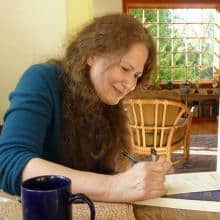
Jane Hirshfield, an award-winning poet, translator and essayist, joins Ken and John for a query into poetry as a way of knowing. They begin with two challenges to this assumption. Firstly, does poetry even set out to produce knowledge? Secondly, does poetry administer a special kind of knowledge? To address these questions, the hosts distinguish between three types of knowing: propositional knowledge, know-how, and that of what it’s like. It is hard to see how poetry provides any of these kinds of knowledge. After all, poetry is more about “expressing feelings and capturing impressions” rather than providing factual information. Similarly, if all poetry provided was skill at composing and interpreting poems, we’d have a predictable show! One more way to reconsider poetry’s contribution to knowledge is to ask whether its offerings contrast with those which one gains from science.
Jane proposes that poetry is language which hears itself and listens in every possible direction. To clarify, when one hears the sound of one’s own thoughts, one thinks differently. This is how poetry expands the listener’s relationship with the subject matter. To add, John notes that poetry accomplishes this by expressing meaning beyond the literal interpretation of the words. The nickname Old Hickory, for instance, refers to Andrew Jackson in such a way as to conjure more sensual qualities (perhaps his smell). Jane agrees; the unique characteristic of poetry is its exploration of the words themselves. In fact, poetry relies on this kind of slipperiness. For instance, the biblical definition of knowledge, in comparison to the philosophical explanation of knowledge, is carnal, erotic, and intimate. That being said, she’s all for poetry as a way of knowing!
A phrase from Wallace Stevens further illustrates word play in poetry. Stevens said, “Death is the mother of beauty,” a statement that many would consider a poetic truth. Yet, if one takes the literal definition of these words, one finds little sense in stringing them together; death is a multifaceted phenomenon, motherhood is a relationship between parent and offspring, and the complex of beauty is very complex. One possible interpretation of this phrase is that an awareness of death reminds us of the beauty in our lives. Yet, it fails to capture the magic of the original wording. It is with regard to this point that Ken makes the crucial observation that a poem’s content and form might be equally important. Perhaps even more, one cannot separate the two. Thus, a paraphrase of poetry is insufficient because it is the synthesis of form and content that constitute the poem’s essence.
As the discussion continues, it becomes apparent that, historically speaking, poetry and philosophy previously bore closer similarity. In response to a question of the philosophical value of Lao Tzu, Ken responds that contemporary philosophy explicitly attempts to remove elements of poeticism whereas quite a few past philosophers (Nietzsche and Wittgenstein as two examples) wrote in verse. John remembers that as an undergraduate, philosophers wrote in terms of intimate “I, thou” relationships, while others wrote in the Eastern tradition, describing a world in which the ego had disintegrated. In this day and age, he laments, philosophers write in objective, technical language. In consolation, Jane remarks that she still reads Wittgenstein for his poetry.
Ken brings the discussion to the what some define as an ancient conflict between poetry and philosophy. Plato himself argued that poetry failed to represent the world truthfully and instead only presented an imitation. Jane reminds us that Plato also said, “poets weave seductive lies.” With their eloquence and compelling language, they convince the listener that what they say is true. Jane notes that poetry isn’t so much concerned with fact as it is with “explorations, investigations, provisional comprehensions of experience.” In other words, a good poet does just what Plato describes.
The audience posits that poetry is free and playful. To use an analogy from the audience, poetry “blisses out” on the grass while science climbs the branches according to the architecture of the tree in order to witness the view at the top. Ken reminds us the while product of good science does provide architectural facts about the construction of the world, the intellectual process intrinsically part of scientific inquiry is enormously playful and liberating. That is, a scientist’s hypothesizing about the world is very much a creative activity which must then be tested with rigorous precision and objectivity. All in all, we should seek to end the ancient conflict between poetry and philosophy by recognizing the distinct contributions of each discipline as investigations into how we live our lives.
- Roving Philosophical Report (seek to 6:40): Caitlin Esch interviews Phillip Davis from Liverpool University in England. Davis collaborates with the department of Neuroscience to better understand the process of reading poetry. In several examples, he demonstrates the Functional Shift: a spike in brain activity in response to the clever manipulation of words. Shakespeare said, “A kind and gracious man, him have you madded.” He used ‘madded’ instead of ‘maddened,’ thereby changing the semantic function of “mad.” The Functional Shift excites and arouses the brain, challenging it to restructure its circuits. Not surprising, poetry therapy has proven useful in rehabilitating patients with brain disorders. Lucille, a patient with traumatic brain disorder, reads an original work about the necessity of rising to the occasion.
- The Sixty-Second Philosopher (seek to 1:03:50) Ian Shoales recites some of his favorite poetry, wondering why it is that we remember poems of great length. One his cherished selections is an allegory about a man who communes with the divine. Why do so few children know this poem today, especially considering its profoundly moral lesson? For an answer, he offers satirical insight.
Ken Taylor
This is Philosophy Talk, the program that questions everything…
John Perry
…except your intelligence. I’m John Perry.
Ken Taylor
And I’m Ken Taylor. We’re coming to you from the Mars theater, the Bay Area’s breeding ground for new performance.
John Perry
But our thinking started across the bay at Stanford University where Ken and I teach philosophy.
Ken Taylor
Welcome, everyone to Philosophy Talk.
Our topic today is poetry, in particular, poetry as a way of knowing
John Perry
Ken, we’re just getting started and I think you’re already off the rails. Poetry is not in the business of producing knowledge. And if it were, I mean, what kind of knowledge would it be? Poetry is about capturing impressions, expressing feelings. It’s not about explaining things and describing things. It’s not about stating facts. That’s what science is for.
Ken Taylor
You surprise me. You have such a limited vision of knowledge. I mean, why? Why think that science is the only way of knowing the world. Lots of things. We know that science doesn’t tell us lots of things.
John Perry
Well, yeah, I mean, you know how to ride a bike. You didn’t learn that by studying biology. You know how to bake a souffle, well, you probably don’t but if you did, you wouldn’t have gotten through science. So are there are things that we science doesn’t tell us if I grant you that
Ken Taylor
well, right. Yeah, that’s an important kind of thing you’re talking about. Those are practical skills are what philosophers like to call know how. And science mostly doesn’t feel and know how it deals in what we call propositional knowledge, knowledge of the facts. But I don’t see what this distinction between knowledge of the facts and no has to do with poetry in your in your view,
John Perry
well, I’ll grant you that if you read a lot of poetry, you’ll develop some know how, or at least should you learn how to interpret a poem, you may learn how to identify and understand metaphors you may learn about meter. Maybe if you read enough poetry and work hard enough, you’ll develop another skill writing poetry. So in that way, poetry could be a way of knowing knowing how
Ken Taylor
Yeah, okay, that’s a really big concession that you’re probably okay. I mean, if all we learned from poetry was well, how to read and write poetry and nothing else that wouldn’t make poetry very interesting. I mean, that would be like saying, Okay, you’re going to learn how to ride a bike and why do you learn how to ride a bike? Well, just didn’t know how to ride a bike. But look, right. Learning how to ride a bike has all kinds of other rewards like it gets, helps get you fed, helps you take in scenery helps you get from place to place without wasting resources. And I think whatever, no, how is involved in poetry. There’s a lot besides just knowing how to read and write poetry. There’s more to it than that, don’t you think?
John Perry
No, I don’t know. It’s still sounds to me. Like you’re telling us that poetry is a way of getting propositional knowledge that Its job is to tell us facts about the world to describe and explain things in the way that science says and that doesn’t seem right. Well, I’m
Ken Taylor
not gonna commit myself. There may be poetry does give us some kind of special propositional knowledge. And I’m certainly not willing to rule that out. But if poetry does tell us facts about the world and explain facts about the world, I don’t think it does so in the same way that science does. I mean, obviously, poetry and science are different, obviously.
John Perry
Well, thanks for that confession. It seems to me that that this whole business of trying to find out what what, what poetry teaches us what the knowledge of produces is, is at odds with the whole point of poetry, which is not to state facts, to describe things to explain things, but to use languages in a creative and imaginative way to express thoughts, feelings and impressions look, but
Ken Taylor
but I think you’re making a decent point. But I think we’ve left something out. There’s another kind of knowledge that philosophers love to talk about. And we haven’t even mentioned it yet. And that’s knowing what it’s like to have a particular kind of experience. I mean, you remember that famous paper of Tom nagels. It’s called what it’s like to be a bat, where in which he argues that subjective experience is subjective experience of something like being a bat with echolocation cannot be reduced to objective facts, you can learn all the science of bat hood that you want, and you would still wouldn’t know what it’s like to be a bat. So maybe poetry gives us a way of knowing what it’s like something that science can’t do. Well, now,
John Perry
I think you’re kind of going down a more promising track. And maybe poetry can express some truths about what it’s like to be a bat or to be a much different kind of person than we are, in a way that that science can’t, because poetry does deal with subjectivity with impressions and science really isn’t in that business. So that’s an interesting idea. We ought to dig into a deeper.
Ken Taylor
I think there are lots of interesting questions here, John. I mean, the first question we should probably ask is exactly what is poetry anyway? And as you say, what do we mean when we describe poetry as a way of knowing? Does it or does it not teach us facts? Does it or does it not explain thing? Or does it just provide us kind of skills? Does it help us know what subjectivity is? Like? Maybe it does all or some or none of the above. Interesting questions are eating well, we’ve
John Perry
been contrasting science and poetry. Maybe it would be interesting to know what science can tell us about poetry and our roving philosophical reporter Caitlin Nash went out and found out what the answer to that question is,
Caitlin Esch
poetry can be used in some surprising ways. Here’s a poem called the Phoenix by a woman named Lucille
Lucille
the Phoenix. One we find ourselves broken when my skirt up and fix it. It is not easy. And it’s difficult. Like this Phoenix you must rise again.
Caitlin Esch
Lucille is a traumatic brain injury patient at the northeast center for special care in Lake Katrine, New York, where poetry is used to rehabilitate Gerry Brooks is the director for brain injury programs. Virtually anything
Gerry Brooks
that can engage the mind and can exercise and cause a person to have to use the creativity have to use their attention and use their thinking and use movement can be used for kind of therapy and poetry is one of those, of
Caitlin Esch
course, Brooks says poetry allows his patients to express themselves in ways they may never be able to articulate otherwise. Poetry is also used by a group of researchers in England on prisoners and people with dementia. And soon they hope to use it on people suffering from depression.
Philip Davis
One of our ambitions there is to help momentarily bring people back to life have by the reading of poetry by something that stirs memories, excites the brain surprises you back into a lively existence.
Caitlin Esch
Philip Davis is a literature professor at the University of Liverpool in England. He’s also the director of the Center for Research into reading, it was about five years ago, when Davis had an idea, I knocked
Philip Davis
on the door of a neuroscientist in the University of Liverpool, and put to him my hypothesis, which was this, that the shape of the syntax of the sentences of the lines in front of your eyes, when you read poetry, may have an effect on the shape of the pathways of the brain, behind your eyes, and change those pathways in relation to what you are seeing or hearing.
Caitlin Esch
Davis thought this specific arrangement of words had an impact on brain activity. So we decided to test the idea with Shakespeare,
Philip Davis
I want you to pretend that you’re in this experiment, and you have on your head all those electrodes, as we begin to try to measure the electrical charge that takes place.
Caitlin Esch
Davis then reads four lines that are all the same, but for the last word, the line is from King Lear. And it’s bad an old man who’s been treated badly by his children. So an outraged observer says
Philip Davis
a father and a gracious aged man. him have you treated very badly. He doesn’t actually say treated very badly. But that’s the sort of phrase that I’m going to offer you alternatives for a father and a gracious aged man. him have you treated very badly.
Caitlin Esch
Davis repeats the lines, each ending with a different word like him, have you charcoaled or enraged or matted? That last word is the one Shakespeare actually used. And it’s also the word that causes a spike in brain activity. Because unlike charcoaled, mad it makes sense. But it’s not the simplest choice like and raged. Davis says our brains like unexpected words, and yet we tend to repeat the same phrases. I overusing cliches, our brains become less stimulated, they become a little dense.
Philip Davis
I’m glad you said this thing about deadened. Because this is about keeping the brain and the mind alive. One of our problems is that we have already made opinions, we have ready made agendas. And if we’re not careful, we will get in our brains, rigid, defied pathways.
Caitlin Esch
In other words, good poetry is also good for your brain. For Philosophy Talk, I’m Caitlin ash.
John Perry
Thanks, Caitlin. We learned a lot about poetry in the brain. I’m John Perry. I’m here along with my fellow Stanford philosopher Ken Taylor. We’re coming to you from the marsh Theatre in Berkeley, California. And we’re
Ken Taylor
joined now by Jane Hirshfield. She’s an award winning poet, translator and essayist. But most recent collection of poetry is called come CIF Jane, welcome to Philosophy Talk.
Jane Hirshfield
Happy to be here.
John Perry
Jang are the author of many volumes of poetry. Not too many people can say that these days. Was there a defining moment in your life? When you you just said, Oh, I’m a poet, or was it something you kind of drifted into?
Jane Hirshfield
You know, it happens so early that I don’t remember I was writing poetry from pretty much the moment I was taught how to write. The first book I bought when I was eight years old was a book of Japanese haiku. Oh,
John Perry
my goodness. Well, you’re an unusual person.
Unknown Speaker
Yeah. They were I should
Ken Taylor
add in English. When was it? When was the point that was there a point at which you said, this can be my life’s work?
Jane Hirshfield
Well, that’s the thing you see, I don’t remember this. But after my first book of poetry came out, my mother pulled from her bottom dresser drawer, one of those big sheets of paper they give you in first and second grade. And on it, it said, I want to be a writer when I grow up. I had no idea that gone that far back?
John Perry
Well, no. Poetry is something that most of us can identify when we hear it or when we read it, when we see it. But what is it we’re identifying? Is there some essential feature that makes something poetry and not prose are not mere rhyming doggerel that you wouldn’t want to dignify as poetry?
Jane Hirshfield
That is such a complicated question that it’s hard to answer simply, but I will try. And I will say that poetry is language, which hears itself and listens in every direction, and that somehow that quality of sound, presence, body presence, knees and lungs, and tongue and mind and memory and pulse creates a different kind of thinking than any other.
Ken Taylor
Poetry hears itself. What just wasn’t when you mean poetry years itself, as opposed to other kinds of language?
Jane Hirshfield
Right? Well, you know, the dictionary definition of poetry begins with meter and rhyme and those sounds, free verse might have dropped the most overt manifestations, but sound is always part of it. And when you hear the sound of your own thoughts, you think differently, it brings in the feelings it brings in the whole person.
Ken Taylor
What distinguishes poetry, say from music, which I assume music hears itself? Well, yes, but
Jane Hirshfield
it doesn’t use words doesn’t.
Ken Taylor
If I saying well, right, but say a song, what’s the difference? Three to put them in a song? Oh, well,
Jane Hirshfield
the words of the song are a poem. I have very capacious definitions, and I would not put song lyrics outside the field of poetry at all.
John Perry
So no, usually when we use language, there’s a feeling that we use the words to get it something beyond themselves. And if you’re not doing that, if you want to remark about the words, you have to say something like if you’re talking about Andrew Jackson, you said old hickory was so called because of his smell, I guess. You have to note that but I guess with poetry that the default is that the the words and not just what they stand for are part of what’s communicated.
Jane Hirshfield
That is it very much so and the words in the broadest possible sense. So as I was listening to you to your introduction and your original querying of, don’t tell me poetry is knowledge. I was sitting there thinking, Okay, what poets do, what poetry does is query the words themselves and include every possible tentacle which which comes forward from them. So as we will know the word know, in the Bible is erotic. It is carnal, physical, intimate, and personal. So when you talk about knowledge and poetry, I say I’m with you all the way.
Ken Taylor
This is. This is Philosophy Talk, coming to you from the March Theatre in Berkeley. We’re discussing poetry as a way of knowing with award winning poet, Jane Hirshfield.
John Perry
What can poetry reveal about the world is there some unique set of insights that we can gain by reading or listening to poetry can help us better understand ourselves and our experiences are just a way of passing the time and having pleasure,
Ken Taylor
poetry and a different modes of knowledge, along with questions from our audience here at the marsh, wind Philosophy Talk continues. History The bullets are distant, and.
John Perry
The plane play tones. This is Philosophy Talk. I’m John Perry.
Ken Taylor
And I’m Ken Taylor. We’re looking at poetry as a way of knowing with prize winning poet Jane Hirshfield.
John Perry
Do you read poetry? Is there something particular you gain from it? Some special insight, some knowledge, you learn about yourself or the world by listening or reading poetry? Or is it just a confection and indulgence, a way of passing the time pleasantly. Join the discussion, tell us what you think by stepping up to one of the microphones.
Ken Taylor
So look, Jane, I love poetry. I love some poets, right? But Plato 2500 years ago, talks about the ancient, the already ancient conflict between poets and philosophers, and he wanted to rule the poets out of his ideal republic, because he thought poetry was a secondary kind of thing. It wasn’t actually a tertiary kind of thing. It was a kind of imitation, it was so far removed from the thing that It imitates that it can never give us knowledge or deep insight. What’s your view about this? Can we actually know something from poetry? Or was Plato right?
Jane Hirshfield
Well, you know, the thing I have always remembered Plato saying, which which you didn’t repeat here is that poets we’ve seductive lies, right. And one reason to keep them out of the Republic is because they could make you believe what wasn’t true by the beauty and provocation of their words. And I’m sad to say I think he’s quite correct about that. We are swayable by beauty, we are hypnotized by rhythm and gorgeousness. I think it is the responsibility of a good poet, to not only articulate beauty, but also beauty grounded in larger and other concerns.
Ken Taylor
I thought the last word of that sentence was going to be because this was played. Other concerns? Yes. Why? Because that was Plato’s problem that poetry could make you believe in anything could make you feel anything, but it had no particular claim or no particular method for getting up the truth.
Jane Hirshfield
Yes. And the reason that I started down the road towards truth and then swerved was because poems are in fact not so concerned with fact. They are concerned with experience and its quality. They are explorations and investigations and provisional inheritances of comprehension, which have very little to do with fact with with mathematical truth or scientific investigation, even though both endeavors are investigating what helps us lead our lives
Ken Taylor
makes me want to stick up for poetry more. Because there are truths about lived human experience. Yes, there are truths about what it’s like to be in a press person here there, what it is the exhilaration of their truths about that. And I could take those in the code and language of science, I suppose. But I can’t give you this kind of first person. Knowledge of that except through something like poetry and art and the works of the imagination. So i don’t know i It seems to me, there is Plato was wrong, right? Plato was wrong. There are truths that can be got out only by poetry. Well, yes, I would you accept that friendly amendment?
Jane Hirshfield
I not only accept I completely agree. But when you take the truth itself is such a tricky word. What do we mean when we say it? So let’s take a very famous poetic statement, Wallace Stevens, death is the mother of beauty. That is a poetic truth. It is a human truth. I am not sure it is provable in the way of science or mathematics
John Perry
to help someone a little closer. What do you mean by that? Thanks. Yep,
Unknown Speaker
it’s the mother of Yeah,
John Perry
I mean, you know, I mean, death is an event and a person or things life where you come to an end and mother is a relation between a parent and a child and beauty something else entirely. We put three words together kind of sounds deep, but doesn’t really mean anything. Well,
Jane Hirshfield
this is why we have called this program poetry as a way of knowing is because the way of knowing of poems requires stepping outside of what you have just demonstrated so perfectly, a kind of plotting, dictionary bound, imagining, harder, pretending I know, I know, I appreciate but we must leave you inside your persona for the moment. So, you know, one of the great things about poetry is its truths are in fact, unpair of freezable and lessened when you restate them any other way. But, you know, we can say what death is your mother furious about, but it won’t sound as good and it won’t mean as much in as few words. So
Ken Taylor
that means okay, so poetry has some content. You know, you could take a bunch of propositions a bunch of philosophical or scientific proposition, you could state them and they say they’re there. I take it poetry often has some, let’s call it propositional content, some things it says about how things are right. And you could just sort of stay them in the way that paraphrase them in the way that John tried to figure out what that could mean. But you would lose the poetry. Exactly. So that the thing about poetry is that it’s got content and form. And it’s the combination of content and form. That is the poetry rising. It’s not just stating these things. So anything that stated the same proposition, but not using the same poetic forms wouldn’t be doing the same thing. So it’s somehow it’s something about the form,
Jane Hirshfield
but the form is part of it. But also, I gave us an example a line of poetry, which was propositional. Many poems convey their content in other ways through image through metaphor to through narrative and storytelling, so they aren’t bound to the statement sentence. Some poems have statements, sentences, some don’t. Here is a very brief poem from 850 by a Japanese woman poet named Ono no Komachi. Was it because I was thinking of him he appeared. If only I’d known I was dreaming, I’d never have awakened. Now that’s a poem which investigates reality. But it doesn’t say anything about investigating reality, Dream appearance, objective truth, it simply feels its way through those issues. In the context of love
Ken Taylor
some of your poems speaking of investigations, or call, you have like you have a, I was reading a bunch of your poetry and I noticed that a fair number of your poetry have a subtitle and assay, you have termites and assay tears and assay, right? What’s an assay?
Jane Hirshfield
Well, assay is a wonderful word in that it is both connected to. So it comes from the French essay gay to try. Which Montagnier famously turned into the essay as we know it in literature, which is basically a form of personal thinking, thinking that includes the self. But there’s another meaning of essay, which I actually had in mind, because I live with a molecular biophysicist, and he gets magazines and on the back of them, there will often be these ads for half million dollar as saying, machines. And assay in science means to take something apart and see what it’s made of, and to analyze it. In normal language, we know this best from the 40 Niners taking their gold to the assayers office to find out, you know, in this or how much was gold. So in these poems of mine, which I have subtitled assay, what I was trying to do was dismantle and investigate them, but not in the way of chemistry in the way of the imaginative mind. Well,
Ken Taylor
that’s really cool. That’s really cool. I love a lot of these poems, and one of them is about judgment, and how can you think about that? You say, you say to judgment and assay, and then you begin by addressing judgment, you change a life as eating an artichoke changes the taste, and it goes on? Right? But you’re talking to judgment. Now, a scientist or philosopher or a psychologist thinking about judgment would never talk to judgment, they would talk about judgment. Why are you talking to judgment in this?
Jane Hirshfield
Yes. So So again, poetry is a way of knowing which is unique to poetry, if other things could do it, we wouldn’t need poems. So there is a convention of form and poetry, the OED which is a usually a praise and description of something at some length, and some oats are in the second person. And so when you talk to judgment, I am signaling to you as you you change your life as eating an artichoke changes the taste of whatever is eaten after you who are now overhearing this conversation with me know that we are in a realm of intimacy, of intensity, of personal connection. And this immediately if it’s working steps the reader into what Martin Buber famously called an i thou relationship to the
Ken Taylor
books, books is a really good thing. We’re taught you’re listening to Philosophy Talk, we’re talking about poetry as a way of knowing we’re at the Mars Theatre in front of an audience there. We’ve got some questions from that audience. Welcome to Philosophy Talk, sir. Ma’am. I can’t see
Jane Hirshfield
ma’am. Thank you. My name is Sandra, I am from San Francisco. I took a poetry class in college. And it seemed to me and we studied famous poems, it seemed to me that there was sort of a right or wrong way to interpret those poems. There was at least direction or agreement in the class and the instructor sort of helped us along. So I’m wondering what you think about the idea that because everyone can sort of gather the same meaning from a poem is that not a way of knowing? So part of me, agrees that if a poem succeeds, people will be in generally the same terrain in their responses. to it. But there’s another part of me which says the very ground of poetry is that it is always multiple, it is always going to move in more than one direction at once, and that you can, in fact, have quite a few different interpretations of the same poem. And all of them can be correct. If the poem is being read carefully, attentively, and not some person sort of running off like a cat in a different direction, because they’ve been spooked by something in the poem. But there are many poems that have two meanings at once, or 10. Meanings at once. But some
John Perry
meanings can be clearly wrong. Yeah, example death is the mother of beautifully I said, I finally figured that out. They’re getting at that that cosmetics, lip gloss and things like that all require the death of of small bugs.
Ken Taylor
That’s a creative,
Jane Hirshfield
I can’t tell you how much I love that statement. Savor of small bugs, that would really be wrong. That’s not what he had. No, that’s that’s not what he had in mind. So
John Perry
there’s there’s lots of room for lots of correct meanings. But there’s still a distinction between the permissible and incorrect.
Jane Hirshfield
Yes, with a few careful exceptions, I have written poems myself, which are subject to two wildly different interpretations, which I noticed with some interest and I can’t say that one’s right and one’s wrong.
Ken Taylor
But so you said language that notice it hears itself so philosophic philosophers and scientists are obsessive about making sure that they cannot be misinterpreted, making sure that I mean this. And you must see that I mean, this and that’s really part of why philosophy is so persnickety about distinctions and that the other thing, are you telling me that poets don’t want to command their reader to get this meaning rather than some other
Jane Hirshfield
poets are absolute pit bulls about precise knowledge of words, but we actually use their slipperiness to our own ends.
Ken Taylor
Let’s get some more questions from our audience here at the mosh Welcome to philosophy talks.
Speaker 1
Thank you. I’m Christopher Arnold from San Francisco. I’d like to bring up the idea of the Zen koan not as an idea of knowing something, but an idea that itself breaks thought and get your thoughts on that.
Jane Hirshfield
Very true, and to to move it one tad more towards what might be familiar to more people. I often think that poetry is akin to a good joke, in that it recalibrates our relationship to what we thought we understood, until we made our way through it.
Ken Taylor
Right? I’m not quite sure I understand what’s at issue between you and our questioner, right. I’m a little. Uh, why did I avoid talking about cones? Yeah, what is what is that? What is that,
Jane Hirshfield
um, because cones are so particular and so intimate, a process that I’m shy of speaking about them in public?
Ken Taylor
Let’s take some more questions. As we talk, sir.
Speaker 2
Hello, I’m Eric Honda from San Francisco. I’m glad you brought up Wallace Stevens because he strikes me as a poet that’s more rigorous than many of the philosophers that I’ve read. And the whole idea that philosophy is more rigorous than poetry somehow just doesn’t make sense to me. But I really wanted you to talk about loud Sue, because he’s a philosopher who wrote in verse and his way of approaching the world strikes me as a as a way that the same way of knowing that poetry is
Ken Taylor
well, I’ll say this, I’ll say this look about poetry and philosophy and foreign rigor and all this. There are many ways to philosophize in the academy. In American Academy, the worldwide Academy philosophy is not very poetic anymore. And especially this thing that we’re talking about the content, divorcing from the form not being divorced from the form. That’s philosophy tries to do its thing in this third person objective more or less. In the old days, philosophers wrote Ponce’s meditations. Lao Tzu is brought in aphoristic you know, Nietzsche wrote a aphorisms and on the and and I think for those kinds of philosophical undertaking, the forum was essential, you couldn’t just Plato wrote dialogue, you can just draw out a set of propositions and then get you know, what was really a you had to have the have the content and the form together and the whole experience was supposed to be an exercise in coming to understand this through this form. philosophy was more like that in the past than it is now. So May in the past, it was more like poetry than it is now.
John Perry
I mean, this conversation is bringing up a lot of names that were once the whole core of my philosophical being when I was an undergraduate lauter was in the way and Zen presented one picture and then Martin Buber with AI and now presented in Another one was definitely dualistic. There’s an I and thou that that was supposed to be another person or God, maybe a Grecian urn or judgment but and then then there was the more Asian way of thing we had the great flow of being and you lose your personality and rather than affirming it in his, in this relationship, and that was that was philosophy to me when I was a junior in college, and then at some point, it became the duality between proper names and definite descriptions. I don’t know what happened. Well, you became the poetry left my philosophy.
Jane Hirshfield
Whereas I continue to read Wittgenstein for the poetry. I mean, Vidkun Stein’s notebooks are line of poetry after line of
Ken Taylor
poetry. Well, they’re certainly true. Again, that’s a place again, where the form and the content can’t really be meaningfully divorced from one another. I think you’re listening to Philosophy Talk. We’re thinking about poetry as a way of knowing with award winning poet Jane Hirshfield, where do
John Perry
poetry and philosophy overlap, visitor value a particular value and philosophical poetry or poetic philosophy for that matter, to poets deal with philosophical themes differently, more deeply, more interestingly, more accessibly than mirror philosophers do.
Ken Taylor
We’re coming to you from the Mars theatre, the Bay Area’s breeding ground for new performance. We’ll take more questions from our audience when Philosophy Talk continues.
The Plāto’nes
Let me be more specific.
John Perry
That’s the play tones. I’m John Perry. This is Philosophy Talk, the program that questions everything
Ken Taylor
except your intelligence. I’m Ken Taylor. We’re discussing poetry as a way of knowing with award winning poet, Jane Hirshfield, and we’re at the Mars Theatre in front of a live audience here. And we’ve got more questions from that audience. Welcome to Philosophy Talk,
Speaker 3
man. Thank you. I’m Helene from Berkeley. And there’s a distinguished philosopher, scientist and poet, Philip Appleman, who wrote a wonderful poem that goes Dharma karma putting in pi, give me a break before I die. Maybe thoughtful, courteous kind, give me great abs and a steel track mind. That’s what poetry is good for. It’s nonlinear. Science is only just discovering nonlinear. But putting in pie takes right off the Dharma karma track, and puts you in a very different place. It’s playful. official science is only playful when the scientists stop talking to each other. So I’d be very interested in what the philosophers say when they stop talking to each other.
Ken Taylor
Well, we’re talking to you now.
John Perry
I love that I love the fact that you memorize poetry. I mean, Ken has a lot of poetry that He’s memorized. I used to know a couple of poems by Robert ws service, but I’m not sure their poems about dangerous Dan McGrew and things like that. So do you
Ken Taylor
agree with that take?
Jane Hirshfield
Very much and and I’m happy to have it raised something I’ve been thinking about throughout the course of this program, which is that poetry we tend when we talk about poetry, and that beautiful investigation of the neuroscience of poetry at the beginning, which was fascinating and gorgeous. We have a tendency to lean towards the utilitarian. What is it good for? Can it help treat dementia? We are we are very purpose driven mammals when we get together and think about things together. But in fact, a great deal of the reason for poetry, if I can sort of tangled myself in a knot here is that it does unlatch us from a utilitarian relationship to the world and plunged us into this moment gorgeousness.
Ken Taylor
I agree with you totally. But I don’t want to speak up for science and philosophy as not about utilitarian thing but the free play of thought. I mean, science, real science, theoretical science that is bad probing the deepest reaches of the universe. They want to know what’s there and why not because they want to make a better windmill or something. I mean, theoretical philosophers Why do I want to know about the nature of truth not because I don’t know just because it’s interesting. So I think science, philosophy, art, poetry all have this in common at their highest level, that it’s about the free play of thought so
John Perry
but but If you look through scientific research proposals, they seem to overcome that to find out. We knew what communication was in our submarines could communicate better, at least in philosophy, poetry, you don’t get any funding, but we don’t have to tell lies a little bit. Let’s try it. Let’s
Ken Taylor
try it. Let me try another kind of thought experiment for you. Okay, suppose I want to know about the time and the experience and passage of time, I could do a physical investigation of the nature of time, I could do psychological studies of time perception. I could write a philosophical treatise about time, I could poetry eyes. I don’t know if it was a verb very well, but I’m thinking of not just the writing, but the thinking through in a poetic fashion. I could poet eyes about time.
John Perry
Number poem you could go on? Yeah. What’s the what’s the
Ken Taylor
what’s the distinctive? Why would I? Why would I say, write a poem about time? What am I trying to do with my mind, as opposed to doing a scientific investigation with any free time as opposed to philosophizing about,
Jane Hirshfield
right so you are, as with the scientist or the philosopher, you are in search of something which is both epiphanic and thrilling, that enlarges your relationship to the subject beyond what you’ve already known? The difference with doing it in poetry, I think, is that you are including in that investigation, exploration, your most intimate personal relationship, your emotions, and the gorgeousness of how you do it.
John Perry
Well, that’s pretty deep. But I want to get back to our to our comment about the playfulness of poetry. One of the poems I do know by heart goes, Nietzsche is peachy, but liquor is quicker.
Ken Taylor
I don’t think that’s published any journal.
John Perry
I suspect it’s by Ogden Nash, although maybe it was Dr. Harker? I’m not sure. So So what do you think about that Ogden Nash, some of Dorothy Parker stuff to the playful? Do you disapprove of that as a serious poet?
Jane Hirshfield
Oh, not at all, I completely approve of it. One of the things I’ve loved about the reviews of my most recent book is that they say I’m funny. But you know, it took me a long time to get funny in my poems. But
Ken Taylor
let me ask you another question, though, just because of something you said. Can poetry ever have the goal of distancing your you from the subject of I mean, you said intimacy, but does it ever say, you know, there are there are movies that strive to do this, and they’re demanding on people they make you take a distance from something right represented as other outside yourself, as you better think hard about this, because you’re compelled to do
Jane Hirshfield
that. All art does it art is the creation of a different relationship to the experience than if you were simply in its grip. The act of turning it into art, or reading somebody else’s art or seeing the play or whatever, is in fact, a step out of being at the brunt of your own experience, archs craft creates that distance which gives you freedom. I think freedom is a really fundamental concept, playfulness, gifts, freedom. Jokes, give freedom art gives freedom.
Ken Taylor
Let’s take some more questions. This room Welcome to Philosophy Talk, sir.
Speaker 4
Hi, I’m Jose Panetta, from San Francisco. I guess on that note, I’d ask about my read a piece of literature called metaphors we live by. And it’s about metaphor and poetry in philosophy. So it would be just an example. There’s the idea of an argument as a battle. And within that idea, it shapes the writing. So I was wondering, whoever wants to take that the the interplay with them.
Jane Hirshfield
It’s one of my favorite books that I’ve ever read. It’s by George Lakoff, who lives here in Berkeley and and Mark Johnson. And for me, it was a transformative book because it made conscious for me the fundamental idea that all language is based in physical experience, and that all metaphors are vivified by our lives as creatures on the planet. So up generally means good. Well, when people lie down, they’re either asleep or in the end dead. So the idea of increase and augmentation is tied to good. The experience of bitterness in our lives goes back to the bitterness of plants. It’s a fantastic book.
Ken Taylor
So I but I was reading something in preparation for this show, or a brilliant researcher has opened up my mind to all sorts of things and I read this piece in which some poetry person she was a poet, claims metaphor is passe in poetry, men Unimax stuff is more contemporary and metaphor is dead. Do you think about that? I thought that sounds like gibberish but I don’t know what do you think
Jane Hirshfield
it sounds like trendiness to me and I disagree? Is
Ken Taylor
is, is there a trend away from metaphor toward meta them more? Is that right? descriptively? Right?
Jane Hirshfield
Um, no, no, there are. So I’m trying not to get too technical here. Do people even know the definition of meta NEM, we might want to bring that forward. So meta nem is basically functions as symbol. So when you say the White House, meaning President Obama, that’s an example of metta nim. So that might be helpful to know.
Ken Taylor
For is like there’s more of a corresponding Well, there’s one thing over here and one thing over there isn’t gonna metaphoric correspond. Yeah,
Jane Hirshfield
so similarly would be the moon is like a white cat metaphor would be the moon is a white cat. And, you know, all of these are tools in our cognitive and linguistic tool chest. Every one of them has plays. It’s sort of like a free verse poet saying rhyme and meter are dead, that no nothing can ever be killed. It’s all tool.
Ken Taylor
Okay. Question from over here. Welcome to philosophy toxic.
Speaker 5
Hi, my name is Tony Bell. I’m from Berkeley, and I’m a scientist at the University. And I would offer a metaphor for your consideration, and you can tell me where it fails. And I like your reference to Vidkun Stein. So maybe science and poetry are not quite on the same ground, but in the same landscape, except that scientists are climbing trees according to specified moves that have to obey the rules of where the branches are, and the poet’s have taken the plunge that you mentioned into the water. And they’re just basically blissing on it down there. And that those two different kinds of activities have got different kinds of thrill involved in them on different kinds of dangers falling are drowning, what do you
Ken Taylor
think you have a response?
Jane Hirshfield
You know, like, can I tend to be a bit contrarian? And, and, you know, I would have perhaps said the same thing, but when I hear it that I go, Oh, no, we’re much more, you know, poets aren’t blissing out and scientists, I do think there is something to be said, for the idea that science as it is practice today, there are structural ladders of ascent, such as provability, replicability, which one is supposed to follow. But you know, I have a lot of scientist friends. And when I talk the way you did they all beat me up. And they say, No, no, we’re as thrilled as you are. We’re, we’re as completely immersed in, in, in, you know, the all of the universe as you are, which is why I love scientists. But you know, so there’s much the same. There are differences. I agree with you, and it would be yes. And
John Perry
so science is now apparently discovered that the whole physical world that we know and love is only about 4% of reality, and the rest is black matter and stuff we don’t know and can’t conceive. And that thrills you.
Ken Taylor
Oh, yeah, it feels me.
John Perry
I just gives me a headache,
Ken Taylor
the fruit of what the mind can think of it just thrills me and what the mind can create. It’s just thrilling. And you know what, this has been a thrilling conversation. And I want to thank you for joining us.
Jane Hirshfield
Thank you very much.
Ken Taylor
Our guest has been Jane Hirshfield. She’s an award winning poet, translator and SCS and really cool person to talk to her most recent collection of poetry is entitled, come thief. So John, what are your poetic thoughts today? Actually, I’m sure your thoughts are kind of prosaic.
John Perry
But yeah, my prosaic thought or this has been an hour with with a poet and with people from the audience and with our talented play tones. So it’s been creative and poetic in a way that seldom intrudes on my prosaic life. So it’s been a lot of fun. Well, you know, I am convinced,
Ken Taylor
I think the world would be infinitely poorer, without art and literature and poetry and philosophy and science and all that. But But, but one of the things that I think is important about this topic is that we not lose sight of the distinctive contribution of things like poetry, to human flourishing to human emotional flourishing, and cognitive flourishing. So I think it’s really cool and really important that we end the ancient conflict that Plato refer to between poetry and philosophy. We’re doing our bit we’re doing our bit and this conversation and this battle continues on our blog, the blog dot Philosophy Talk dot O R G, where our motto is Cogito ergo Blago, I think, therefore, I blog. You can also find out more by following us on Twitter and by visiting our very active Facebook page. If you
John Perry
go to our website Philosophy Talk orgy you can sign up to get the free weekly podcast of Philosophy Talk. But now we’re going to wax poetic with Ian Scholes, The 62nd philosopher.
Speaker 6
He ensures I’m a fairly literary guy and have a selection of poetry by among others. William Blake, Emily Dickinson, Shakespeare, John Berryman. I still buy the occasional slim volume, but I can’t see I’m really up on poetry trends. I know about the poetry slams Of course, which I don’t really understand. I must say it’s is it like a reading? Is it like wrestling only with words? And many poets? I just don’t get like Ellen Ginsburg, Sylvia Plath. Walt Whitman, it seems like a windbag to me. But my first introduction to poetry was too late verse Ogden Nash limericks, Little Willie jokes, the Purple Cow, one arcade, the cockroach. And I read scads of poems that nobody reads anymore. We read them in school, they were in the big anthology my parents had, they are no longer read, but I still have snippets of them stuck in my head. The road has a ribbon at moonlight by the shoulders of Gucci Goomy they’re a strange things done the midnight sun by the manual oil for gold. And the goblins get you if you don’t watch out the tintinnabulation of the bells bells bells quoth The Raven Nevermore hot butter for the world toolmaker stacker of wheat mumbo jumbo Who do you boom boom boom, boom. Blessings on the little man barefoot boys cheeks of tan are spreading Chestnut Street the village smithy stands Woodman spare that tree. I tear her tattered Ensign down resort a man was also dead never to himself has said this is my own. My native land boy stood in the burning deck curfew must not ring tonight, a banner with the strange device Excelsior. There was one poem in particular I was trying to remember Abu Ben Adam. All I could remember was a blue bed Adam he has tried to increase a woke one night from a deep dream of peace. What the hell was that poem all about? Why did we read it? Why could I even remember that much of it? Visiting my mother recently asked if she remembered it. She brightened and promptly rattled the whole thing off from memory. It’s about this guy. Ben Adam wakes up in the middle of the night to find an angel in his room, writing down the names of those who love the Lord. Why he’s doing this in bed, Adams bedroom instead of back in his office in heaven. The poem does not say anyway. But Adam asked the angel if his name is on the list. Nay not so the angel says I pray thee then Ben Adam says write me as one who loves his fellow men. The angel does and vanishes and then the next night appears again and show the names whom love of God had blessed and lo then Adams name led all the rest the end? Well, I looked up the name on Wikipedia turns out that there is a mosque in Springfield Missouri named after the poem. It’s not really a mosque. It’s a building built and run by the Shriners you know, who are the faces and Dr. Funny Little cars and local parades. The real Ben Adam himself was a legendary Sufi mystic. In other words, he was a Muslim. American children used to recite and memorize in class A poem praising a Muslim. So there’s one reason this poem isn’t read much today if we do you know, the terrorists when I gotta go.
John Perry
Philosophy Talk is a presentation of Ben Mennella productions and the trustees of Leland Stanford Junior University, copyright 2012. Our executive producer is David Demarest. The program is produced by Devin stralla vich Laura McGuire is our Director of Research music from Merle Kesar Amy Kessler and Joshua roll Brody the play tones Special
Ken Taylor
thanks go to back again and Stephanie Wiseman. Thanks also to Dan Brandon Caitlin ash Dave de la Jimmy Tobin, Adrian jewel and Corey golden
John Perry
support for Philosophy Talk comes from various groups at Stanford University, the friends of Philosophy Talk, and from members of KL Ws, San Francisco, where our program originates.
Ken Taylor
The views expressed or miss expressed on this program do not necessarily represent the opinions of Stanford University or other other funders, not even when they’re true and reasonable.
John Perry
The conversation continues on our website Philosophy Talk dot o RG.
Ken Taylor
I’m John Perry. And I’m Ken Taylor. Thank you for listening
John Perry
and thank you for thinking.
Guest
Related Blogs
-
March 31, 2012
Related Resources
Jane’s Recent Publication Come, Thief, Knopf Publishing
Charles Griswold “Plato on Rhetoric and Poetry” Stanford Encyclopedia of Philosophy
Daniel Honan, “This is your brain on Shakespeare” BigThink
Jane Hirshfield’s Biography Barclay Agency
Wallace Stevens, Sunday Morning (Where one can find the phrase, “Death is the Mother of Beauty”). University of Michigan’s Center for the Study of Complex Systems.
Lao Tzu, translated by S. Mitchell The Tao Te Ching, City University of New York at Brooklyn
Get Philosophy Talk

Leave a Reply
You must be logged in to post a comment.