Nachman of Breslov and the Obligation to be Happy
October 25, 2026
Listen


Nachman of Breslov was an 18th-century spiritual rabbinic leader, mystic, and storyteller, known particularly for his creative parables. His religious philosophy involved fostering an individual, conversational relationship with God. And he believed that being happy was not just a nice thing but a positive requirement. If you don’t feel happy, he said, you should pretend to be; genuine joy will follow. But is it really possible to make yourself happy, from the outside in? And even if it is, should we really be doing that, rather than facing a sometimes painful reality? Josh and Yonah practice joy with Ariel Burger, founding director of The Witness Institute.
Part of the Jewish Thinkers series.
Josh Landy
Can you force yourself to be happy?
Yonah Schiller
What about all the brokenness of the world?
Josh Landy
To live a serious life, do we need to be foolish?
Yonah Schiller
Welcome to Philosophy Talk, the program that questions everything…
Josh Landy
except your intelligence. I’m Josh Landy.
Yonah Schiller
and I’m Yonah Schiller. We’re coming to you via the studios of KALW San Francisco Bay Area.
Josh Landy
Continuing conversations that begin at Philosopher’s Corner on the Stanford campus, where I teach philosophy.
Yonah Schiller
And at Common Era, where I run an R & D lab for finding and lifting up new talent and ideas.
Josh Landy
Today, it’s the next episode in our Jewish Thinkers series, generously sponsored by Common Era. We’re asking about Nachman of Breslov and the obligation to be happy.
Yonah Schiller
Nachman was an 18th century mystic, visionary, and religious provocateur. He lived a tortured life, but in spite of all that, or maybe even because of that, he says it’s essential to find happiness. He says it’s even a spiritual obligation.
Josh Landy
I don’t get it, Yonah. I mean, I like being happy.
Yonah Schiller
That happens to you?
Josh Landy
Occasionally, and it’s nice when it does, but I don’t understand how happiness is supposed to be required.
Yonah Schiller
Well, Nachman’s point is that it’s not only good for you when you’re happy; it’s good for the people around you, for the whole world. I mean, think about it. It’s much harder to have the emotional energy to help other people when you’re depressed. If you’re walking around with joy, you’re going to be much more capable of showing up for other people.
Josh Landy
That’s actually a really nice argument, but I still don’t quite see how that makes it a religious requirement.
Yonah Schiller
Well, here I think Nachman’s coming close to something from Christian tradition. Being sad about breakups and losses is fine, but being in despair is not, because it’s a kind of ingratitude towards God. I think he is what he was saying. You have to imagine God saying, “Look at all the wonderful things I set up for you. Aren’t you grateful?
Josh Landy
I don’t know, man. I feel like God also made a bunch of lousy things like illness and death. And when those things strike our lives, isn’t it appropriate to feel sadness and grief? Are we supposed to be in denial all the time, like the lotus eaters at home, or those soma guzzlers in Brave New World?
Yonah Schiller
Not at all. I mean, Nachman himself had a really tortured life. I mean, he lost his wife. He lost four of his eight children. He was vilified by his community. He says it’s totally appropriate to feel sadness. In fact, he taught you also should break your heart every day, feel the deep pain of the world, but you have to keep that personal devastation within limits, he said. “You need to be brokenhearted for about an hour a day.
Josh Landy
An hour a day-that’s a fascinating idea, but it just seems impossible. I mean, how are we supposed to turn our sadness off and on?
Yonah Schiller
He talked about mastering yourself.
Josh Landy
Mastering myself-I mean, that’s a lovely idea, but how am I supposed to do it?
Yonah Schiller
Well, Nachman has a kind of an Aristotelian approach here. He thinks you can work from the outside in. You have to work at it and commit to finding ways of bringing happiness to yourself. In his words, behave with happiness; genuine joy will follow.
Josh Landy
Explain how that’s supposed to work.
Yonah Schiller
He has all sorts of strategies for this. For example, he says you should consider adopting unpredictable behaviors, spontaneous singing and dancing. He talks about the power of forgetting and redirecting stuff.
Josh Landy
Power of forgetting. I mean, if I forget all the bad things that happen to me, won’t I just keep making the same mistakes over and over again? Won’t I end up a little foolish?
Yonah Schiller
Maybe that’s not so bad. Nachman says it’s better to be a fool who believes everything than a skeptic who believes nothing. Since the key is happiness and the truth is sometimes painful, we should all be maybe holy fools, loving God, the people who surround us, and the world.
Josh Landy
You know what, Yonah? This sounds very different from Maimonides, who you and I were talking about in another episode.
Yonah Schiller
No kidding. Maimonides is all about the power of logic and science, how everyone should study it, how it can lead you to love the world and even get you closer to God. Nachman is sort of the opposite.
Josh Landy
Yeah, Nachman even has that great joke about medicine. He says the angel of death didn’t have the bandwidth to kill all the old people, so he recruited an army of doctors.
Yonah Schiller
Maimonides would hate that joke.
Josh Landy
Yeah, and it gets worse. Nachman also says the worst thing you could possibly spend your life on is philosophy. You shouldn’t read a word of it, even the philosophy of the great rabbis. That feels to me like a direct dig at Maimonides.
Yonah Schiller
It really does. But isn’t Nachman himself doing philosophy? All that stuff we were mentioning earlier about the reasons to be happy-I mean, that’s philosophy. Plus, he talks a lot about providence, and he has arguments for why people should live religious lives. I mean, he sure sounds like a philosopher to me.
Josh Landy
Well, maybe our guest will help us sort it out. It’s Ariel Berger, an author and teacher who’s written extensively on the thought and stories of Rebbe Nachman, including in his book *Witness*
Yonah Schiller
But first, how would Rabbi Nachman’s ideas go over in the 21st century? We sent our roving philosophical reporter Sheryl Kaskowitz to talk to an expert on the science of happiness. She files this report.
Sheryl Kaskowitz
If Rabbi Nachman. Breslov had been born a few centuries later. He would have found at least one place where people agree with his take on happiness: the Broadway stage.
Broadway medley
Put on a happy face.
Sheryl Kaskowitz
But these songs don’t tell us if Nachman was right. Is it better to act happy even when you’re feeling down? I wanted to talk to someone who could give us some real answers.
Emiliana Simon-Thomas
My name is Emiliana Simon Thomas, and I am the science director at the Greater Good Science Center at UC Berkeley, I write, I read, I teach all about the science of happiness.
Sheryl Kaskowitz
Iasked for her take on some of Rebbe Nochman’s writings. “In the future, joy will increase greatly. Thus, in the future, all sickness will be remedied by way of joy. Joy and dance are the remedy for illness.” So I’m just curious, you know, from your standpoint, is there any truth in that? You know, like what does the future say back to him?
Emiliana Simon-Thomas
I don’t think that it’s likely that joy and dance is a cure to all illness. I wish it was.
Sheryl Kaskowitz
Okay, cience says wrong. Well, mostly.
Emiliana Simon-Thomas
It can certainly alleviate the existential angst about a really unfortunate prognosis, but it’s it’s not necessarily a cure quite yet.
Sheryl Kaskowitz
I moved on to something else that Nachman wrote. “It is forbidden to give up hope, is one of the things he says, and he says work on having only positive thoughts. If you don’t feel happy, pretend to be. Act happy. Genuine joy will follow.”
Emiliana Simon-Thomas
So there’s a scholar actually here at UC Berkeley named Iris Mauss, and she studies this pursuit of happiness, and it’s a little bit like what you just read to me. This idea that you should expect yourself to always feel good, and that you should stifle feelings and thoughts that are not positive, and you should always assume that there’s a good outcome that’s possible. Turns out that approach is counterproductive.
Sheryl Kaskowitz
The article her team published is literally called “Desperately Seeking happiness, valuing happiness is associated with symptoms and diagnosis of depression.” Turns out, focusing on acting happy can actually make things worse. Sorry, Rebbe Nachman, science says wrong again. But maybe not completely.
Emiliana Simon-Thomas
So there’s these funny studies that were done a while ago where you give someone a pencil and they put it in their teeth, and when you do that, if it’s longer than the outside of your mouth, that kind of forces you to smile. When you get people to do that for like I don’t know 90 seconds and measure their feeling, and people tend to feel just a little bit better. They’re they’re getting this kind of feedback going on where they’re like, oh, their brain nervous system’s like, oh, smiling. Oh, I guess I’m feeling good.
Sheryl Kaskowitz
It seems like there may be science that backs up that idea of fake it till you make it, where happiness is concerned.
Emiliana Simon-Thomas
But fake it in a way that is suppressing or stifling or denying, again, something else important that’s going on is not usually helpful.
Sheryl Kaskowitz
Another study followed people based on the kind of smile they had in their yearbook pictures.
Emiliana Simon-Thomas
And the ones who had these more genuine, robust, authentic smiles, they live longer, healthier lives. Being more likely to experience positive emotions is certainly an important part of having a good life.
Sheryl Kaskowitz
Simon-Thomas says Rebbe Nachman actually had a lot of things right.
Emiliana Simon-Thomas
There’s just some edges where we have to be a little bit careful about what we recommend because it’s true that toxic positivity is a problem, and we don’t want to force that on anyone.
Sheryl Kaskowitz
So finding ways to bring joy into our lives does have some scientifically proven benefits.
New Rose Hotel
Yeah, but don’t expect me to be happy about it.
Sheryl Kaskowitz
For philosophy talk, I’m Cheryl Kaskowitz.
Josh Landy
Thanks for that great report, Sheryl. It’s super interesting to see how psychologists are wrestling with the same questions that Nachman of Breslov was wrestling with. I’m Josh Landy. With me is my fellow philosopher Yonah Schiller, and today we’re thinking about Nachman of Breslov and the obligation to be happy.
Yonah Schiller
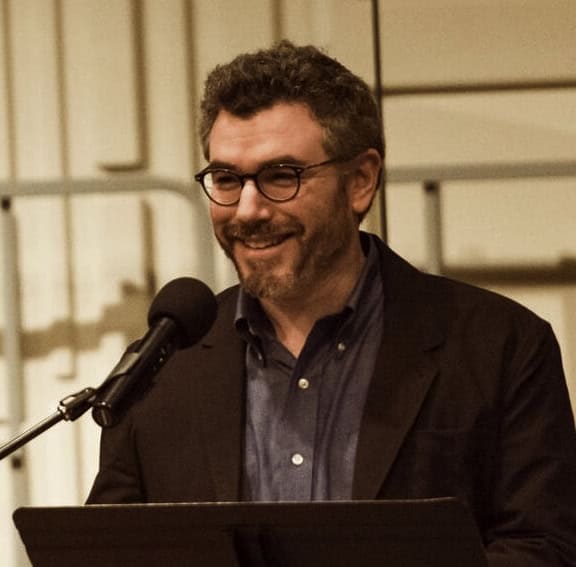
We’re joined now by Ariel Berger. He’s founding director and senior scholar at the Witness Institute, and author of “Witness: Lessons from Elie Wiesel’s Classroom.” Ariel, welcome to Philosophy Talk.
Ariel Burger
Thanks so much. It’s good to be with you.
Josh Landy
So, Ariel, you’ve been teaching and writing about Nachman of Breslov for many years now. But how does his wisdom show up in your everyday life?
Ariel Burger
Well, I would say Rabbi Nachman is not just a universe; he’s a multiverse, and so in many ways, I see the world through the lens of his his teachings, his stories, and it really shapes my life on a daily basis, especially in moments of crisis.
Josh Landy
Can you give us an example of that?
Ariel Burger
Well, sure. Not too long ago, a good friend of mine was in the hospital, and the situation did not look good. And I was in the hospital with his family, and the doctors came out with really bad news and scans that looked terrible. And so we all descended into this this kind of pit of despair. And suddenly, I remembered something from one of Rebbe Nachman’s stories, where he he says, with God anything is possible, and so it reminded me, and I reminded the family that the doctors actually don’t know everything, and the scans don’t know everything, and our job in that moment was to hold on to possibility and not to fall into magical thinking, but at least to hold that possibility open, and it really shifted the whole experience.
Yonah Schiller
So Ariel, earlier Josh and I were talking about how Nachman combined a life of suffering with a philosophy of joy, and he was full of contradictions like that. He was incredibly influential and also had a huge following, but he hated the trappings of power, prestige, and personal gain. What’s your favorite fact about this fascinating and unusual figure.
Ariel Burger
Well, some people call Rabbi Nachman the master of paradox, and one of the things I love about him is that he’s not systematic, not just in his teachings but in his life. And so there’s an amazing story where he decided, when he was about 20 something years old, to travel from Ukraine to the Holy Land, and he spent about eight or nine months traveling over the oceans during a time of war, and going through all kinds of adventures. Finally, got to the land of Israel, got off the boat, took four steps, and then said, “Okay, I’m ready to go home. And the person who was with him said, “What? What are you talking about? We just got here, so we stayed longer. But that initial impulse, that paradox of quest and then immediate readiness to leave, kind of captures that wildness, that paradox.
Yonah Schiller
And how did that play out? I mean, you know, when I think about religious communities in you know the 18th century, I don’t think about necessarily like you know, wild, creative containers to hold thoughts and behaviors of influential figures. I think more of a conservative orientation, particularly to religious figures. Like, how did he fit in or not fit in with this kind of wild disposition as related to what I would imagine would be a pretty conservative, you know, religious community.
Ariel Burger
Yeah, he basically did not fit in, and there was a ton of controversy around him because of that. One of the great quotes, one of my favorite quotes that he said to his students is, “You know, you’re all you’re good people. You’re all you’re all kosher people. He said, “But that wasn’t what I was trying to do in teaching you. What I wanted was to get you to the point that you’d be like wild animals howling all night in the forest, so that did not go over well with the religious establishment of the time, and that’s a difficult trick to pull off, right? It’s a kind of paradoxical advice: be like me by not being like me. You know, it sounds like he wants to have followers, but he kind of wants those followers to, to you know, live the sort of the same life as him, but in their own different way. Is that about right? Well, I would actually push on the the followers part. I don’t think he wanted followers. I think he wanted to open up a kind of spiritual path or set of practices for anyone of any walk of life who is interested in growing in a certain way, growing in joy and and other aspects of life. And he said explicitly, this is for Jews and and non-Jews alike. This is for the entire world. I’m not trying to create another sub community of a sub community of a sub community in Eastern European Jewish life. Something much much wider than that.
Josh Landy
You’re listening to Philosophy Talk today. We’re thinking about Nachman of Breslov with Ariel Berger, author of “Witness: Lessons from Elie Wiesel’s Classroom.”
Yonah Schiller
What do you do when you wake up feeling down? Do you try to cheer yourself up, or do you explore your feelings in all their unhappy places? Do you ever act a serious fool?
Josh Landy
Cheap happiness or exalted suffering, along with your comments and questions when philosophy talk continues.
Bobby McFerrin
Don’t worry, be happy.
Josh Landy
Don’t worry, be happy—hmm, why not both? I’m Josh Landy, and this is Philosophy Talk, the program that questions everything…
Yonah Schiller
…except pure intelligence. I’m Yonah Schiller, and we’re talking about Nachman of Breslov and the obligation to be happy with Ariel Berger, founding director of the Witness Institute.
Josh Landy
Today’s episode is generously sponsored by Common Era, an R&D platform building new Jewish futures for the common good.
Yonah Schiller
One of the things that makes us happy is getting questions from you. So if you have thoughts about Reb Nachman, please email us at comments@philosophytalk.org, or you can comment on our website. And while you’re there, you can subscribe to our free podcast and find your joy in our library of more than 600 episodes. So Ariel, we were just talking about Nachman stretching the boundaries of what’s acceptable and what maybe where imagination, religious imagination, goes for the people who would follow him, people who are fans of of him. In what ways? What other ways did you find, you know, in your in your research and your reading and your expertise? What do you find other ways that that Nachman was fond of stretching the people around him towards.
Ariel Burger
Well, one of the central principles that he taught is that we are here to really develop an open heart and to feel all the joy, all the grief, all the feelings, and not to shut them down, not to numb that. And so, in in religious communities, very often, particularly conservative religious communities, there’s an emphasis on intellectualism or kind of avoidance of certain experiences or feelings. And Rabbi Nachman’s approach was: you have to be disciplined in life and make good choices, but you have to open yourself to the entire panoply of human experience. And even if there are contradictions in that, you have the capacity to hold those contradictions. That was a a very radical new idea.
Josh Landy
And of course, one of the main emotions that he talks about is that of joy, and finding joy in spite of the genuine difficulties that face us, the genuine sources of sadness and grief. What is his most important reason for thinking that it’s not only nice to feel joy, but it’s really important to feel joy.
Ariel Burger
Well, I want to preface just by saying that you know my teacher Elie Wiesel was a very very big Rebbe Nachman fan, and believed that Rebbe Nachman stories were the greatest stories ever told. He said this publicly several times, and you know, Elie Wiesel was a person who had face-to-face contact with the utmost darkness in the world, and still believed that it’s possible to choose a life of hope, and a life of joy, and a life of activism to make the world better, and not to give in to despair. And I think that rootedness in Rabbi Nachman’s teachings was a secret ingredient in his approach because Rabbi Nachman believed that joy is the foundation for all growth and all hope and all continuity of action in life.
Josh Landy
So, can we put some of those things together and say, if you are able to find a way to joy, then you will retain a sense of hope, and if you retain a sense of hope, that’ll make it more likely for you to take action in the world and and actually change things, make things better.
Ariel Burger
Exactly right. The only tweak I would say to that is it’s not just finding your way to the feeling of joy. It’s it’s basically a commitment to the practice of joy.
Yonah Schiller
And can you maybe help us understand the mechanics of of when we say joy? You know what is that actually from Rabbi Nachman’s perspective? Like, what’s the threshold or what’s the criteria that actually we would say this is joy?
Ariel Burger
I think the most precise way I can say it is that joy in Rabbi Nachman is the opposite of numbness, because depression leads to a kind of numbing of our feelings, and joy, or the language he used in the original Hebrew and Yiddish that he spoke, is really about having a wide open heart, vividly alive and awake to all experience, and then to take that and use it in some way to dance, to sing, to connect with other people.
Josh Landy
And this, as you were saying earlier, this is just good advice for everybody. He’s not-he’s not trying to found a sect within a sect within a sect. He’s not just talking to Jewish people. He’s talking to everyone around the world and saying, “Feel everything, including this, you know, technically defined joy. Feel that by singing and dancing. Feel that by being foolish from time to time, Yonah earlier mentioned forgetting certain, letting certain things go. One of my favorite additional piece of advice he has along these lines is to appreciate everyday miracles. So he has this nice line: “Seek the sacred within the ordinary, seek the remarkable within the commonplace. I think that’s really beautiful. Is there an example of something that you think is sacred within the ordinary that Nachma might point us towards?
Ariel Burger
I mean, it’s everything, literally everything. But one practice that followers-it’s you know-it’s this moment. It’s being with you here now. One of the practices that Rabbi Nachman’s followers really emphasize is waking up before the dawn, and there’s this idea that you can allow the dawn to wake you up, where you’re kind of a subject of the world. The world is acting upon you, or you can wake up before the dawn and participate in the sunrise. And that’s something that a lot of people do in this in these circles. And when you wake up in the morning and you watch. The sunrise and each sunrise is totally different. You start to feel a sense of awe and amazement about what what is this place and how is it that I’m here and what an incredible miracle and opportunity it is that I’m here.
Yonah Schiller
You know, Arm, just going back to what you were saying earlier in terms of you know the definition of happiness is the ability, the capacity to feel you know and experience everything you know the vitality of life. Does that come with a potential danger? And is that is that not on sort of a razor’s edge of how to live? And just curious if and how Rebbe Nachman related to that.
Ariel Burger
I think first of all, Rabbi Nachman anticipated because he had contact with the early modernizers in the Jewish world in Eastern Europe. He anticipated modernity and industrialization and the commodification of life and and even of human beings and the kind of paving over of the green grass of our world. You know, and he really knew that that was coming, and so he saw the dangers in that, and the danger that in response we would all become mechanistic and kind of shut down. And so he really wanted people to have open hearts. And yes, there’s a danger there because if then in response you’re just you’re just emo, you’re just constantly at the mercy of your own emotions, right? And and you’re kind of indulgent and you have no boundaries, then you know you’re not going to be a force for good in the world. So that’s where all the disciplined practice comes in in Rabbi Nachman’s teachings. It’s not just about howling at the moon. It’s also about having real disciplined practice of study, of prayer, and of community.
Yonah Schiller
It’s funny when you think of happiness, one doesn’t think of discipline. It’s just a strange combination, particularly in today’s society. It’s like you know we’re so seeking out living our best life, and how do we maximize and and how do we you know enhance all things in our lives? And we don’t tend to think discipline doesn’t seem to be part of the pursuit of happiness. So I’m curious, you know, can you say a bit more just about how discipline fits in and how it is maybe critical to achieving happiness?
Ariel Burger
That’s a great question. I think the pursuit of happiness is is a little bit different than what Rabbi Nachman was talking about. I think he was talking about participation in something really, really massive, which is that the world is, on the one hand, hurdling towards crisis and catastrophe in every moment as we’re experiencing these last years, on so many levels, and on the other hand, the world is moving towards infinite possibility for redemption and grace and connection and joy and celebration, and I get to choose. You know, what am I participating in? How am I living my life in every moment, in the smallest details of my life? Am I contributing to that redemptive possibility, or am I am I polluting the world around me? You know, spiritually or maybe literally. And that’s not just about my own happiness. That’s about something much bigger than myself.
Josh Landy
You’re listening to Philosophy Talk today. We’re thinking about Nachman of Breslov with Rabbi and scholar Ariel Berger. So, Ariel, it sounds like there are a number of places where it’s a kind of a delicate balance. Jona talked about things being poison and knife edge, so you know there should be joy, maybe more than you currently have, but also discipline. Don’t go overboard. I guess we talked about the need to forget things, but probably you don’t want to forget everything. You talked about how we need to have hope, but also a kind of certain realist sense to how we approach the world. Does that seem right to you as a characterization of what Nachman is calling for from us. He wants us to be able to find a balance between these sort of necessary pulls on us.
Ariel Burger
Well, you mentioned Maimonides earlier. I think you did another episode on Maimonides. Maimonides loved balance. Rebbe Nachman I think is not talking about balance exactly. I think he’s really talking about paradox. So, for example, you should go overboard. You should be you should be crazy. You know, Elie Wiesel used to say, “When the world is mad, the solution is you need a better madness, right? So you have to go crazy, but you have to do it in the right way. You have to do it with discipline, with consciousness and awareness of who’s around you and the context you’re living in, but but find a time every day to go a little crazy, dance in your basement. You know, dance like no one’s watching. That’s that is not a Rabbi Nachman quote, but it could be.
Josh Landy
So is that the way you resolve the paradox? Is sort of by localizing things in time. So you know, from two to three, that’s the time when I go wild and I howl at the moon, but then at 3o’clock I’m back to you know hitting the books and being a sensible.
Ariel Burger
That’s definitely part of it. It’s one of the ways that practitioners of this path navigate this stuff. They often spend the the wee hours of the night in that that holy madness, going out literally into the woods, into the forests. To pray, to scream. If you go to certain places where followers of Rabbi Nachman hang out at two in the morning, you will hear people screaming. Not just one person. You’ll hear, you know, almost like echoes of people practicing this wild practice. But if you see them during the day, they’re they have jobs and they have families and they’re responsible citizens of the world, and they’re studying and very disciplined people.
Yonah Schiller
So Ariel, we have this comment from Barry from Cambridge, England. He writes, “My favorite story about Nachman is of him and someone else seeing a person praying, pushing a cart. The other person says, ‘How awful! Even when praying, he is trading. Rabbi Nachman responds, “How wonderful! Even when trading, he is still praying.” Ariel, what do you think? What do you make of that comment?
Ariel Burger
Well, that story is is definitely in the spirit of Rabbi Nachman. It’s it’s technically not about Rabbi Nachman. It’s about a different master or lady. It’s like a bridichit, but it’s it’s a similar kind of vibe to Rabbi Nachman, which is a real emphasis on on the positive and and really flipping like when you say a sentence and the word but is in the middle, so the order matters a lot, right? I I woke up this morning feeling really down, but I got out of bed is very different than saying I got out of bed this morning, but I was feeling really down, right? So the shift in perspective, which can be so subtle and so easy to make, to focus on the positive and generate some positive energy or connection with someone else or with yourself. That is a that is a classic Rabbi Nachman move, and it’s very simple but sometimes hard to do.
Josh Landy
Yeah, and it goes along with his idea that we should see the best in other people and in ourselves. Which, as you say, simple advice in theory, but how do you how do you do it in practice? What do you think? Does Nachman have specific tips for how we can shift that balance?
Ariel Burger
Yeah, well, that practice is known to sound simple and to be much deeper than it sounds like because he claims in that teaching that you can actually shift someone’s destiny through that practice. You can actually shift someone’s path and open up new possibilities for them by seeing the good in that. So that is not just, you know, a nice idea in terms of my perspective. I’m actually doing something, you know, quantum related maybe. And so, how do we do that? I think the general answer to that question is the advice that Rabbi Nachman said for everything, which is turn it into a personal prayer, which really means marry it to your will and your desire. If you can really want this, and you can express your desire in words, and you do that over time, you definitely start to see shifts in yourself around any issue.
Yonah Schiller
You know, it seems like a lot of the success factors for kind of using Rabbi Nachman’s sort of approach to life is based on a resolve and kind of knowing yourself. Did he speak at all about how to access? Because you need to sort of you know he was very much drawing. He asked you to draw upon your own power to you know be in the world in a way that’s that’s best for you. How did he how do you advise or speak about how one goes about doing that?
Ariel Burger
About 1011 years ago, I had mono and I was I was sick in bed. I couldn’t get out of bed for about three weeks, and one day I asked one of my children to bring me a book of Rabbi Nachman’s teachings, and in this book there was a poem from a later follower of Rabbi Nachman that’s also a song, and I knew that I couldn’t get out of bed and and and do anything with this, but I knew that I could actually I could just have the book next to me. It was a little tiny step, and I took that book, and over the next few hours, to make a long story short, somehow by the end of the hour-long period, I was literally out of bed, singing and dancing, which seemed completely impossible at the beginning of that process. So it’s about harnessing desire, pointing ourselves in a direction, and then taking micro steps, really moving in the direction we want to move slowly but surely, and all these spiritual ideas can be weaponized, you know, or we weaponize them against ourselves, and we say, well, I should be this or that, or I should be better, or more liberated, or more enlightened, and we use it. We just use it to pound ourselves into the dirt instead of recognizing that I’m human, it takes time, and in many of Rabbi Nachman’s stories, the the characters take you know 7080, 90 years to grow and and figure things out.
Yonah Schiller
It’s like you know the the painful process of our own existence. What was the biggest like obstacle that Rabbi Nachman talked about was the biggest impediment obstacle for us to getting to where he would he really thought we need to be?
Ariel Burger
Despair. And despair in Rebbe Nachman is not a feeling, which which is a feeling I’m familiar with when I read the news. You know, it’s it’s a natural thing to feel like, oh my God, where are we going as a species? Right, it’s not the feeling of despair that he. Against it’s the existential move. It’s the throwing up of the hands and saying there’s nothing else I can do, either in a very big way, or even in small ways. I know that I can do a little bit more, but I’m not because it’s not going to get me anywhere. Why should I bother? That move, that little tiny micro despair, gets in the way of any any growth, not just spiritual growth.
Josh Landy
You’re listening to Philosophy Talk. Today we’re thinking about Nachman of Breslov with Ariel Berger, author of “Witness: Lessons from Elie Wiesel’s Classroom.”
Yonah Schiller
What is the true power of storytelling? Does every story need a moral, or are the best stories the most mysterious? What can stories do that nothing else can?
Josh Landy
Tall tales and happy trails, plus commentary from Ian Shoals, the Sixty-Second Philosopher, when philosophy talk continues.
Pharrell
Clap along if you feel like that’s what you wanna do.
Josh Landy
Clap along, you might just make yourself happier. I’m Josh Landy, and this is Philosophy Talk, the program that questions everything…
Yonah Schiller
…except your intelligence. I’m Yonah Schiller. Our guest is Ariel Berger, and we’re thinking about Nachman of Breslov and the obligation to be happy.
Josh Landy
Today’s episode is generously sponsored by Common Era, an R&D platform building new Jewish futures for the common good.
Yonah Schiller
So, Ariel, you know when we think about Nachman and other Hasidic or religious figures, we tend to think of you know of their teachings are primarily directed towards a following, a community of people who are religious who believe in this person and and will live out these tenets of behavior. I’m so curious because Nachman’s seems beyond you know his time. It seems both timeless in some of these teachings, and and more importantly, it just seems so potentially critical for today and how the world is evolving and all the different corners of technology and social platforms people are living and experiencing life on. How would you relate to the application? Can it be applied? In what ways should it be? Is it already happening in the modern world that is seems to be so needing something like this right now?
Ariel Burger
Yeah, if you read the history of Rabbi Nachman and his followers, it’s pretty clear that a lot of his own followers didn’t really understand him, and and it’s pretty clear that he was speaking about and for people in the future. He anticipated a lot of the things that we’re experiencing now, including alienation from the earth, from nature, and the commodification of of human life, and the breakdown of of our capacity for joy and delight, and so I think it is happening. There are places where there’s a massive renaissance of interest in Rabbi Nachman in in Israel now, in a lot of different parts of society, both religious and secular, in various academic circles. It’s really spread and grown a lot, and I think I think it’s designed for us. I think it’s designed for you know, semi-apocalyptic moments that confront us with so many challenges to joy and to to a sense of hope. I think he was really teaching for and speaking and telling stories for us today.
Josh Landy
Storytelling. I want to hear a bit more about that. As you say, he wasn’t just teaching; he was also telling stories, telling beautiful and often somewhat mysterious stories, why did he think that storytelling was so important?
Ariel Burger
Well, Yona mentioned earlier. You said that he lived a tortured life and he lost some of his children. So, after one of these losses, which which really thrust him into a deep, deep kind of devastating depression, he said, “Now I’m going to start telling stories, and so it was really a shift from the kind of frontal, traditional teaching, or radically creative but traditional in form, Torah teaching, Jewish teaching that he was doing. This is in 1806. He started telling stories. He told a story called “The Tale of the Lost Princess, which was the first of 13 stories that he told in in the next few years before he before he died at the very young age of 38, and around that time he said, “The world says people say that stories put you to sleep, but I say that stories wake you up, and stories, especially the kinds of stories he told, are designed to wake us up.
Josh Landy
Can you give us an example of a story he told that wakes us up?
Ariel Burger
I can. This is a story that Elie Wiesel loved to tell at the beginning of semesters in university. It’s called “The Tale of the Tainted Grain, and it’s also the story that we use in the Witness Institute at the beginning of each of our programs to capture all of our work in one story. So the tale of the tainted grain. There was once a king who was an astrologer who saw in the stars that anyone who eats of next year’s grain harvest, wheat harvest, will go mad. The grain will grow with some sort of fung. Or some problem that anyone who eats of it will go crazy. So he called in his second in command, his viceroy, and he said, “What should we do? And the second to the king said, “It’s very easy. We will stockpile enough grain from this year’s harvest for you, Majesty, and for me, and therefore we will remain sane, and we’ll be okay. The king said, “That’s a terrible idea. If you and I are the only people in our entire society who are sane, then they will all think that we are insane. All the mad people in our country will think that we’re crazy, and they won’t listen to us. We won’t be able to influence them or help them in any way. Therefore, he said, “I have a different solution. You and I will join our people in madness. We will eat from the tainted grain, but we have to remember that we are mad. And so, I will put a sign, a mark on your forehead, and you will put a sign on my forehead. And every time we look at each other, we will remember that we are mad.
Josh Landy
I mean, that’s a beautiful story. Is there supposed to be a moral of the story?
Ariel Burger
Definitely not a simple moral. His stories are generally clearly against simplistic morals. These these are stories that are meant almost like coed, like Zen koans to sit with to live with for a long time to think about to let them settle into our bones and see what happens.
Yonah Schiller
There’s there’s something about that story that makes me think: Are we all crazy and we just forget that we’re crazy? I’m curious, you know, how you maybe just you know having having digested that story for so long and you know, through many of those teachings, how do you? How does that story sit with you, and what do you think it’s telling us?
Ariel Burger
Well, I want to pause and just say that that’s a question for everyone who’s listening to let the story settle in first, and I don’t want to foreclose any any possible directions that come to you, but I will share. For me, the story is very much about the reality that we have all been shaped by a world which is infected by a kind of madness, a kind of moral madness, and none of us are immune. And so I think the the reality is that when we look at each other, we can sometimes remember that we’ve been infected and touched by this craziness around us, and therefore, we have to ask a lot of questions. We have to question everything, and not take for granted that we’re living in in reality. This is not reality. This is a kind of madness. We’re not going to wake up so quickly, but we can at least practice the memory of our madness and the awakening that comes with that.
Josh Landy
And the story seems to work in a beautifully complicated way, in the way that a lot of philosophical thought experiments do. Imagine a world in which you had just enough safe grain for two people, and everyone else would go mad. What would you do? You could everyone could go mad, or maybe maybe it shouldn’t be for the king and the viceroy. Maybe it should be for you know pick the two best artists, two best storytellers. Pick the two, you know, best financial wizards or something like that. You could imagine people debating this for hours in a very productive way. I wonder whether or notman thinks that at the end of that conversation, the chances are that our hearts will be more open, our eyes will be more open, if we listen to these stories and debate them with our friends and fellow believers. We will come to have a better relationship with the world around us.
Ariel Burger
That’s a great direction to explore. I think the the fundamental thing is that when I see another person, I’m looking at the mark or the sign on their forehead, and and the face of the other person itself is a reminder to me that I need to question things. I need to ask questions. I think this is particularly true when when I see someone who who sees the world very differently than I do. You know, that’s we often think of that or feel that as a threat these days in our hyperpolarized moment, but actually, that’s the person who can remind me to ask questions of my worldview and my assumptions. That’s an incredible opportunity, but it’s very, very typical of Revinachman’s stories that he doesn’t give us the the final end of the story. What happens next? Does this save the world somehow? We don’t know. We’re left in the middle of the story, which is where we’re living now.
Yonah Schiller
You know, I’m fascinated by just the technology of story. You know, there’s something about the story, a story that breaks through our normal kind of modality of thinking, of understanding, of exploring. What do you, what have you learned about the power of stories that’s unique that only could be accomplished through a story, and and why is that?
Ariel Burger
I’ve been doing a lot of work with Rabbi Nachman stories with different groups, both in the Jewish community and and far beyond, in very diverse global conversations and things. And one of the things I’ve noticed is that it’s very clear when you’re engaged in that technology of stories and storytelling. That you’re not telling people what to think, you’re not moralizing, you’re not being didactic or pedantic. Instead, you’re inviting people into a conversation that we just started to dip our toes into here, which is delightful. It’s it’s imaginative. There’s there’s infinite possibilities. There’s a text which is guiding us in certain directions, but the conversation is open, and at a certain point in that process, we realize that we are the protagonists of those stories, and so we’re seeing ourselves from a different vantage point through the through the story that Rabbi Nachman told 200 something years ago, and that I find that to be really liberating, intriguing, evocative, mysterious, frustrating sometimes, very different than you know a lecture or or a policy paper or a statement.
Josh Landy
That’s such a beautiful way of thinking about the value of stories. That the value of a great story is not necessarily that it tells us what to think about something. It’s that it is forms a kind of model for us for how to be. The practice of telling and listening to stories, the practice of talking about those stories with other people, remaining open, and remaining open to the possibility that somebody else, believe it or not, may have a better idea than you. That seems such a beautiful and uplifting a thought. Before we go, Ariel, I did want to ask you. Started our conversation today by talking about a friend who was in the hospital. What was the end of that story?
Ariel Burger
So there was a shift in that moment of of kind of a shift towards hope, away from despair, with with his family in the hospital, and the idea was that you know miracles can happen. It doesn’t mean it will happen here, but there is possibility of miracles. There’s possibility of hope, and in fact, our our dear friend had an unbelievably miraculous recovery that the doctors couldn’t explain. And in fact, it was on it was on the Purim holiday, which is all about radical 180 degree turnarounds. That’s what the story of the Purim holiday is about. And I got a text in the middle of that celebration of that historical Jewish moment of radical reversal. I got a text from his sister that said the nurses just said he had 180 degree turnaround. They can’t explain it, and he’s thank God he’s doing incredibly well. And it was one of the was one of the moments in my life where, although I’m skeptical and careful about magical thinking, it reminded me that in fact we don’t know very much about the world around us. Neither do the experts, and so the the kind of moral or spiritual responsibility of holding on to radical hope in the face of major major life crises or challenges is real and it’s possible, and it’s a it’s a bedrock responsibility I think we have, especially in moments like the ones we’re living through now.
Josh Landy
Well, Ariel, you’ve given us so many reasons to hold on to hope and even joy through times of great difficulty, and I want to thank you so much for joining us today.
Ariel Burger
Thank you. This is really fun and inspiring.
Josh Landy
Our guest has been Ariel Burger, founding director and senior scholar at the Witness Institute, and author of *Witness: Lessons from Elie Wiesel’s Classroom* So, Yonah, what are you thinking now?
Yonah Schiller
So many things. I mean, there’s one idea that keeps reverberating my head: the idea of being a protagonist in in the stories that we read. We become the protagonists in the stories that we read. I just think about what story are we telling ourselves, right? And what life, and what character, and what narrative, and you know what’s the next page of the next script that we find ourselves authoring, and it feels to me that Rebbe Nachman was somebody who was well aware that we really are the authors of our own life, and no one’s going to tell us what that looks like, and the best sort of advice we have is probably within ourselves somewhere, and then the question becomes: What’s the best way to excavate and to find find my voice? And and and it’s only whatever voice we find that the one only one worth listening to is one that’s rooted in a certain connection to the vitality of life and being aware and being cognizant of all of all the all the good stuff that’s surrounding our lives, and so that’s what I’m thinking about right now.
Josh Landy
That’s really beautiful, Yana. We’re going to put links to everything we’ve mentioned today on our website, philosophytalk.org, and while you’re there, you can subscribe to our free podcast and question everything in our library of more than 600 episodes.
Yonah Schiller
Now, only one guy is obligated to talk this fast: it’s Ian Shoales the Sixty-Second Philosopher.
Ian Shoales
As a small child in what is now Ukraine, Rebbe Nachman would speak to God in Yiddish. As he grew, this became sort of the practice, you might say, of the Hasidic sect he founded in Breslov. He became the Rebbe of Breslov, the first and only formal Rebbe of that sect, which continues today, emphasizing joy, clapping, singing, dancing. He emphasized that seclusion and frank talks with god can bring about potent mystical experiences. He told a disciple, that this practice should be done in a simple, straightforward manner, as conversing with a close friend, whispering, sometimes even screaming (in your own head, of course, silently). He also advised: “You are children to God. Therefore, it is good to express your thoughts and troubles to God like a child complaining and pestering his father.” Apparently, he experienced wild mood swings allhis life, leading to conjecture that he may have been bipolar. Maybe he was just charismatic! Also, life itself can affect your moods, faith notwithstanding. Be that as it may, at one point Nachman was floating himself as the Messiah, and later, his son. Then his son died, and the Messianic impulse seemed to go with him. Nachman certainly considered himself a Tzaddik, however, a righteous person, and leader. Leading a life of radical simplicity, hearing confessions from his flock, sermonizing, writing, leading silent meditations. He also wrote stories, fables, parables, Zen koans, or Breslovan koans, if you will, kind of like fairy tales that require exegesis. His unorthodox approaches earned him a lot of controversy. Many of his teachings could be taken from any self-help book published over the last 10 years. Back in the early 1800’s, Rebbe Nachman waged a full out war on depression, suggesting various strategies, including denial. Also, spontaneous personal prayers in Yiddish? Rabbinical critics thought this diminished the dominion of liturgical prayer. As a mark of his irresponsibility, further, he named no successor, which led to the Breslov Hasidim being called the Dead Hasidim, because they followed a deceased leader. Well the joke was on those critics, because indeed, the Breslov Hasidim continue to this day. In his brief lifetime, he died of tuberculosis aged 38, he seemed most proud of his Rosh Hoshana celebrations, perhaps because he was a forward looking kind of fellow. He said, “My Rosh Hashana is greater than everything. I cannot understand how it is that if my followers really believe in me, they are not all scrupulous about being with me for Rosh Hashana. …Rosh Hashana is my whole mission.” Since his passing, spending Rosh Hashana with the shade of Nachman has become an annual event, with thousands gathering in Uman, Ukraine, where he is buried. Nachman had written, “…on Rosh Hashana, Jews flock to the synagogue, to their leaders. They come from all the towns and villages to be together …. T…he Jewish People are likened to a flock of sheep who gather around their shepherd. When the shepherd wishes to call his flock, he blows his horn. This is the reason for the blowing of the shofar on Rosh Hashana. The shepherd, the true tzaddik, is calling his “flock” together, seeking ways to help each one of them fulfill his destiny.” Even with the current situation in Ukraine, 40,000 Breslavian Jews showed up last time, most of them men, of course, praying loudly, screaming, singing… The pilgrimage has been going on for more than two hundred years, and even in the midst of the ongoing war, it has attracted attention, for its longevity, but also for the fact that it seems to be a kind of spring break blow out equivalent for some of the Breslovers as they are called, devout enough to make the journey, but don’t mind a drink or two, or even a bit of LSD, so it’s been reported. Rebbe Nachman said his high spiritual level was something he worked on, not something he attained at birth. All Jews can attain his level! After writing his first story, The Lost Princess, I think, Nachman declared, “The world tells stories to put people to sleep. I tell stories to wake people up.” I have a hunch that even today kabbalists spend many sleepless nights decoding the mysteries of his stories. If they want to blow off a little steam in a war zone on Rosh Hashanah. Come on. Woo hoo! Boys will be boys. I gotta go.
Yonah Schiller
Philosophy Talk is a presentation of KALW San Francisco Bay Area and the trustees of Leland Stanford Junior University, Copyright 2026.
Josh Landy
Our executive producer is James Cass. The senior producer is Devon Strollovich. Special thanks to Merle Kessler, Angela Johnston, Karen Ajluni, Steve Choy, and Linda Fagan.
Yonah Schiller
Support for Philosophy Talk comes from various groups at Stanford University and from the members of KALW Local Public Radio San Francisco, where our program originates.
Josh Landy
Support for this episode comes from Common Era, an R&D platform building new Jewish futures for the common good. Special thanks
Yonah Schiller
The views expressed (or mis-expressed) on this program do not necessarily represent the opinions of Stanford University or our other funders.
Josh Landy
Not even when they’re true and reasonable. The conversation continues on our website philosophytalk.org, where you can question everything in our library of more than 600 episodes. I’m Josh Landing,
Yonah Schiller
And I’m Yonah Schiller. Thank you for listening.
Josh Landy
And thank you for thinking.
“Pimpernel” Smith
Oh, a message from Breslov.
Guest
Related Blogs
-
October 22, 2026
Related Resources
Burger, Ariel. “Two Versions of a Tale of Rebbe Nachman of Breslov (1772-1810)”
Burger, Ariel (2019). Witness: Lessons from Elie Wiesel’s Classroom.
Green, Arthur (1992). Tormented Master: The Life and Spiritual Quest of Rabbi Nahman of Bratslav.
Get Philosophy Talk

Leave a Reply
You must be logged in to post a comment.