How Do We Learn?
July 19, 2026
Listen


We’re all learning about the world all the time—not just as small children but all the way into old age. But how do we learn how to learn? How much depends on the circumstances of our birth, our upbringing, and our formal education? How can we get better at learning and teaching? And how do we figure out what’s valuable to retain and what’s important to ignore? Josh and guest-host Blakey Vermeule learn from NYU psychologist Catherine Hartley, Director of the Hartley Lab.
This episode was generously sponsored by the Stanford Symbolic Systems Program.
Josh Landy
What’s the difference between learning a fact and learning a skill?
Blakey Vermeule
Which is more important for life?
Josh Landy
How do we learn how to learn?
Blakey Vermeule
Welcome to Philosophy Talk, the program that questions everything…
Josh Landy
…except your intelligence. I’m Josh Landy.
Blakey Vermeule
And I’m Blakey Vermeule, sitting in for Ray Briggs. We’re coming to you from Braun Geology Corner on the Stanford campus.
Josh Landy
Continuing conversations that begin just across the quad at Philosopher’s Corner, where Blakey and I teach in the Philosophy and Literature program. Thanks for guest hosting today, Blakey.
Blakey Vermeule
Oh, it’s a pleasure to be here. We’re very grateful to the Stanford Symbolic Systems Program for sponsoring today’s episode.
Josh Landy
Welcome everyone to Philosophy Talk. Today we’re asking, how do we learn?
Blakey Vermeule
How do we learn what?
Josh Landy
Oh, Blakey, such a philosopher move, answering a question with another question.
Blakey Vermeule
Wait, you don’t want me to answer a question with a question?
Josh Landy
Who, me? But seriously, it sounds like you think there are lots of different kinds of things that we can learn.
Blakey Vermeule
Exactly, there are facts, there are things that happened, and there are skills, you know that pastries are delicious, you know that you went to Paris last month and ate pastries, and you know how to order those pastries in French, we all completely different kinds of knowledge.
Josh Landy
All right, so which one of those do you want to talk about first.
Blakey Vermeule
Well, how about we start with pastries being delicious.
Josh Landy
This is a topic that’s very dear to my heart. Tell me about that. How do we learn that pastries are delicious?
Blakey Vermeule
You put one in your mouth, it’s sweet and warm and melty. You learn what a pastry is, what sweetness is, how good it is to be alive.
Josh Landy
Let’s not go that far.
Blakey Vermeule
But that’s the way you learn anything. It’s all about gathering information from the world via our senses. Remember that cool slogan that empiricists like to quote: There’s nothing in the mind that wasn’t first in the senses.
Josh Landy
I don’t know. I mean, constantly learn something by somebody else telling me, like, okay, let’s say I want to learn where the fire is hot. I could learn that by putting my hand in one, but don’t you think it’d be better for me if I took somebody else’s word for it? What’s wrong with doing that?
Blakey Vermeule
Okay, but my sister-in-law is constantly telling me that swimming is deathly dangerous, and that I should give up scuba diving immediately. Surely I shouldn’t trust that bit of testimony. If you really want to know something, you have to go out and learn it for yourself, using those wonderful senses of yours, which tell you how amazing the ocean is.
Josh Landy
I mean, I see that about the ocean, but isn’t there plenty of stuff out there that you can’t see or touch or taste? Let’s go back to my tasty pastry. I ate that pastry, and it caused me to feel happy.
Blakey Vermeule
Yeah, so what’s the problem there?
Josh Landy
Well, how do I know what a cause is? My senses can tell me what a pastry is, and they can tell me what sweetness is, but they can’t tell me what a cause is or what an effect is.
Blakey Vermeule
So, where do you get that from, smart guy?
Josh Landy
Well, Immanuel Kant would say we don’t get it from anywhere. It’s already inside our brains when we’re born, it’s true that we don’t have any information about specific things in the world, like delicious pastries or hot fires or beautiful oceans, or whatever, but we do have a kind of pre-programming that leads us to expect some things to cause some other things, and that’s already in there, right from the beginning.
Blakey Vermeule
That sounds a little bit fanciful. You don’t need anything magical like that. All you need is a bunch of data from the world, and then a brain that’s ready to think about it a bit and draw conclusions.
Josh Landy
I don’t know, Blake. Yeah, I feel like that’s a lot to ask of a brain that doesn’t have anything in it. I mean, think about what it’d be like if my minds didn’t have the capacity to organize experience, everything would just be total chaos. We wouldn’t be able to learn anything about pastries, because we wouldn’t even be able to single out pastries from the giant mess that would constantly be bombarding our senses. It’s lucky for us that we have the brains that we do. That’s how I was able to learn that pastry causes yum.
Blakey Vermeule
But did you really learn that? Let’s say one day all the pastries in the world started tasting like cilantro.
Josh Landy
The horror!
Blakey Vermeule
Exactly. So, if that happens, you’ll realize that you were totally wrong. You just happened to have eaten a few hundred pastries.
Ian Shoales
Thousand…
Blakey Vermeule
A few 1000. And pastries that tasted delicious, your mind jumped to the conclusion that all pastries must be delicious. You thought you were getting reliable knowledge, but you weren’t.
Josh Landy
You know what, Blakey, that is a really good conundrum, and kind of a horrifying scenario. Maybe we should ask our guest to solve that problem. It’s Catherine Hartley, Professor of Psychology and Neuroscience at NYU.
Blakey Vermeule
But first, all learning starts in childhood. So, we wanted to find out how school teachers are thinking about education. We sent our roving philosophical reporter, Sarah Lai Stirland, to find out. She files this report.
Sarah Lai Stirland
For years, schools across America have been all in on tech, plonking down a screen on every kid’s desk to prepare them for the future.
Bryan Love
We got to look at what we haven’t learned.
Sarah Lai Stirland
Now, from Silicon Valley to the strawberry fields of Watsonville.some teachers are dialing that enthusiasm back.
Bryan Love
What’s the name of this class? Mr. Love’s class! Thank you, Sari. Environmental studies.
Sarah Lai Stirland
Brian Love teaches science and PE at the New School in Watsonville, California. He has his 12 high school students take notes manually, even though they have laptops at their desks.
Bryan Love
Listen, the reason we’re writing, even though it’s already on there, and you can access it anytime you want, is because when you write, it’s the physical part of your hand and your muscles to your brain.
Sarah Lai Stirland
Love is referring to studies that repeatedly show that students who write with their hands remember more and learn better than those who type. This insight is important to the new school’s mission, which is to teach the students how to learn, says Principal Susan Graulty.
Susan Graulty
A lot of our students here have four to seven of those adverse effects that they’re having to work through while trying to be educated.
Sarah Lai Stirland
Graulty’s school is a community day high school, a last stop for kids who need more support than most high schools can provide. The 47 students at the new school have been through some horrible stuff.
Susan Graulty
Sexual abuse, domestic abuse, verbal abuse, the loss of one or two family members, incarcerated parent, witnessing violent crime.
Sarah Lai Stirland
The pencils and no phone approach is a deliberate strategy to help the students focus and support their mental health.
Susan Graulty
They need to learn how to talk to each other again. They need to learn how to relate to one another, because you can have all the technology in the world, but it’s really hard to marry it. It’s really hard to raise it, you know. It has its place. However, I think first you need to learn how to be a human being.
Sarah Lai Stirland
Earlier that day, I visited the Chesterton Academy at St. James in Menlo Park. It’s 60 miles north in the heart of Silicon Valley. The private Catholic high school is in 130 year old mansion, originally built to house retired San Francisco archbishops related to grammar. As I walked into one of the classrooms, a small group of seniors were sitting at a U-shaped table discussing Aldous Huxley’s 1931 novel, Brave New World.
John Jolly
Like, the only reason why they had a solidarity service was because, like, as some sort of, like, a tradition, but not because they believed anything truly from it.
Sarah Lai Stirland
The book is about an emotionally disconnected society that uses science and technology to manipulate nature for human convenience and to maintain social order.
John Jolly
What do you mean by that?
Sarah Lai Stirland
The students are discussing the meaning of Huxley’s work with their humanities teacher, Dr. John Jolly,
John Jolly
For the dystopian sort of hyper-like rationalist enlightenment culture, religion is a construct, right? It’s just this sort of Wizard of Oz type endeavor, the great Supreme Being that’s descending down the stairs, or whatever, that doesn’t never comes.
Sarah Lai Stirland
The two school circumstances couldn’t be more different, but in 2026 they both use a Socratic method to teach, run small classrooms, and discourage screens at the Chestnut Academy in Silicon Valley, for example. One of the first things I noticed was a pencil being sharpened. I haven’t heard that sound for a decade, at least. Students took notes with pens and pencils, and they used binders. Phones and laptops were nowhere to be seen. The pencil sharpening was happening in a history class for seniors. Greg Billion, the headmaster at Chesterton, says that it’s part of a low-tech approach that Menlo Park parents appreciate.
Greg Billion
Many tech executives, you will find if you talk to them, they are very adamant about their children learning how to do things, thinking for themselves.
Sarah Lai Stirland
At Chesterton, students learn Greek philosophy, ancient and modern history, math, and science, but Billion says the focus is on methods that may seem outdated to some, like learning basic grammar, logic, and rhetoric. It’s a liberal arts curriculum that proponents call classical education
Greg Billion
Classical methods that have withstood the test of time, that are perennial methods that were maybe codified in the ancient and medieval world, but have nevertheless formed many of the greatest literary figures, many of the greatest philosophers, many of the great scientists of our history.
Bryan Love
Ms. Graulty’s here, ladies and gentlemen, put your golf clap.
Sarah Lai Stirland
Back at the new school in Watsonville. Principal Graulty says her students study the ancient philosophers too. They just come at them differently.
Susan Graulty
If you want to teach them about Aristotle and Socrates, take something that’s new and relevant to the student, and then you can backwards map that and teach that, that’s where it actually came from.
Sarah Lai Stirland
They also study history.
Susan Graulty
History does repeat itself over and over, you know. We’re living through another Hitler phase, right? And so, if you don’t know about that, if you didn’t know what happened the first time, how are you gonna get through the next time?
Bryan Love
I’m sorry, you guys have some writing to do, but I will talk while you write.
Sarah Lai Stirland
For Philosophy Talk. I’m Sarah Lai Stirland.
Josh Landy
Thanks for that fabulous report, Sarah. You know, I’m actually really relieved to know there are schools out there where it’s still brains and pencils, not laptops and cell phones. Very encouraging. I’m Josh Landy. With me is my Stanford colleague, Blakey Vermeule, sitting in for Ray Briggs, and we’re in front of a live audience at Stanford for a program generously sponsored by the Symbolic Systems Program. Today we’re asking, How do we learn?
Blakey Vermeule
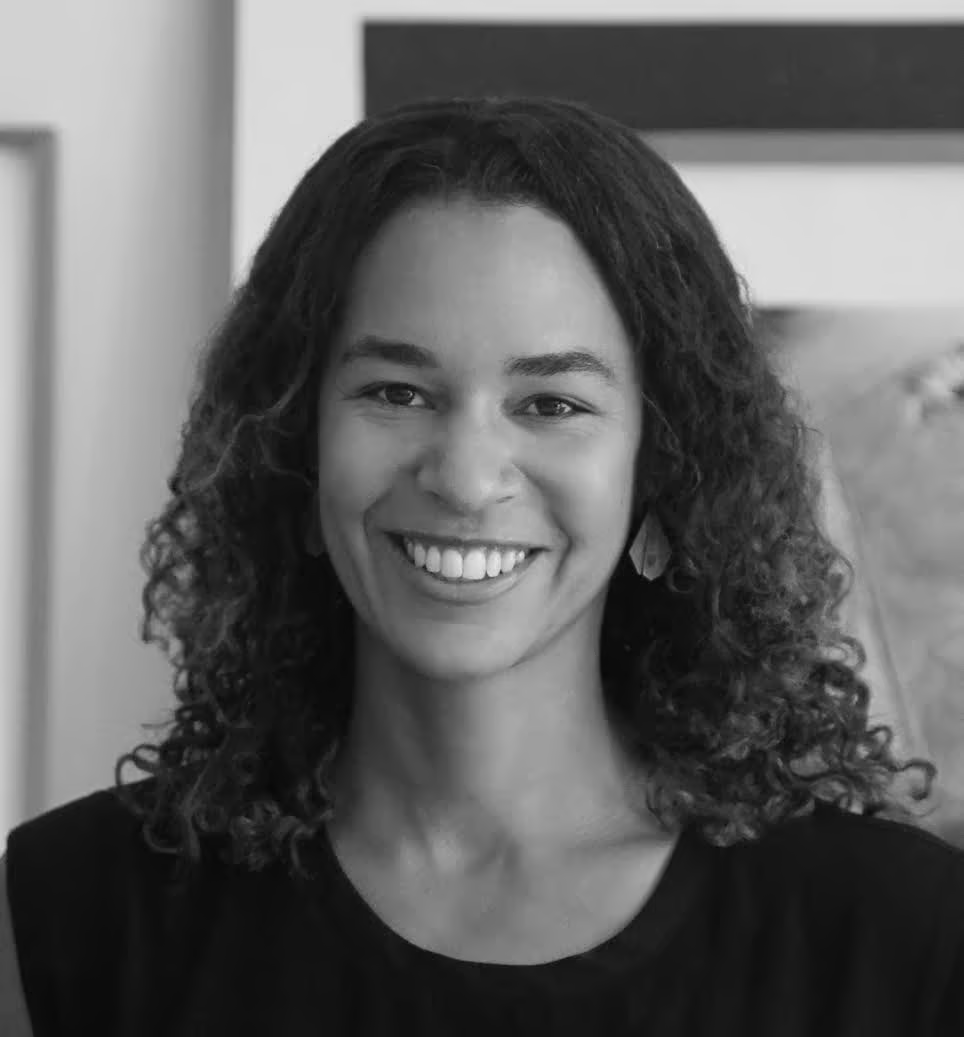
Our guest today is a professor of psychology and neuroscience at New York University and director of NYU Hartley Lab. Please welcome to Philosophy Talk Dr. Catherine Hartley,
Josh Landy
So Cate, you’ve done a lot of fantastic studies about learning, but is it also something you think about in your everyday life?
Catherine Hartley
Yeah, I’m a scientist, but I’m also a parent, so like many parents, I’ve had the remarkable experience of having babies that you are watching, learning in real time, and sometimes the things that they do are sort of puzzling and remarkable, and really stoke my intuitions for these aspects of how children might learn differently, you know. One example, when my children were little on our local playground, they installed a new type of sprinkler in the summertime, and you press the top of it, it’s a water conserving sprinkler, it would turn on for a couple minutes, and then it would shut off again, and my kids, when they first saw this, watched another child do it, and immediately when it shut off, they’d run up and they’d press the top of it. So they learned just through single observation how to do this thing. They did this all summer long, so when we’d come back the next day, they knew it. They knew how to do it. But one thing that was striking was when it, when summer turned into fall, one day they pressed the top of it. Nothing happened, and I said to them, you know, it’s the end of the summer, maybe the parts have turned off the sprinklers, and they won’t, won’t come on again. And yet, all through the month of September, when we go to that playground, they’d run over and press the top, and I thought, you or I wouldn’t do that, we would, we would stop, but this learning was so persistent, and the explicit information that I told them was not enough to make any difference.
Blakey Vermeule
Cate, earlier Josh and I were arguing about how we learn. He said there has to be some stuff in there before we start looking around at the world, and I said there doesn’t. So, who’s right?
Catherine Hartley
Well, there’s a little bit of both. I think there’s a lot of stuff in there that imposes organization on the information that we’re getting from our senses. So evolution has imbued in our brains systems for taking in information and turning that what is perceived into representations like entities we are imbued with learning processes. They may be applied to these kinds of representations that enable us to predict things. You know what is going to happen. You said this before, and we have physiological states. We’re biological organism, so we can perceive what our bodies feel like, and so when we taste a tasty pastry, we can have the experience of, oh, that’s good, you know, and so these are the kinds of ingredients that I think are harnessed to learn and to extract information about the structure of our environments.
Josh Landy
So that makes it sound like, okay, look, I’ve got this stuff in my brain, and I’m going out there with my body and my senses, and so on. It sounds like that would be enough to get us learning, and yet you said a moment ago that it didn’t quite work in the case of the sprinkler. So, what else, do we need beyond just what’s already in our brain, and then us going out in the world and trying things out?
Catherine Hartley
Well, you know, I would argue that my child, who’s still pressing the top of the sprinkler, is still trying to learn. Right, there’s an attempt to understand why there’s been a change in the environment, and it’s a change that they, you know, don’t yet have a systematic understanding of, and so they’re doing little experiments by, you know, maybe now, and until they have the ability to really have a, an understanding, and maybe children’s understanding, our work suggests this, they may more readily derive useful evidence from experience than from instruction, and that’s a valid way of learning, you know, verifying what they know.
Josh Landy
You’re listening to Philosophy Talk today. We’re thinking about how we learn with Catherine Hartley from NYU.
Blakey Vermeule
How do children learn what about adults? Does how we learn change over our lifetime?
Josh Landy
Reading, writing, and refinement—along with comments and questions from our live audience, when Philosophy Talk continues.
Tom Petty
I’m learning to fly, but I ain’t got wings. Coming down is the hardest thing.
Josh Landy
if you ain’t got wings, how do you learn to fly? I’m Josh Landy, and this is Philosophy Talk, the program that questions everything…
Blakey Vermeule
…except your intelligence. I’m Blakey Vermeule, sitting in for Ray Briggs here at Braun Geology Corner on the Stanford campus, and we’re talking with Catherine Hartley from NYU about how we learn. Special thanks to Stanford Symbolic Systems programs for sponsoring today’s episode.
Josh Landy
Learning about a question that’s forming in your mind? Join the discussion by going up to the microphones whenever you’re ready, and we’ll open it up to questions.
Blakey Vermeule
So Cate, we’ve been talking rather generally about learning, but the example of your kids is really interesting. If somebody said to me, the parks department turned off the water. I probably wouldn’t waste a lot of time going over there and testing it again and again. How does learning change over the course of your life? Do grown-ups learn the way that children do? Are we more open to testimony than children?
Catherine Hartley
Yeah, children have a task that is a unique one, they, we come into the world, and we have to build up knowledge about what our worlds are like, and it’s really important that those world models be accurate, right? And our worlds may be different from the worlds of our parents, so I think testimony can be useful to a degree, but a lot of foundational knowledge comes from behaving in the world and observing what happens. I think that because children have these long time horizons to form this knowledge and build these world models, there is a lot of room for them. Them to explore and discover that the nature of the world is dynamic and so the child’s environment may be different in systematic ways from the adult and so this propensity to learn through exploration and individual experience is probably a useful adaptation for kids to get it right.
Blakey Vermeule
So adolescents are at a certain point in your development you become notoriously immune to testimony, especially parents, and so I’m wondering what what’s happening adaptively at that during that change,
Josh Landy
Is there any good reason for us having adolescence?
Catherine Hartley
I have two. They’re fabulous, but yes, I think there is a reason why adolescents are seeking out different sources of information during that stage of development. What is the task of adolescence? One of the primary tasks of adolescence is to gain autonomy to transition toward independence from one’s parents to form new social connections to find one’s place within the social structures that they’re operating within, and this requires a whole lot of learning, exploring novel contexts, assessing one’s own competencies in these domains, and the biology of adolescents sort of drives them toward these novel learning experiences. The, you know, peers become rewarding. Why? Well, that’s an adaptive thing if what you need to do is move into a different social sphere, where those are the relationships that are really critical to the goals that you’re setting for yourself.
Josh Landy
If I understand correctly, one of your studies showed that, although we, we tend to think that children explore and grown-ups exploit, right, so children explore words and eventually have a world model, and then the adults don’t do that much exploring anymore, and just kind of use the knowledge they have. Adolescents are doing the most exploring.
Catherine Hartley
Well, we see, you know, if we look at just a raw measure of exploration, we were GPS tracking participants over over four months, and we were looking how does exploration of the physical environment vary with age, and what we found is that there are increasing levels of environmental exploration into adolescence. When we observed a peak in this level of exploration was at the stage where culturally we grant teenagers autonomy, you know, around the age that they leave their parents’ house and may go to college or move out, so in the late teens, early 20s. I think a really important question is the extent to which those exploratory drives are sort of culturally shaped by our, you know, what we allow teenagers to do, or the restrictions we place on how they can roam driver’s licenses, these types of constraints on how they can engage in their environments can meaningfully determine how much they’re able to explore, but yes, there seems to be a strong drive toward exploration during adolescence, that’s very important.
Blakey Vermeule
So, what about people of the older persuasion? Do we keep exploring?
Catherine Hartley
Well, okay. So, in my own work, I focus mostly on the sort of early phases of development into adulthood.
Josh Landy
Is that your way of being diplomatic?
Catherine Hartley
Well, I think I think there’s a way to think about this, which is, what do we explore? We are driven to explore circumstances that are novel, where we may have uncertainty about the way that system works, that part of the environment works, and as we get older, we gain more crystallized knowledge. Our understanding of the way our environments work may be more sophisticated, more robust, and so that may look like a reduction in exploration, but that comes from having built a world model that’s extremely robust, you know, if we explore the things that we were not able to predict well, those same drives may lead to a sort of decrease in exploration, just because you know so much.
Josh Landy
Alright, so let’s talk about this whole idea of a world model, because it seems like there are some things that a human being can do without having a kind of rich conscious model. So, for example, speaking your first language, people very often know how things go in their language without necessarily being able to say why they are that way. So, we have a lot of, you know, we just sort of filtration machines for all this. Data that we gather kind of statistical inferences from, and then there’s that famous example of the folks, chicken sexers, so people who have to tell the sex of baby chicks, and it’s kind of impossible, and they just sort of figure it out by osmosis or something crazy. Yeah, so there are there are these things that people seem to be able to do without forming a model, but presumably your view is that only goes so far, and actually human beings do need to form a kind of conscious, explicit model of the way things are in the world. What’s likely to happen, otherwise there’s stuff you won’t be able to do. Is that about right?
Catherine Hartley
I think you raised some really interesting. so there are learning is not a unitary construct. These are two examples of types of learning where the knowledge that’s gained may not be readily declarable. Sometimes cognitive psychologists will talk about declarative knowledge, what we’re able to report, one thing that’s interesting is that in the course of engaging in these other forms of learning, it can become over time increasingly accessible or available, such that we’re able to report it. The process of it’s referred to as memory consolidation, but sometimes we can, we, our behavior reveals that we’ve learned what’s going to happen next. We show these signatures of anticipation in our actions, but over time we can come to report what it is that’s going to happen next. So this shows us something really interesting, which is that one form of learning can sometimes be converted into a form of knowledge that is what we might call part of one’s world model, something that you’re able to understand and report, so that the separations aren’t clean, but I think you know this distinction between something being implicit or explicit knowledge, it’s more complicated than that, because one can turn into another.
Josh Landy
You’re listening to Philosophy Talk, and we’re on the Stanford campus, asking how we learn with Catherine Hartley from NYU, and we have a question from a live audience. Welcome to Philosophy Talk. Can you tell us your first name, where you’re from, and your question or comment?
Mary
Sure, my name is Mary, and I’m from Berkeley, California, and my question relates to the discussion around experience leading to learning leading to knowledge, because often having knowledge can be an impediment to learning, because we think we know something when we really don’t, so whether you are a kindergartner learning that the fountain don’t want to go on when you press it, or whether you’re Professor Landy learning that not all pastries are delicious, how do we keep learning, and what are the key factors in correcting incorrect knowledge?
Catherine Hartley
Yeah, you make an excellent point, which is that we learn best in circumstances when we discover that we’re, we’re wrong, we learn from surprise, we learn from our errors in our prediction, so we learn when we discover that our world models have an error within them, so I think if we expect that we know the way a system works, and we’re not putting ourselves in situations where that understanding is challenged, you know, this is it’s a different domain, but one common approach in clinical therapeutic context when people have false beliefs about the way the world works, someone who’s anxious thinks the world presents a danger. Maybe peers are going to evaluate me negatively. One of the ways of correcting that is getting them to engage with the situations they think are bad and recognizing that they’re actually not that bad, and this kind of error in their prediction starts to refine and revise their model of the way the world works. So, I think coming into contact with disconfirming information is really critical.
Blakey Vermeule
Let’s take another question from our live audience. Welcome to Philosophy Talk. Tell us your first name, where you’re from, and your question.
David
I’m David from Palo Alto. We have, as animals, we learn even without consciousness, but we have consciousness, and computers don’t have consciousness, and yet we look at these large language models, and we’re amazed by how competent they are, so what’s the role of consciousness in learning?
Catherine Hartley
You’ve said the C word. I was afraid of this. There is a thing that it is like to enjoy some. Thing to, you know, eat a delicious pastry, to eat a delicious pastry. When stimuli have qualities like the deliciousness or sweetness of an apple, you know, this provides information. This experience, the ability to have this experience provides information. I mean, one thing that’s interesting is sweetness, the hedonic experience that’s associated with the flavor of sweet that is actually not sufficient to drive learning, but it’s an early cue that there are calories in a thing, right? So, for a biological agent, having that experience allows you to find an early predictive stimulus of energy, right? So you know these conscious experiences can allow us to learn in ways that, absent awareness of a phenomenon, the quality of an experience. Now, your assertion animals don’t have consciousness. This, you know, this is debated and outside of my direct to area of expertise, but I think the experience we have of what our sensory experiences are like are fundamentally important for shaping our learning.
Blakey Vermeule
Can I follow up on that? It’s always struck me that a cruel feature of human life is that there’s a kind of asymmetry between pleasure and pain, so Josh eats 1000 tasty pastries, and the 1000 and first tastes like cilantro, and all of a sudden he’s going to be nervous. So we learn things from cues, but we have a pain-based nervous system, so we’re very sensitive to things that hurt us or threaten us.
Catherine Hartley
It makes sense that there should be any symmetry between learning from good things and learning from bad things, and the reason is that bad things can end the whole enterprise, right? So it you know, we don’t want to learn about negative consequences predominantly through experience, you know, you mentioned earlier the hot stove, you don’t want your child to learn by touching it, necessarily, so a lot of what we, you know, we’re motivated by avoidance of pain, and there’s actually evidence that our brains code the, you know, when, when we expect that something bad might happen, and nothing happens, the brain actually codes that as a reward, right? Nothing, that nothing relative to the expectation of something bad is treated as a good outcome, and I think that’s really important, because it allows us to understand that if there’s the possibility of threat or danger, that the actions we can take to prevent that from happening, even if nothing happens, we’re able to treat that outcome relative to our expectancies as a success.
Josh Landy
You’re listening to Philosophy Talk today. We’re asking, How do we learn with NYU psychologist Catherine Hartley for a program generously sponsored by the Symbolic Systems Program at Stanford.
Blakey Vermeule
How can we do a better job of helping people learn? Can we make sure that all kids have a decent learning environment. What can we do as individuals, and what can a society do?
Josh Landy
We’re coming to you from Braun Geology Corner on the Stanford campus, and we’ll take more questions from our live audience when Philosophy Talk continues.
Shakira
I won’t give in until I reach the end all start again.
Josh Landy
If nobody learns without getting it wrong. I sure am learning an awful lot. I’m Josh Landy, and this is Philosophy Talk, a program that questions everything…
Blakey Vermeule
…except your intelligence. I’m Blakey Vermeule. Our guest is Katherine Hartley from NYU, and we’re asking, how do we learn for a program generously sponsored by the Symbolic Systems Program.
Josh Landy
So Cate, with the powers vested in us by public radio, we’re going to make you czar of learning.
Catherine Hartley
Oh, exciting.
Josh Landy
What is the first thing you’ll do as czar to make sure people have the best chance of figuring out the world around them?
Catherine Hartley
Okay, well, I think one of the most important things that drives us to learn is curiosity. So, you need to be learning about things that you want to understand, and so that means that everyone has to set about their own learning project to really understand what it is that they wonder, what it is they want to do, what it is that they’re uncertain about.
Josh Landy
So that sounds a bit like Jean-Jacques Rousseau’s theory of education. You try to give as much latitude to the child’s own curiosity as possible, and a little bit different from theories that involve more guidance and maybe even more kind of reinforcement, bad grades if you didn’t do your homework, good grades if you did, gold star. Do you think it should, the emphasis should be more on just fostering and carefully curating the child’s intrinsic curiosity, or do you think there should be guidance and reinforcement?
Catherine Hartley
You know, this is a real challenge. There’s a body of knowledge that we’ve amassed culturally, mathematics, sciences. You know, we want to transmit this knowledge to young learners, but we know that people learn best in situations where their curiosity is peaked, and we know that people learn best when their knowledge is just being stretched slightly beyond what it is that they know or understand already, and so I think the challenge as a teacher with a classroom of learners is, well, the challenges are many, you know, how are you trying to pique the curiosity of many different children in the classroom, and how can you keep learners at the edge of what they understand, so that they’re constantly stretching forward?
Blakey Vermeule
I think it’s a wonderful way of putting it, and you know, on this campus, there’s so much talk about how we learn and how we teach. I’m curious. You’re a, you’re a teacher, you’re also a, an alumna of this university. I mean, how is this? How do you…
Josh Landy
What are we doing wrong?
Blakey Vermeule
Yeah.
Catherine Hartley
You know, project-based learning, collaborative learning, where you put learners together, and it puts the student in a position of explaining to another student what it is they understand. There’s spontaneous questioning, you know. One thing we know is that when you’re tested, when your understanding of something is probed, and you see how well you’re able to explain it, you gain a greater understanding of where the gaps in your knowledge are, so you know being challenged to explain the way something works, which you know there’s a notion of a sort of Socratic interaction of questioning someone to test the nature of their understanding, and I think learning in these more interactive settings, where students have the ability to really recognize what is it that I understand, or where do I hit a point of uncertainty, where I have knowledge gaps, and this teaches them what gaps they need to fill in, but these are challenging things to accomplish in classroom contexts.
Josh Landy
So we’ve been saying ‘we’ a lot, and I include me in this we saying, but presumably there’s a lot of differences between us, and I wonder how much difference that makes in terms both of how we learn and also how. What the ideal teaching method is, so are there different learning styles people sometimes talk about that as neurodivergence. We talk about age, we might think about the growth mindset, whether you believe that you have the capacity to learn, which is the most important type of difference between people when it comes to teaching and learning,
Catherine Hartley
So one perspective on individual differences in learning that’s really core to my research is the idea that these individual differences come from differences in our environments, from learning that our environments are different in systematic ways, you know, we heard earlier about kids growing up in an adverse environment. Well, what might one learn from growing up in an environment where there’s a high degree of unpredictability? For example, you know, if low resources are preventing you from being able to know what tomorrow or the next day is going to be like. Well, this reduced predictability might mean it’s not as beneficial to plan one week out, or I am not going to have, you know, expectations that the promise that is made to me is, you know, to that something’s going to happen in the future is actually going to occur, and so in this perspective, behaving impulsively or not setting goals for oneself that sit far away in the future, you can think of this as an adaptive response to learning that one can’t make reliable predictions many steps in the future, so I think a lot about these individual differences as arising from learning about what your environment tends to be like.
Josh Landy
We have another question from our live audience.
Mike
Hi, I’m Mike from Stanford, and I wanted to go back to your question or your discussion of adolescence, so you were talking about how adolescents are doing the right thing by exploring, but the other thing that people talk about with adolescents is their change in risk tolerance, that they are constantly doing riskier stuff than they would as kids, and that they will want to do as, as adults, so I guess my question is, do you think it’s the experience seeking that drives the changes in risk tolerance, or is it a change in risk tolerance that lets them go out and explore more?
Catherine Hartley
Yeah, it’s an interesting question. If you, I think, if you propose that there’s a drive to explore things that are uncertain, and that during adolescence they’re exploring new types of domains, right? They may be trying a type of thing for the first time, and the key thing is an adolescent that’s in that novel decision context, you know, whether it’s engaging, you know, with their, with their friends, whether it’s trying a drink, you know, they may not have an understanding of how do I behave. What’s my policy for how I behave in this situation, and so you can think of this risk taking as reflecting exploration. I’m going to try out behaving this way or that way, and then the learning should kick in, and it begins to shape the young adult tendency of, here’s how I behave in this context, and so the risk taking may be a sort of epiphenomenon that arises from simply entering into novel decision contexts where you’re really uncertain about the right way to behave, so you experiment, and then you do what you’ve learned is good, and so I think that there’s an aspect of that adolescent risk taking that really is a key driver of learning, because it’s reducing their uncertainty about how to behave in these new domains.
Josh Landy
Welcome to Philosophy Talk.
Cameron
Hi, my name’s Cameron. I’m from New Zealand. You’ve talked about a lot of different types of learning, learning from errors in your predictions, learning from rewards, learning from the statistics in your environment. Do you think that the field of learning will converge on saying that these are united, or do you think it will remain helpful to think of them as different mechanisms?
Catherine Hartley
You know. I think, as a neuroscientist, there was an emphasis early on in the study of different learning systems on trying to dissociate them and tease them apart, and, and we could observe that, oh, if the brain-specific regions of the brain are damaged, we see that this type of learning is particularly impaired, whereas another type of learning is spared. So that really focused on their differentiation, but I think we know that these multiple learning systems, one are highly integrated, so reward doesn’t just. Shape whether we repeat an action reward may shape what we retain in long-term memory as well. So these systems are highly interactive, and these multiple memory systems provide different sources of information that we can draw upon to guide our actions, behavior, and choices, so I think the, you know, thinking of them as integrated, not unitary, but as necessarily within biological systems functioning in an interactive way to support the types of adaptive behavior that we’re challenged to do.
Josh Landy
Cate, it seems like, based on what you’ve been saying, if you had some advice for policy makers, it might be to try to help people have stable learning environments with novelty but regularity. But what would your advice be for parents. If you have one thing to say to parents, either of adolescents, as in the case of your kids, or smaller children, what would your advice be based on everything that you’ve learned about learning?
Catherine Hartley
Oh, wow, I wanted someone to give me this advice. Well, you know, I mean, one of the challenges of parenting is that every child, and I think you know anyone who has a second child realizes, oh, there is a lot of idiosyncrasy, the ways in which I thought I was shaping the behavior of this one, you know, so individuals are different, and you know, you really need to follow the lead, you know, the needs of how much autonomy, how much encouragement, how much exploration, or opportunity. Some children want to approach uncertainty and dive in. Others may be wary of uncertainty, so these sorts of individual differences are starting points that you need to continue to challenge the child to sort of grow and expand their knowledge and explore new things, but you also need to follow their lead and sort of keep them in a zone where they’re feeling safe, comfortable, competent.
Josh Landy
And if parents have any other questions, they can just call you, right?
Catherine Hartley
Yeah, call me up.
Josh Landy
Wait, I don’t know how I’ve learned everything I’ve learned today, but I’ve learned an awful lot. Thank you so much for joining us today, KCte.
Catherine Hartley
It’s been a pleasure. Thank you.
Josh Landy
Our guest has been Catherine Hartley, Professor of Psychology and Neuroscience at NYU, and Director of the Hartley Lab.
Blakey Vermeule
We’ll put links to everything we’ve mentioned today on our website, philosophytalk.org where you can also become a subscriber and learn to your heart’s content in our library of more than 600 episodes.
Josh Landy
Now, a man who’s never learned how to slow down, it’s Ian Scholes, the 60-second philosopher.
Ian Shoales
Ian Shoales… I was a bright conformist child, as honest as the day is long. Well, okay, full disclosure, there was the occasional shoplift, mouthing off, fist fights, inappropriate, self-touching, but all in all, I was a choir boy, a boy soprano, anyway, who once sang a verse of “O Holy Night” at a Christmas service solo, and grandmas perked up in 17 states. Also, I never cheated. Sometimes I admit I was not fully prepared, just not at help with multiple choice, but once essays came along, I was golden. If I had to write about something I had not actually read, I learned to filter my ignorance through my outrage around the author’s failure to achieve his intentions, which, of course, I didn’t know. I suspect with practice and close attention to gender pronouns I could have been a low-level college professor or a book critic for Atlantic magazine. I have to say, though, to be honest, my education pretty much ended when I learned cursive. After that, I was just reading and memorizing, really. My only enemy was algebra, which, after a disastrous encounter in the eighth grade, I managed to avoid. It was when I first learned how to write pretty. Is the point that I learned this is how you produce the things we learn. You get notions, you write them down, they become plans, rules, screenplays, pornography, poetry, manifestos, theories. Of course, then we wised up. We got rid of cursive. Don’t get fancy, keep that John Hancock for check writing, and who writes checks anymore? Typewriters led to computers now, AI writing and reading for us, all part of our creation and consumption of information, all kinds of stuff, manuals, fillers, radio programs, cryptocurrency, for example, is a new thing about which we need to know, but it just seems to me like money a ghost might use if they had banks or pockets, makes a lot of people rich, though. For a couple of minutes, so the old dog we call the economy was taught a new trick. Somebody learned something, but what is a sucker still born every minute or faster? What is the stick by which the duration is measured? We improved ourselves so much with eyeglasses, submarines, orthopedic footwear, yet we are ignorant in a forest of signs. We don’t fulfill needs anymore. We may. Improvements needs are sugar free, lower and higher than more of less. Evolutionary cues are marketing tools. Hungry, try food. The cues are confusing. If it hurts, you’re improving. If there’s a scab, you’re healing. You’re laughing to keep from crying. Our emotional palate is thin, but the more reduced to become, the plumper our self regard. Consider the Mar-a-Lago face. This was dreamed up, I suspect, by a demented cosmetic surgeon in a Vegas mini mall, who decided that bee stung lips just don’t cut it. When it lives like the swollen victims of a hornet invasion, it has swept the fashion world. So that’s a lesson learned, but more important, a lesson we teach. We do not weep, we clock the numbered tears on Fitbit. What is our health? The numbers that come back from our lab tests, all made real through coding, through numbers. Look, if we’re going to live on Mars, which seems to be the dream, move to Mars, get a job, we need to know how to do that, how to be creatures that can survive on Mars, which means I think, if I read Elon Musk correctly, we must become altering vehicles with enormous breasts. It’s an androgynous android future, why fight it? There will be pixels to burn, headphones implanted at birth, AI more us than we are, we’ll end up a shell, a highly sensitive, sexy shell with tons of appendages, hands replaced by wrenches, Allen and monkey, and also by bringing fingers and feathers for that special me time on the plant surface. So we’d be a ghost and machine, but the machine exists to please the ghost, whose needs are now completely machine driven. It’ll be awkward for a while. We won’t really have faces like dogs or monkeys, so we won’t know if that gleam on our grill is a smile, a scream, or a ruthless frozen rictus of rage. The point is, we’re probably just an Elon Musk thought experiment. So, Richtus of Rage, it is a Rictus of Rage. You can see from outer space. Now, there are worse fates. It’s kind of like being an astronaut. I wanted to be an astronaut as a kid for a minute until I learned you had to take algebra. I gotta go.
Josh Landy
Philosophy talk is a presentation of KALW San Francisco Bay Area and the trustees of Leland Stanford Junior University, copyright 2026
Blakey Vermeule
Our executive producer is James Kass. The senior producer is Devon Strolovitch. Dan Brandon is the technical director.
Josh Landy
Special thanks to Merle Kessler, Angela Johnston, Karen Adjluni, Steve Choy, and Linda Fagan.
Blakey Vermeule
Thanks also to Michael Frank, Todd Davies, and the Stanford Symbolic Systems Program, which has generously sponsored today’s episode.
Josh Landy
Support for Philosophy Talk comes from various groups at Stanford University and from the members of KALW Local Public Radio San Francisco, where our program originates.
Blakey Vermeule
The views expressed (or mis-expressed) on this program do not necessarily represent the opinions of Stanford University or our funders,
Josh Landy
Not even when they’re true and reasonable. The conversation continues on our website, philosophytalk.org where you can question everything in our library of more than 600 episodes. I’m Josh Landy.
Blakey Vermeule
And I’m Blakey Vermeule. Thank you for listening,
Josh Landy
And thank you for thinking.
-
Daniel
Unable to attend tonights’s 5/19 discussion, a question has nevertheless arisen for me about learning with respect to its distinction from thinking: If learning can be characterized by material acquisition within a consistently formalized system, and thinking by voluntary behavior under conceptual constraints which is non-kinetic physiologically, can learning be truncated from thinking altogether, as indicated by the phrase “machine learning”? Or conversely, if a formalized system is consistently updated by new combinations of previously acquired material independently of preference tied to intuition of anticipated objects, could the updating-function approximate products produced by thinking to a point where requisition of intuitive contents tied to voluntary intellectual labor is eliminated and retainable only on an optional and elective basis? More directly, –can learning take place without thinking, since the products of thought can be successfully replicated for instrumental use in optimizing satisfaction of diverse goal-directed actions?
Guest
Get Philosophy Talk

Leave a Reply
You must be logged in to post a comment.