
Time, Motion, and Henri Bergson
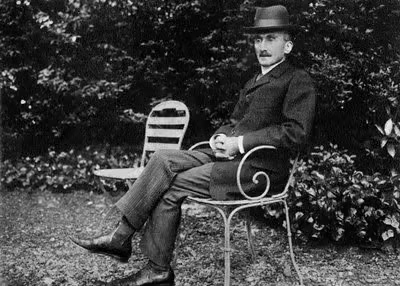
Bergson is one of the great French philosophers of the 20th century, famous for saying that everything is in constant motion. Even when you’re sitting still, your body is making tiny movements in space (not to mention all the stuff that’s going on inside you). The air around you is circulating. The river nearby you is flowing. Even the mountains over there in the distance erode over time, albeit extremely slowly.
This has all kinds of implications, Bergson thinks: we need to abandon any belief in the self as something constant from birth to death; we need to abandon so much as a belief in a life “stage”; we need to stop thinking in terms of (fixed) species, since evolution is continually at work, and no form of life is ever “done”; and we need to reduce our confidence in reason, which so frequently gets it wrong about things, seeing stasis where there is only change.
One lovely illustration of that comes from Zeno. Let’s say you shoot an arrow into the bullseye of a target. When it gets there, it’s stationary. When it’s about to leave the bow, it’s stationary. And at any moment along its route it’s stationary. So, asks Zeno, when does it actually move?
For Bergson, this epitomizes the way our rational minds foolishly picture change: namely, as a series of freeze-frames. When we look at a photo album, we wrongly imagine that life really is like that—that a lifespan is made up of instants, in which nothing is moving or changing. But this is a mistake: all of the people in those photos were in motion at the time, as was everything around them. Photographs are deceptive, because there are no instants. And Zeno’s arrow is never stationary, because nothing is ever standing still. The intellect has it all wrong about motion.
That doesn’t mean the intellect is entirely useless; on the contrary, if you want to get stuff done, the best you can do is set reason to work. (“Of the altogether practical character of this operation there is no possible doubt.”) Science is fantastic for delivering “news we can use.” But if we want to see the deeper truth about the world—the world in all its glory, rather than a world simplified for the purposes of calculation—we need to dive into our “intuition.”
Once you get Bergson’s point about movement, he believes, you’ll never see anything the same way again. Instead you’ll see everything in constant, glorious motion. And you’ll attend to the fascinating differences between things—two leaves on the same tree, two chairs in the same room, even the same musical note played twice in succession. (“Every sensation,” writes Bergson, “is altered by repetition.”) And you’ll try to do justice to that glorious variety by being yourself, rather than striving to conform ( “the greater part of the time,” he laments, “we live outside ourselves”).
How does all this work? Does it all ring true? Can we prove it, or do we just have to feel it? Our guest will help us answer those questions: it’s Barry Allen from McMaster University, and author of Living in Time: The Philosophy of Henri Bergson.