
A Blog Without Qualities?

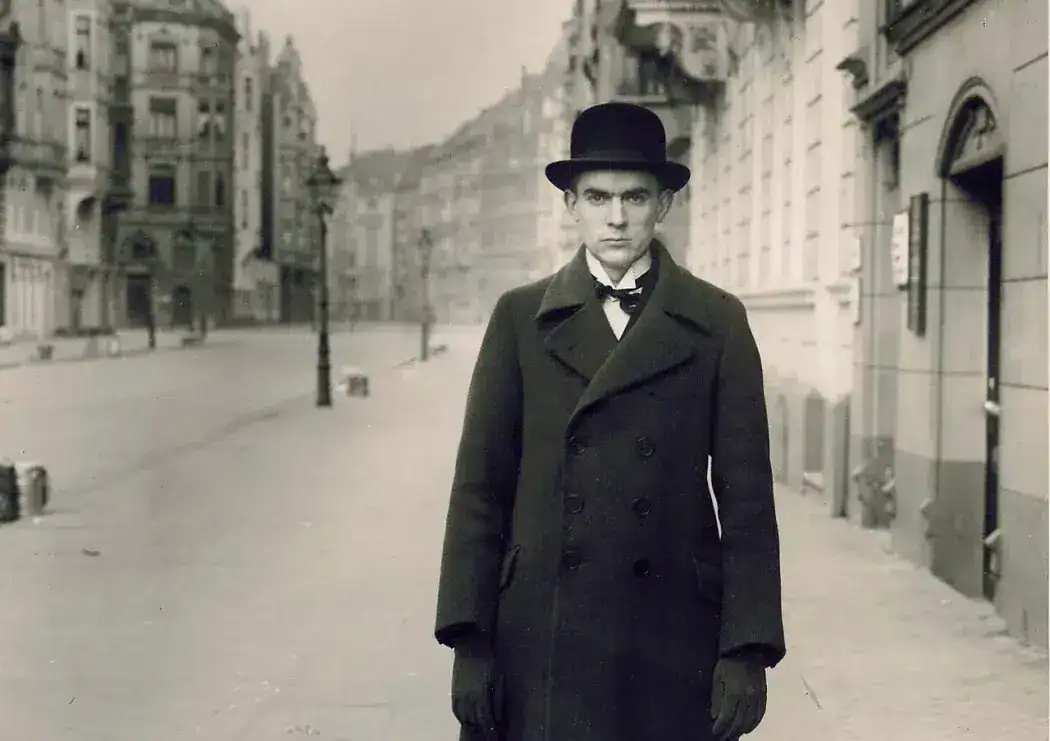
Robert Musil was an Austrian novelist writing in the 1920s and 30s. He’s most famous for a book called The Man Without Qualities, one of the most philosophical (and brilliant) novels of all time. In it, the central characters are busy planning a big anniversary celebration for the German Kaiser and the Austrian emperor. But the novel takes place in 1913, so by the time the anniversary rolls around, World War I will be underway. In other words, their whole activity is pointless—which makes the novel hilariously funny.
The protagonist is a fascinating fellow named Ulrich, who has many deep and cynical thoughts to offer us—for example, reason is reductive, values keep changing, the unified self is an illusion—and who also thinks we should change the way we live based on all these insights. We can’t just trust our culture to tell us how to live, he suggests, because “in the long run mankind revokes everything it has done, to replace it with something else; what it used to regard as a crime it regards as a virtue, and vice versa.” A few hundred years ago, for example, it was quite OK to send your kids down the mine. Nowadays, fortunately, that is rather frowned upon. In another few hundred, who knows, maybe kids will be mining minerals on Mars.
So we can’t defer to our culture when looking for values to live by. And we also can’t just orient ourselves by the light of reason. Science is the pinnacle of rationalism, and what science does, thinks Ulrich, is to deflate all of our heroic pretensions: “the scientific mind sees kindness only as a special form of egotism; brings emotions into line with glandular secretions…; reduces beauty to… the proper distribution of fatty tissue; graphs the annual statistical curves of births… to show that our most intimate personal decisions are programmed behavior.” So love isn’t real. Emotion isn’t anything more than hormones. Desire isn’t ours. And kindness is selfish. If we’re thinking purely rationally, nothing is good or bad; it’s all just economics and statistics.
All of this means that it makes no sense, on Ulrich’s account, to adopt a way of life either because it’s good (that’s society speaking!) or because it’s sensible (that’s reason speaking!). What should we do instead? One of the alternatives Ulrich proposes is to pick something that hasn’t been tried before. (He discusses a kind of experimental living, “trying out the best ways of being a human being and discovering new ones,” “opening up some new experience of life.”) On this model, you’re not just following society’s rhythm, and you’re not even dancing to the beat of your own drum. Instead, you’re looking around to see what hasn’t been tried so far. When you spot a gap, you say “I’ll do that—it’s never been done!” Succeed or fail, you’ll have given the rest of us an interesting example, either to follow or to avoid.
Another of Ulrich’s ideas is to live with “punctured seriousness”: “One probably had to tackle everything one wanted to do effectively with the utmost seriousness, even when one knew that in fifty years every experiment would turn out not to have been worthwhile.” “Wouldn’t it be more original to try to live, not as a definite person in a definite world… but… as someone born to change | surrounded by a world created to change…?”
Or we can set about maximizing moments of epiphanic contact with the world, moments where “the world flows into the self,” instead of the self trying greedily to master the world.
All of these are fascinating and powerful visions, and the charismatic Ulrich has a great turn of phrase when presenting them. But how much does Musil want us to believe him? This is a novel, not a treatise. And it recounts not just Ulrich’s adventures but also those of Moosbrugger, a serial killer. Every time we hear about Moosbrugger, it’s as though the novel is reminding us that there are serious dangers to Ulrich’s approach. If we don’t follow some of the norms of morality, how will we know what to avoid doing? And if we don’t give any credence to reason, might we not go off the rails? Isn’t it sometimes important to pick a side, joining forces to defeat evil?
But if Musil doesn’t want us (entirely) to believe Ulrich, what’s the point of the book? We’re going to ask our guest. It’s Bence Nanay from the University of Antwerp, author of a forthcoming book called Philosophy Without Qualities: Robert Musil, the Thinker.