
My Body, My Perception
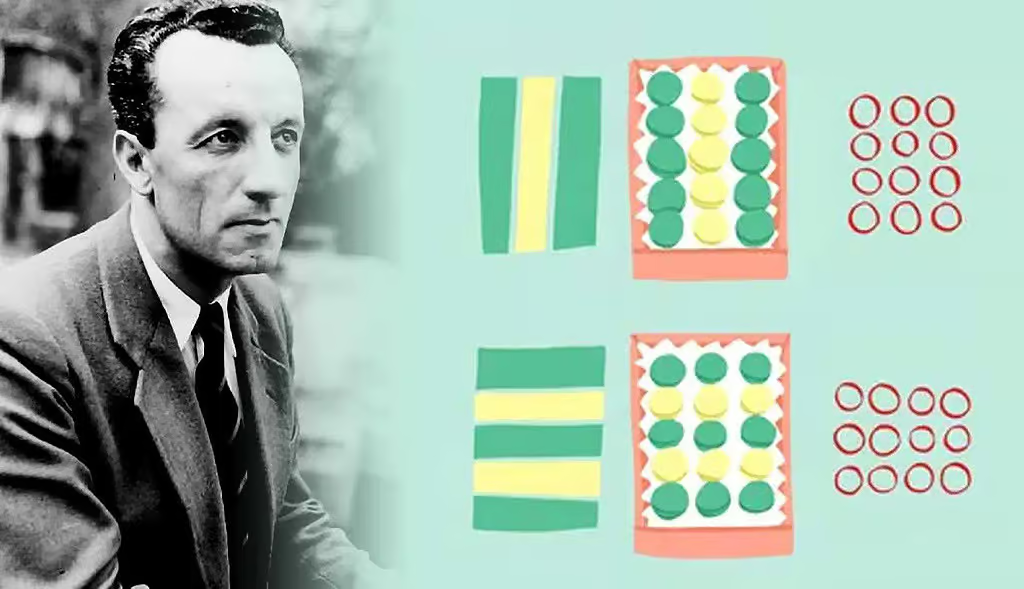
Maurice Merleau-Ponty was a 20th century French philosopher who had all kinds of theories about who we are, how we perceive things, and how important our bodies are to all that. He was a big proponent of Gestalt psychology, a school of thought that says perception is more than just the sum of its parts. For example, when you’re looking at a tree, you don’t just see a bunch of green and brown dots that you painstakingly piece together. You just… see the tree.
We might wonder how this applies to abstract art. Imagine you’re looking at a beautiful painted ceiling in a mosque, and you see a lovely red triangle next to a really cool blue circle. Maybe you even see some green and brown dots! Aren’t you genuinely seeing those dots?
Or again, imagine you’re taking a walk in the woods at dusk and you see something in the bushes. At first you think it’s a bear, but then you realize it’s just a tree stump. Isn’t that a situation where you initially saw some green and brown dots, and only later recognized them as belonging to a tree?
Merleau-Ponty would say “no problem” in both of these cases. In the mosque, you are seeing not just dots but a beautiful ceiling. In the forest, you are seeing not just dots but something you take to be a bear. Your mind can’t help putting things together into some kind of pattern. You can’t escape from meaning-making.
What does all this tell us about the world and our place in it? Well for one thing, it tells us that perception is active. For a long time it was common to imagine that the world just flows into our eyeballs, and all we have to do is sit there and drink it in. The reality is that we have a whole bunch of work to do: we have to keep track of objects as you move around; when an object gets dimmer, we have to keep track of whether it changed, or the lighting changed, or we just shaded your eyes; and then we have to stitch everything together into a unified picture of the world.
All of this reminds us just how important our bodies are—that even when we’re doing philosophy in a disembodied blogspace, we still need our eyes and our fingers. But above all, it reminds us that the world is kind of magical. There’s so much more to the world out there than what we normally notice, caught up as we are in our tasks and projects. Even “the tiniest perceived thing,” says Merleau-Ponty, has aesthetic value; and the task of philosophy is “to reveal the mystery of the world.” Our guest will tell us why—it’s Taylor Carman from Barnard College, author of many books and articles about Merleau-Ponty.