
Discriminating Streets
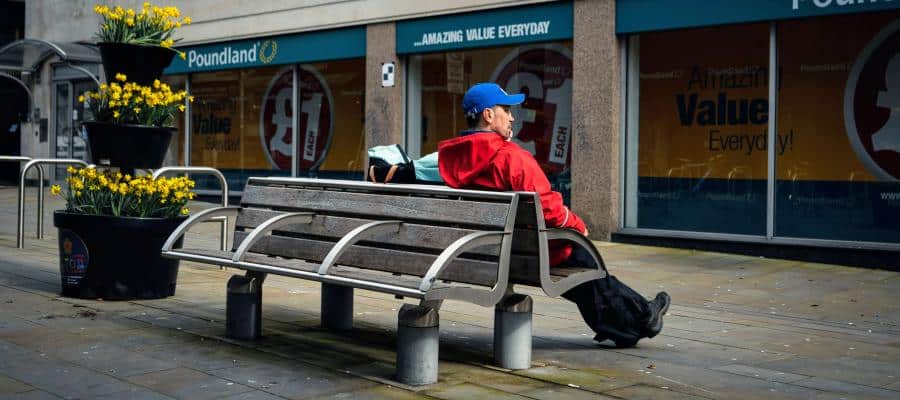
Why is there so much bad urban design? How can we make our streets more welcoming to everyone? Is the perfect city merely a mirage? This week on the show we’re asking whether streets can discriminate, and how we can design our cities so they are more just.
Why is there so much bad urban design? How can we make our streets more welcoming to everyone? Is the perfect city merely a mirage? This week on the show we’re asking whether streets can discriminate, and how we can design our cities so they are more just.
Cities are unjust in all sorts of ways. Many are still segregated because of redlining, where the government deliberately denied loans to black families in order to keep them out of white neighborhoods. Homeless people struggle with hostile architecture that’s deliberately designed to prevent them from lying down to rest. Many poor people live in food deserts, neighborhoods where they can’t access healthy and affordable groceries. Even though the Americans with Disabilities Act was passed 30 years ago, many buildings remain inaccessible to disabled people.
What should we do about this? One simple idea is that we should hire some architects to design the ideal city, then build it. But figuring out how to implement this plan is staggeringly complex!
The ideal city might just be beyond our reach. If a measure is good for people, but bad for business, it will be hard to pass. Sometimes, everyone agrees that an improvement is great in principle, but homeowners balk at having it in their own backyards; this is often true of needle exchanges, metro lines, sewage treatment plants… even affordable housing. Why envision an ideal if you can never attain it in practice?
Idealists might reply that it’s important to have something to work toward, even if you never achieve it. But there are other problems. How can any small group of architects know what an ideal city looks like? They might get tangled in their own ignorance and prejudice, ignoring crucial possibilities. For example, they might try to invent a perfectly efficient road system, forgetting that public transportation is more affordable and better for the environment. Or they might design a bunch of single-family homes, without even considering the possibility of communal living.
Architects could try to solve the problem by asking diverse groups of city stakeholders what they want. But then a new problem arises: how will they balance everybody’s concerns? If a city needs affordable housing, public transit, beautiful parks, desegregated neighborhoods, and environmentally-friendly design, how will they know what to prioritize? They’ll either need to adopt a systematic theory, or find some other way of settling disagreements.
One last problem with building toward the ideal city is that our current cities have non-ideal features that are costly to dismantle. Highways that were built to destroy black neighborhoods, or cut them off from the rest of the city, still exist today. In an ideal world, they would never have been built in the first place, but dismantling them is expensive to taxpayers and bad for the environment. (If a piece of architecture is still causing serious present-day injustice, destroying and replacing it might be worth the cost, but we’ll need to weigh the trade-offs.)
So, what does urban justice look like? I’m looking forward to gaining a clearer vision in this week’s discussion with guest Shane Epting.
Photo by Shengpengpeng Cai on Unsplash
Listen to the Episode
No related shows found.