“Beautiful” and the Metaphysics of Beauty
People argue whether beauty is objective or subjective. But what would it mean for it…


People argue whether beauty is objective or subjective. But what would it mean for it…
Here are what I take to be some deep truths about philosophy. First philosophy currently is, has always been, and probably will always be a fragmented discipline. There is really no one thing that philosophers do and not much that unifies the mulipliticity of different things that philosophers do. Philosophy is what people who call themselves philosophers do. And people who call themselves philosophers do all sorts of things.

We’re back in the studio after our trip to DC. DC was great fun and…
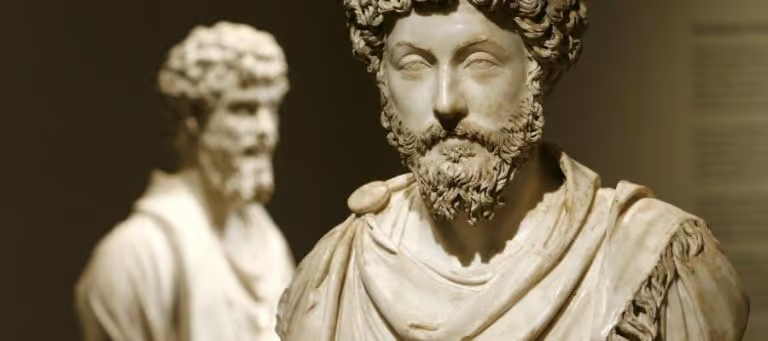
I don’t profess to fully understand stoicism. I never read much stoic philosophy before now. I did read the Enchiridion by Epictetus as an ndergraduate, but frankly, it left me pretty cold at the time. I couldn’t relate to it at all. Maybe that’s because as a young man, I was pretty non-stoical.

Our limited forray into podcasting via the Stanford Itunes experiment has been a great success. …

The imagination is a pretty cool thing, but also in some ways puzzling. On the one hand, it seems sometimes to give us cognitive acquaintance with real possibilities. A kid from Hope Arkansas imagines growing up to be president of the United States. And lo and behold that kid does grow up to be president. So some of the things that we merely imagine are really possible. And it’s arguable that the imagination teaches us that they are possible.

I don’t really have anything to recommend, per se, but the weird assortment of matter…
Let me say a few things about the value of truth to get today’s conversation started. First, it seems to me that truth is a very good thing. We think science is grand because it reveals deeper and deeper truths about nature. We typically would much prefer to know and be told the truth than to be told a lie. We hardly ever say to ourselves, “I know that false, but I choose to believe it anyway.” To believe something is to believe it’s true.

Aristotle’s characterization of man as the rational animal will seem flattering, if you think about many behaviors we people engage in regularly. While many people in our society are overworked, short on knowledge, and pressed for time, many of us take time out to watch unusually tall individuals get together in groups to hurl a spherical object through a suspended ring. These tall individuals get dressed in outfits with shiny colors and are glorified for the ability to hurl the sphere through the ring. Whole buildings fill up with people who want to watch the hurling of the sphere and pay good money to do so, often sacrificing the valuable time and money they could have used for more sensible things like food and shelter.
We at Philosophy Talk are proud to have offered something uniquely valuable to the radio…

Stand-up comics often bemoan the fact that “everyone’s a f**king comedian!”, and its true: every one appreciates humor (to some degree) and most are capable of generating some form of spontaneous humor. But this very ubiquity makes humor harder, rather than easier, to understand formally, since humor assumes many guises and operates with subtle differences in myriad contexts.

Why do birds fly? Because they don’t like to walk. That was a joke made up by my granddaughter Erin when she was three. She had learned the form of one kind of joke, without quite mastering the part about being funny. She made up jokes non-stop for about three hours, most of them even less funny than the above, regaling those trapped in the car with her, while turning blue from laughing so hard at them herself.

We all carry around two self-conceptions. Imagine having amnesia. The amnesiac knows whose mouth he has to put food in to relieve his hunger; he knows that things detected visually are things that he sees; he knows that the aches he feels belong to his body. So, in one sense, he knows who he is; his most basic self-concept, as the person whose pains he feel, whose hunger he can relieve by eating, whose environment he learn about by the deliverance of sense, remains.

I don’t think the legislature is morally or rationally obligated to advance legislation only on the basis of public reasons. One can, though, read the non-establishment clause of the constitution as requiring legislation to have a basis in public reason. But whatever the precise legalities, I think there are very strong practical reasons for the legislature to refrain from adopting any narrowly sectarian rationale for its laws.
You now have three ways to listen to past episodes of Philosophy Talk. As always, …

I have to admit that I mostly applaud the scientific overthrow of cultutral formations based on illusion, superstition, error, authority and the like. Still, I think that the “destructive” side of science is too often overlooked or greeted with a shrug by those like me who fully and completely endorse the canons of scientific rationality. It is not obvious to me that our ability to reform our culture and society can keep pace with the ability to undermine archaic forms.