Philosophers’ Corner

  • Humanism

    Here are the fifteen points of the original AHA Manifesto — for later revisions, see their website. FIRST: Religious humanists regard the universe as self-existing and not created. SECOND: Humanism believes that man is a part of nature and that he has emerged as a result of a continuous process. THIRD: Holding an organic view of life, humanists find that the traditional dualism of mind and body must be rejected.

  • Bodies for Sale

    Our topic this week is Bodies for Sale.The buying and selling of vital organs is…

  • William James

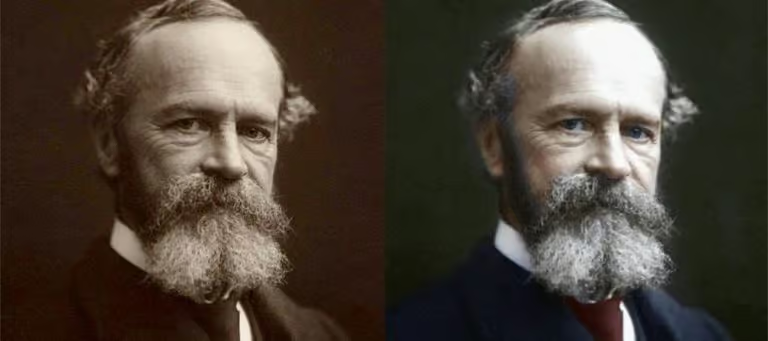
    James was a precursor to contemporary philosophers, in that he was really a cognitive scientist / philosopher. He was in both departments at Harvard. His two-volume PRINCIPLES OF PSYCHOLOGY was the bible of psychologists at the time. It still makes fascinating and rewarding reading. His book THE VARIETIES OF RELIGIOUS EXPERIENCE, which is a combination of philosophy, psychology and sociology, virtually originated the serious study of the psychology of religion.

  • Social Reality

    Our  topic this week is social realities.  I must admit that when I first brought…

  • The Irrationality of Human Decision Making

    Decades of psychological research has shown, though, that although philosophers may be paragons of rationality — ahem, ahen – in fact most people (and probably most philosophers too) are pretty irrational in their decision-making. People go wrong at every turn. We aren’t so good at figuring out what we want. Our preferences aren’t very stable or coherent. We’re bad at assessing risks and reward. You name it, when it comes to decision making, we’re bad at it.

  • Loyalty

    Loyalty binds people together. Friendships, marriages, even nations are built on loyalty. Try imagining a person who has no loyalty whatsoever to anything or anyone. Such a person would be friendless, loveless, nationless. She would feel no devotion to any higher cause or principle – like truth or justice. She would not even be a fan of any sports team. A life like that would be empty, devoid of many of the things that make us fully human.

  • Rawls on Justice

    One of the most influential political philosophers of the 20th century, John Rawls articulated a vision of a liberal state, focused on justice. Continuing the ideas of Locke and others, Rawls maintains the best way to think of the state is as the result of a social contract.

  • Democracy and the Press

    Freedom of the Press was important to the Founding Fathers; it’s right there in the first amendment: “Congress shall make no law respecting an establishment of religion, or prohibiting the free exercise thereof; or abridging the freedom of speech, or of the press; or the right of the people peaceably to assemble, and to petition the Government for a redress of grievances.” Still, the founding fathers had a lot of ideas.

  • What are Human Rights?

    Our question this week is “What are human rights?” The American declaration of independence offers a compelling answer to that question so its the first place one might think to look of for a characterization of human rights. It says in what I personally find stirring language that “All men are created equal … they are endowed by their Creator with certain unalienable Rights … among these are Life, Liberty and the pursuit of Happiness.”

  • Corporations as Persons

    Groups of people, and corporations too, can do a number of things that people do. They can make promises, tell lies, incur debt, and the like. Perhaps the concept of corporations and other collections of human beings as fictional persons simply recognizes that fact. Groups of people were issuing statements, true and untrue, buying and renting buildings, going into debt, and stuff like that long before the law or Supreme Court came into it.

  • Hannah Arendt

    All the philosophers we talk about have interesting thoughts. But many of them have relatively dull lives. Hannah Arendt is not one of them. She led a very interesting life, and the events in her life had a lot to do with her philosophy.

  • Culture and Mental Illness

    Koro is mental disorder, characterized by a debilitating fear that that one’s genitals are retracting into ones body and that once they are fully retracted you will die. You don’t find many instances of in Western societies. But Southwest Asia koro epidemics have been known to break out. There was such an epidemic in 1984-85 in Guangdong, China. And between 997 and 2003 in several different West African nations, there were local outbreaks of koro-like panics.

  • Apologies

    When one hears the word “apology” in a philosophical context, one naturally thinks of Plato’s famous Socratic dialogue, “The Apology”. And then it strikes one that Socrates doesn’t sound all that apologetic. Historically, “apology” often meant “reasoned argument or writing in justification of something”. Nowadays it mostly means “a regretful acknowledgment of an offense or failure”. It’s in this latter sense we are interested in apologies, including apologies in the political sphere, whether sincere or self-serving statements pretending to be expressions of regret.