Author: Kenneth Taylor

  • Too Much Information?

    I can hear someone wondering, “Too much information for what?” To answer that question, we need to go back in time. Some of you will be too young to remember, but once upon a time, if you wanted to find a book, for example, you went to this place called a library. And you searched in this ancient artifact — a thing called a card catalog. The card catalog gave you a number that was assigned to the book. And the books were all shelved in order in dusty old library stack.

  • Derrida and Deconstruction

    Derrida was one of the most widely revered—and widely reviled—thinkers of the mid-to-late twentieth century. Many people in a variety of disciplines—especially in the literary humanities—regard him as an absolutely seminal figure. On the other hand, many philosophers would strongly disagree with that assessment.

  • The Moral Costs of Markets

    Free markets are, on balance, wonderful things, I think. When they’re truly open and free and not monopolized by a few big players, or overly regulated by excessively intrusive governments, markets are amazingly efficient ways of providing people with the things they want and need. They’re the chief engines of economic progress, and are singularly conducive to human happiness. But my enthusiasm for free markets is not unlimited.

  • The Philosophy of History

    There are different ways the word ‘history’ might be defined, so we had better start out by defining our terms. For example, you could define history as the sum total of past events. But that’s not how historians or even philosophers of history would define it. The problem with that definition is that it encompasses every single event that has so far happened in the Universe – from the big bang to the emergence of humankind and everything in between. We do sometimes talk about history in this broad and inclusive sense, but that’s not what we’re talking about today.

  • The Power of Thought

    Human thought is an amazing thing. It has given us science, literature, morality, and last — but certainly not least — philosophy. Thought even has the power to create new realities. And I’m not primarily thinking of literature and the arts or even of technology. I’m thinking of the entire social world. Every size social reality from clubs to nations and every thing in between is a creation of the human mind, of human thought in particular. They all exist because we simply think them into existence.

  • Reading, Narrative, and the Self

    This week’s topic is Reading, Narrative, and the Self. I suppose everybody has a pretty good idea of what each of those things, taken individually, means. Reading is something that most people do. A good narrative — or story, to use a less fancy term — is something most people enjoy. And a self is something everybody has. But I think I need to explain what reading, narrative, and the self have to do with each other.

  • The Occult Philosophy

    During the Renaissance, things like Alchemy, Astrology, White Magic, Hermeticism, Cabala, Numerology were intensely studied by some of the best minds in Europe. Literature from that period is often rife with references to the occult. The works of Shakespeare are a prime example.

  • Gandhi as Philosopher

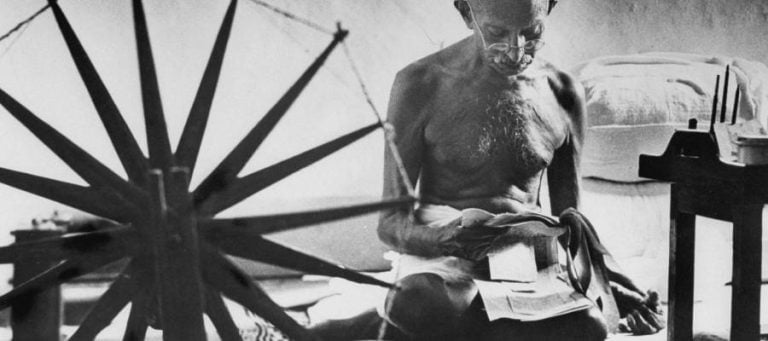
    Most revolutionaries – or whatever exactly Gandhi was – are utterly and inalterably convinced that they have morality wholly on their side. Though Gandhi was a deeply principled man who constantly strove to be on the side of morality, he wasn’t big on claiming to know the moral truth. And he actually thought that the ethical condemnation of one’s opponent was itself a form of violence. And he rejected all forms of violence.

  • Philosophy for the Young: Corrupting or Empowering?

    The charge that philosophy actually corrupts the young is nearly a old as philosophy itself. Over 2,400 years ago, in one of the most famous trials of all times, Socrates, one the founding fathers of Philosophy, was condemned to death for corrupting the youth of Athens. Now I have no doubt the young men who followed Socrates all around Athens being tutored by him were royal pains for the authorities. But Socrates didn’t corrupt the young; he empowered the young.

  • Self Deception

    Self-deception is rampant in human affairs. And although too much self-deception is probably a bad thing, a little self-deception may be just what a person needs to get through the day. One should never underestimate the power of positive illusions. For example, psychological studies show that people who are overly optimistic about their own abilities often have enhanced motivation, which enables them to do better in the face of challenges than people with more realistic assessments of their own talents.

  • Bodies for Sale

    Our topic this week is Bodies for Sale.The buying and selling of vital organs is…

  • Social Reality

    Our  topic this week is social realities.  I must admit that when I first brought…

  • The Irrationality of Human Decision Making

    Decades of psychological research has shown, though, that although philosophers may be paragons of rationality — ahem, ahen – in fact most people (and probably most philosophers too) are pretty irrational in their decision-making. People go wrong at every turn. We aren’t so good at figuring out what we want. Our preferences aren’t very stable or coherent. We’re bad at assessing risks and reward. You name it, when it comes to decision making, we’re bad at it.

  • Loyalty

    Loyalty binds people together. Friendships, marriages, even nations are built on loyalty. Try imagining a person who has no loyalty whatsoever to anything or anyone. Such a person would be friendless, loveless, nationless. She would feel no devotion to any higher cause or principle – like truth or justice. She would not even be a fan of any sports team. A life like that would be empty, devoid of many of the things that make us fully human.

  • What are Human Rights?

    Our question this week is “What are human rights?” The American declaration of independence offers a compelling answer to that question so its the first place one might think to look of for a characterization of human rights. It says in what I personally find stirring language that “All men are created equal … they are endowed by their Creator with certain unalienable Rights … among these are Life, Liberty and the pursuit of Happiness.”