
Author: David Livingstone Smith

  • Sexy Beasts

    Love it or hate it, Freud’s decades long exploration into the nature and power of human sexuality is something that any philosopher of sex needs to contend with. I turn to this curiously under-explored region of the philosophical landscape in the final installment of my Philosophical Freud series.

  • Mind the Gaps!

    In this installment of my series on Freud as a philosopher, I explain how Freud arrived at the view that mental states are brain states, that mental processes are unconscious, that we have only indirect access to our own minds, and that introspection is an inadequate tool for exploring the mind.

  • The Puzzle of the Unconscious

    Most of Freud’s contemporaries believed that the human mind was all conscious. Historians of ideas who write about the development of psychology often get Freud’s original contribution wrong because they don’t attend carefully enough to what was meant by terms like “subconscious mind” and “unconscious states.”

  • Freud’s Philosophical Challenges

    Last month, I started a new series of essays on Freud as a philosopher. This month, I want to lay out some of the perplexing philosophical issues that Freud and his intellectual community were confronted with towards the end of the nineteenth century, and how they grappled with them.

  • Philosophical Freud

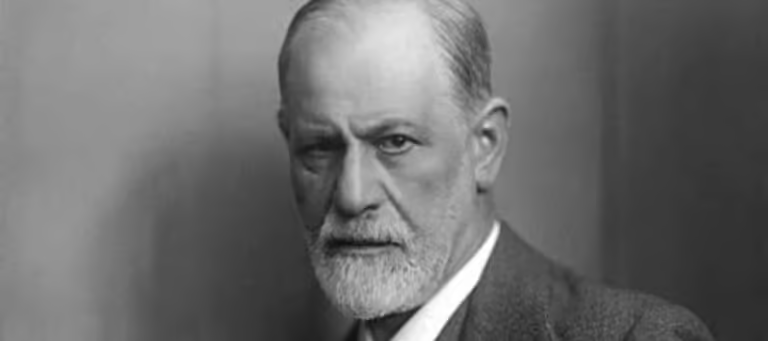
    Most people think of Freud as a psychologist rather than as a philosopher. And worse, they often think of his work as achingly passé and of the man as a pseudo-scientist at best, and a charlatan at worst. But I think that Freud was a great philosopher who still has a lot to teach us about ourselves.

  • Anti-Semitism 101

    Many Americans seem have a hard time grasping the idea of Jews as a race because they think of race mainly in terms of the color of a person’s skin. So they tend to frame anti-Semitic violence as attacks on the Jewish faith, rather than racist terror.

  • They’re Only Lobsters

    The Great Chain of Being—the notion that the biosphere is partitioned into ranks, with humans at the top, and every other organism at some inferior position—is a way of thinking that’s incredibly difficult, if not impossible, to dislodge. Most of us have a strong conviction that it’s true, but we don’t have a clue why we think that.

  • Lessons from Lobsters

    At a gut level, most of us consider humans’ lives far more significant than lobsters’ lives. But does this intuition just reveal a cognitive bias most of us have? Are there any good arguments to support the idea that lobster lives matter less?

  • Failing Successfully

    To say that a person can fail successfully sounds really weird. To succeed at something is to achieve some goal that you’re aiming at, and to fail at something is to not achieve a goal that you were trying to achieve. But this isn’t the end of the story.

  • Enlightenment Peddlers

    Because the IDW thrives on consumer popularity rather than peer scrutiny, it doesn’t have mechanisms for sorting out the worthwhile stuff from the trash. The burden is on the consumer to decide to what extent the dark web pundits have something valuable to offer or to what extent they’re “enlightenment peddlers.”

  • An Antidote to Bullshit

    One of the problems with the Intellectual Dark Web, in common with other online, non-academic outlets for discussing big ideas, is that it doesn’t have have any effective mechanisms for intellectual quality control. With this in mind, I’ve assembled a twelve-point checklist for evaluating what you might come across on the IDW and beyond.

  • Dark Knowledge: A User’s Guide

    The Intellectual Dark Web has developed into an academic counterculture, with an enormous and rapidly growing fan base. While it’s wonderful that there are sites where taken-for-granted orthodoxies can be challenged in accessible ways, I have grave concerns about the way that this movement is unfolding.

  • Dark Knowledge?

    A new intellectual counterculture has been coalescing in virtual space. The intellectual dark web is billed as island of free speech in a sea of dogma: a place where bold, creative thinkers can discuss their ideas at length and without censure by the mainstream media or suppression by a hidebound academic establishment.

  • Stories To Think With

    Philosophers are notorious for expressing themselves in a dry and, let’s face it, boring way. But this isn’t the only way to do philosophy. There are some great philosophical stories that delight and engage, rather than putting the reader to sleep.

  • Fatal Attraction

    Regular readers know that I have a longstanding interest in the appeal of Donald Trump, and the social and psychological forces that catapulted him into power. What is this personal magnetism certain people who rise to leadership positions seem to exude that many find irresistible?

  • The Puzzle of Possibility

    Now that we’ve launched into 2018, many of us are wondering what the year ahead has in store. What might happen, to you, your loved ones, the nation or the world as a whole? There seem to be a lot of possibilities, some to be hoped for and others to be feared.