Author: Antonia Peacocke

  • Gaining Knowledge without Learning

    You can come to know something by observation, by testimony, or by working it out in your head. But there’s another way of knowing something that doesn’t involve learning because it doesn’t involve coming to know a pre-existing fact. This way of knowing arises when you do something intentionally.
  • Say it Enough, They’ll Believe It

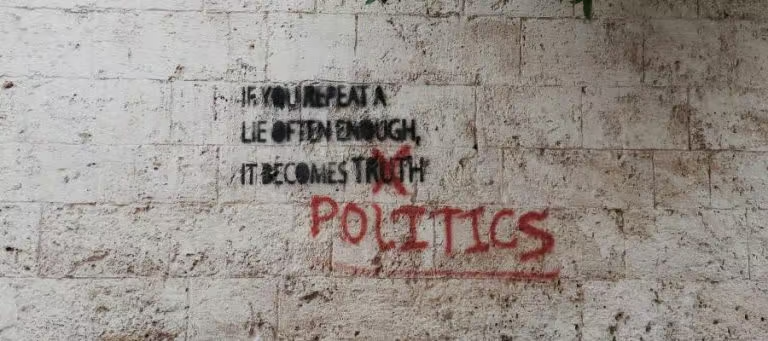
    If you repeat something often enough, people are more likely to believe it. That’s a phenomenon called the illusory truth effect. It can happen with smart people, and even when the statement is already known to be false. So why does repeating something make people more likely to believe it?

  • What Would We Lose If We Had No Art?

    Think about the art you’ve enjoyed in your life: the novels, the television, the music, the poetry, the sculpture, the paintings—the list goes on. Now try to imagine a scenario in which none of this art had ever been made. What would we lose in a world like this?

  • Philosophy for the Apocalypse

    Several philosophers have recently remarked that it’s hard to do philosophy in the face of the apocalypse. Philosophy is sometimes seen as a special treat for the fattest of times, and an utterly impractical hobby in the leanest. Not only is this idea false, it’s also self-defeating.

  • Another Reason Zoom Is So Draining

    There is a particular dead-eyed, mind-numbing exhaustion I feel at the end of every video meeting I’ve ever attended. Zoom is exhausting for many reasons, but the most important one is that it is missing a fundamental piece of social interaction—joint attention.

  • The Value of Metaphor in a Pandemic

    Metaphors are some of the greatest tools of human expression. They can have great emotional power and can unite us in how we conceptualize the world. But we don’t yet have the rich and transformative ways of thinking about the global pandemic that a good metaphor could provide.

  • Your Racist Mental Habits

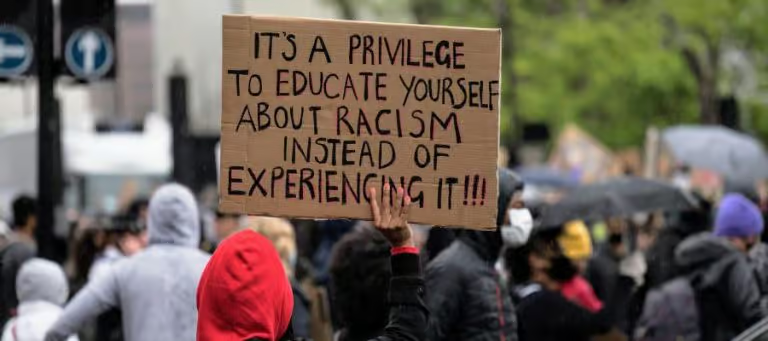
    A flurry of studies have shown that even self-avowed non-racists can still be implicitly biased against black people. There is not much agreement about how to think about the nature of this ‘implicit’ phenomenon, but one possibility is that our racist biases are best understood as a perceptual habit.

  • Narrative Burnout

    When I’ve felt depressed or isolated in the past, fiction has been a source of escape and catharsis. But during this lockdown, I’ve been struggling with stories. I’ve been streaming less television, reading fewer novels, and watching fewer movies than ever before. I’ve got a case of “narrative burnout.”

  • Proust and Social Distance

    Marcel Proust once wrote about a hypothetical sufferer of “spiritual depression” who has no physical incapacity but lacks the will to act. If you’ve been walled up at home for weeks, you might suffer from this type of mental languor. A good book may be the jolt you need to spur you into new and creative thoughts.

  • Thinking and Mental Action

    Sometimes your mind wanders, and sometimes your thoughts focus on a specific topic. When your mind wanders, you’re not really doing much, but when you focus, you’re engaged in a specific mental action; you control what you’re thinking about. So what is this mental control?

  • Am I in Everything I Imagine?

    Imagination is one way we can get outside our own skin and get a sense of other people’s lives. But when we take imaginative travels, must we always imagine ourselves being part of these other worlds—or can we simply imagine these worlds without including ourselves in them?

  • What Is a “Vivid” Mental Image?

    What is a mental image? You might say it’s like a picture that belongs to the “mind’s eye.” Or you might say it’s like a visual experience, only less vivid. But what, exactly, does it mean for mental images to be less vivid than genuine visual experiences of the world?

  • How Much Thought Is Inactive?

    How much of your mental life is intentional action? And how much of it consists of inaction, not doing anything at all? To answer that, we need to get clear on what we mean by “intentional action” and “inaction.”

  • Why Not Change Your Core Self? Part II

    If you could snap your fingers and all your tastes and preferences would change overnight, would you do it? In my last post, I considered two kinds of answer to this question, but neither seemed satisfying, because neither gave us any reason not to make the change.

  • Why Not Change Your Core Self?

    Let’s say you could snap your fingers and all your various tastes and aesthetic preferences changed overnight. You would appreciate different foods, you would like different books, you would prefer different colors and clothing styles and jokes. Would you do it? I’m guessing your answer is ‘no.’

  • What’s In a Picture?

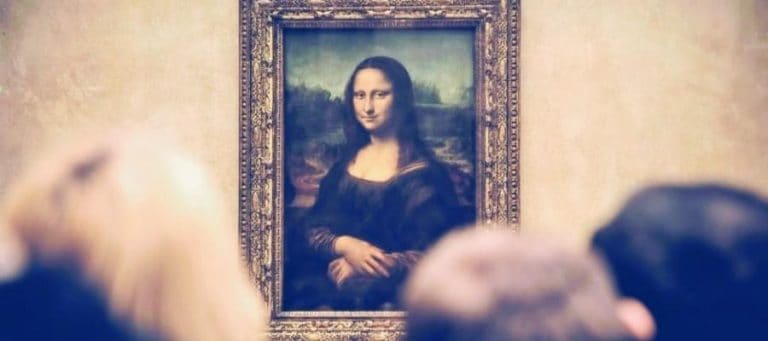
    Pictures are so ubiquitous they often fade into the background of conscious experience. But there’s a special magic to pictures. When you see one, you don’t only see some colors on a surface, some marks jumbled together here and there; you see things—maybe bottles, people, or books—in the picture.