
Truth & Other Fictions
Some people think Aristotle basically had it right when he said, “To say of what is that it is, and of what is not that it is not, is true”. I take it he meant that, for example, if I say this apple is red, what I say is true if this apple actually has the property of being red. If I say this apple is not red, what I say is true if this apple does not have the property of being red. What more is there to say?
We’ve titled this week’s show “Truth – and Other Fictions.” Now that’s a provocative title, since truth is usually opposed to fiction. So why don’t we break it down and start with truth.
Some people think Aristotle basically had it right when he said, “To say of what is that it is, and of what is not that it is not, is true”. I take it he meant that, for example, if I say this apple is red, what I say is true if this apple actually has the property of being red. If I say this apple is not red, what I say is true if this apple does not have the property of being red. What more is there to say?
Well, that’s all about what’s said or spoken. But what about unspoken truths? For instance, did a dinosaur sleep on this spot 60 million years ago? That and a zillion others things like it would be true or false even if no one were ever around to talk about it.
This is starting to sound like Truth with a capital ‘T’ — truth as a thing rather than as a mere property of assertions. There’s everything that happens in the world, and then, hovering over all of that in some strange way, there is the Truth. But do we need Truth with a capital ‘T’? What’s wrong with Aristotle’s focus on truth as a property that beliefs and assertions can have?
We may not need truth with a capital ‘T’, but surely we do need more than apples and colors in the world. We need more than individual objects and their simple properties. There are laws of nature … and truths about morality, and God, and numbers. All kinds of stuff. And Aristotle doesn’t tell us what it means for all those truths to be true.
Maybe that’s no big problem. That’s why philosophers these days talk more about facts. If I say such and such, then what I say is true if there is a fact that’s such and such. I’ll revise the definition. Assertions and beliefs are true if they correspond to the facts. But now in addition to objects having properties, you’ve got a whole world of facts — whatever those might be. And that’s way more complicated than Aristotle’s original idea.
So what if we forget about facts? Here’s the simple point I think Aristotle was making: It’s true that the apple is red if the apple is red. It’s true that E=mc2 if E=mc2. To say that something is true, is just to say that thing. That may not sound terribly informative, but that’s why people call it the deflationary theory. Truth is just a compliment we pay to sentences we are prepared to assert.
Simple as that sounds, though, as a theory it doesn’t work. In fact, it leads to contradictions, something the Greeks worried about too. Let’s say I say, “My statement is not true”. Now, on the deflationist’s formula, it’s true that my statement is not true if my statement is not true. But if my statement is NOT true, it can’t also be true! So we get the Liar’s Paradox. We could try to ignore that problem and just avoiding saying stupid things like “My statement is not true,” but then it seems we’re just pretending that we have a good theory of truth. It’s almost as though there’s really no such thing as truth — it’s just a fiction we find useful at times.
Which brings us full circle to the title of the show — Truth and Other Fictions. The big question, then, is whether there really is something called The Truth? Or is the idea of truth itself a fiction, something we just make up because it’s convenient?
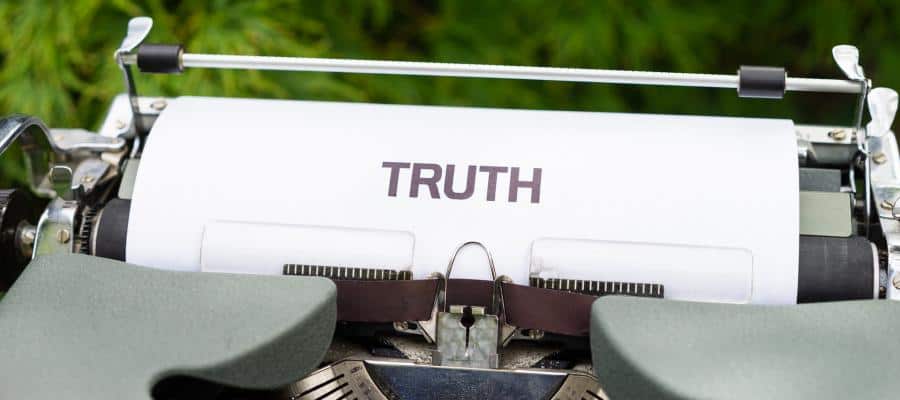
Photo by Markus Winkler on Unsplash