
Separation of Powers and the Charismatic Presidency
I wrote this entry when our Separation of Powers episode originally aired. I’m moving it up to the top since that episode is about to air again. I welcome further discussion. KT
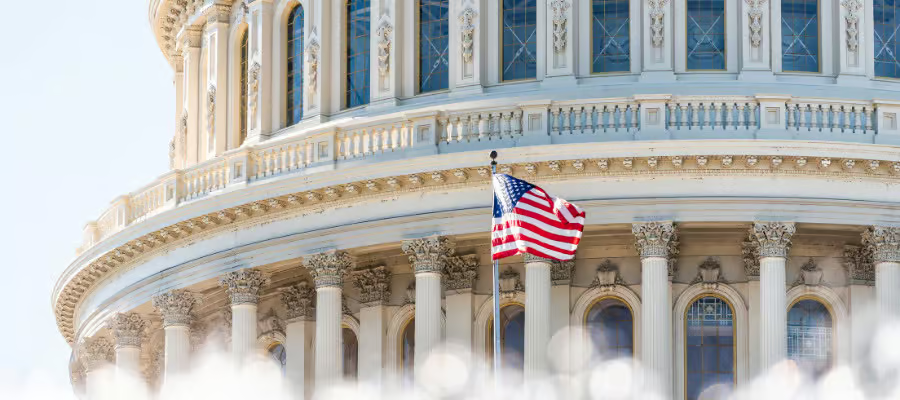
Later this morning, our episode “Power out of Balance? Exploring the Separation of Powers” will air. This episode was recorded back in July [of 2006] on Capitol Hill in a tiny little room in the basement of the building. Though the audience was small, they were quite engaged and engaging. We were there at the invitation of Congresswoman Anna Eshoo. We are most grateful to Congresswoman Eshoo for being our sponsor and for participating in the program. Our main guest during the program was Kathleen Sullivan. Kathleen was a terrific guest. They say that if the Democrats get to make a Supreme Court appointment anytime soon, Kathleen is high on the list of potential nominees. I can see why. She is very smart, very articulate, and has really deep knowledge of constitutional law. It was a pleasure having her as our guest. I’ve invited her to guest blog on the topic of separation of powers. But since she is a very busy woman, who knows if she’ll take up the invitation. Anyway, I hope you enjoy listening to the program.
In the remainder of this post, I’ll ruminate, just a little bit, on what’s become of the separation of powers in our time.
The founding fathers in their considerable wisdom took the separation of powers to be a “bulwark of liberty.” Indeed, they took the concentration of power into a single agency to be the very definition of tyranny. Conversely, they apparently believed that not just the formal separation of powers among the branches of the federal government and between the federal and state governments, but also what might be called the substantive sepration of political interests to which the formally separated branches are asnwerable, was the key to a government that was unlikely to ever devolve into tyranny. By formally dividing the powers of government among competing branches and among the several states and the federal government and by making the various branches and and levels of government answerable to society in different ways that reflect different and competing constellations of “parts, interests, and classes of citizens,” Madison seemed to believe, the government would incapable of trampling the rights of the citizens. Moreover, no ad hoc constellation of citizens would be able to seize the powers of government and deploy them against the fundamental civil liberties of the remainder of the citizenry.
It’s a nice sounding story, but I think the founders vastly overestimated the degree to which the formal separation of powers, even when conjoined with a substantive separation of interests, might suffice, on its own, to guard against tyranny and to protect civil liberties. This isn’t a startling new insight, of course. Jefferson saw the limits of merely procedural safe-guards to liberty right away and rightly insisted that an enumerated Bill of Rights be added to the constitution.
The founders lacked prescience on two particular fronts that have come to define the American political scene and that jointly conspire to make the formal separation of powers far less of a bulwark against tyranny than they imagined. First, the founding fathers failed to anticipate what I’ll call the charismatic nature of the Presidency. Second, they failed to anticipate the extent to which partisan loyalty would come to trump institutional loyalty within the legislature. Let’s consider the second thing first. The founders seemed to believe that Congress would be extremely jealous of its prerogatives and would strongly resist the encroachment of the executive upon its domain. To some extent that has been true over the course of our history but mostly, it seems, at least to my non-expert eye, that Congress mostly resists encroachment when different parties control the executive and the legislative branches. When a single party controls both the executive and the legislative, partisan loyalty seems almost always to trump institutional loyalty. The current Republican House and Senate have been almost supine in their obedience to the will of the President.
Why should that be? The answer has, I think, to do with the charismatic nature of the presidency in a time of modern communications. I’m not talking about the personal charisma of the any particular president. Many occupants of that office, including the current occupant, seem to me to be seriously charisma challenged. Indeed, it’s something of a mystery how such a charismatic office has managed to have so many charisma challenged occupants.
By calling the presidency — the office, not the occupant — charismatic, I’m thinking about the power of the president to set the national agenda, to command national attention. The president’s formal powers aren’t really all that great in comparison with Congress. But the charismatic reach of the presidency far outstrips the charismatic reach of Congress. It’s not just that the president speaks with a single (if sometimes incoherent and conflicted voice), while the legislature is a cacophony of competing voices. It’s also the focus of the national media on every word and gesture of the president compared to its fairly shallow and desultory focus on the Congress. And it’s also the fact that we spend millions and millions on seemingly endless presidential campaigns that seem largely designed to manufacture of exploit competing personality cults rather than competing substantive agendas for action.
If you’re an obscure member of congress trying to rise to greater national prominence, it’s pretty hard to compete with the charisma of the presidency merely in the name of safeguarding the prerogatives of the legislature. After all, if you are a member of the president’s party you probably want most of what the president wants. So why insists on the prerogatives of the legislature?
On the other hand, if your a member of the opposition party — whether in the minority or the majority — you do have some rationale, often considerable rationale — for resisting. But not really because you are jealous as such of the prerogatives of your branch. It’s rather because you have allegiance to the competing party. Still when we have divided government, we get at least the shadow of what the Founders were after, because then we have not just the formal separation of powers but also the substantive diversion of interests that is nicely aligned with the formal separation of powers.
Of course, I haven’t touched on the subject of the Supreme Court. But Kathleen Sullivan has a great deal to say about the court and its role in maintaining a balance between the executive and the legislative branches. I won’t try to summarize what she has to say here. Instead, I’ll urge you to check out the show — which is about to begin right now.
I’m going to tune in via KALW’s website. You could do the same.