
Sanctuary Cities
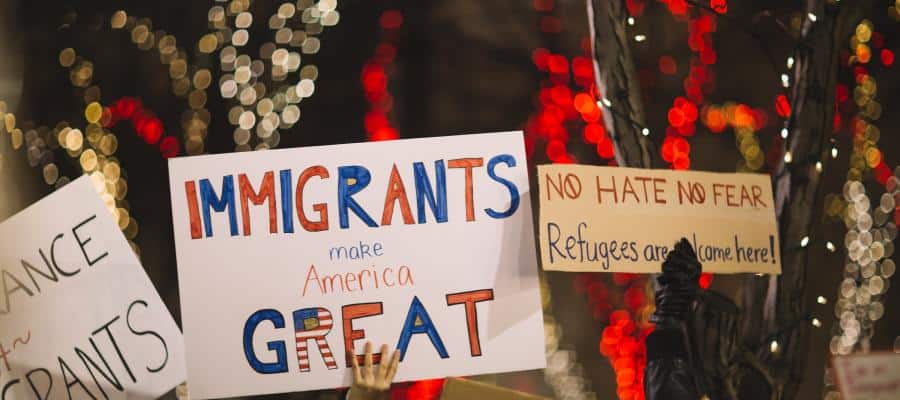
What gives a city the right to offer sanctuary to unauthorized immigrants? Can local or state government ever be justified in defying the laws of the nation? These are some of the questions we’re asking in this week’s show, recorded live in front of an audience at SF State University.
What gives a city the right to offer sanctuary to unauthorized immigrants? Can local or state government ever be justified in defying the laws of the nation? These are some of the questions we’re asking in this week’s show, recorded live in front of an audience at San Francisco State University.
The issue of sanctuary cities is a thorny one because it is the federal government’s exclusive right to make and enforce immigration policy, which might lead you to think that once the feds have established a policy, then a city like San Francisco, or indeed the entire state of California, can’t just thumb its nose at that policy.
However if a federal policy is not a morally just policy—if it breaks up families, forces people into the shadows, and turns its back on desperate people seeking refuge—does that give states and local municipalities the right to ignore the policy?
Some worry that sanctuary policies are not the right approach to fix a broken immigration system because they cause bitter divides in an already polarized political landscape. And they can be exploited and distorted by dangerous demagogues who use these policies as a wedge issue.
That may be the case, but it doesn’t address the question of whether or not sanctuary policies make our cities more just, which is the real issue. As people, immigrants should be treated humanely, so it’s a matter of respecting the human rights of others and making sure these rights are recognized in practice, not just in theory. But it’s also about making our cities safer for everyone. Sanctuary policies do that by putting less strain on local budgets, encouraging undocumented people to come forward and report crimes, and by allowing them safe access to education and healthcare. It’s in nobody’s interest to live in cities filled with sick, uneducated migrants cowering in the shadows for fear of deportation.
I’m not claiming sanctuary policies are a panacea for all our immigration woes. If we had more humane, just, and effective national policies in the first place, we might not need them. But that is not the world we live in right now, so we need to maintain our sanctuary policies.
There is a worry that by openly flouting federal law, we set a bad precedent that makes way for states or municipalities to take other kinds of action, like making access to abortion and reproductive healthcare illegal, despite the fact that federal law protects that right. If local municipalities can just decide to ignore federal laws they disagree with, then shouldn’t we worry about that? Aren’t states that try to provide sanctuary to unauthorized immigrants in the same boat as states that try to outlaw abortion?
The assumption here is that sanctuary cities are flouting federal law, but with some notable exceptions, that’s not usually what is going on. Mostly, they’re simply refusing to be deputized by the federal government. They are not actively undermining the rule of law, rather they are refusing to cooperate with it, which is a different thing. If the feds want to round up and deport undocumented individuals, they’re free to do so. Sanctuary policies just mean they can’t expect any assistance from local authorities. That’s different from states that try to outlaw abortion because they are actively denying women the right to healthcare that is guaranteed by federal law. They are not merely refusing to cooperate with the federal government’s own enforcement.
But what if ordinary citizens took that same attitude and refused to cooperate with law enforcement and refused to report crimes they’ve witnessed? Wouldn’t that make them complicit in the spread of crime? How is it any different with sanctuary cities?
There are already many ordinary citizens in this country—people of color, poor or homeless people, LGBTQ people—who have legitimate fear of law enforcement and will not report crimes because of histories of violence at the hands of the authorities. If we want people to report crimes and cooperate with law enforcement, then we have to make it safe for them to do so. Certainly, blaming vulnerable people who fear for their lives for their lack of cooperation is not the solution. We need to address the underlying causes, not attack the symptoms.
Advocates for sanctuary policies are not to blame if immigrants don’t want to cooperate with law enforcement. That’s a result of misguided and harmful federal policies. If we genuinely want safer cities, then they have to be safe for everyone. When unauthorized immigrants fear they will be deported if they come forward as a witness to a crime, we all lose.
Photo by Nitish Meena on Unsplash