
Philosopher of Action
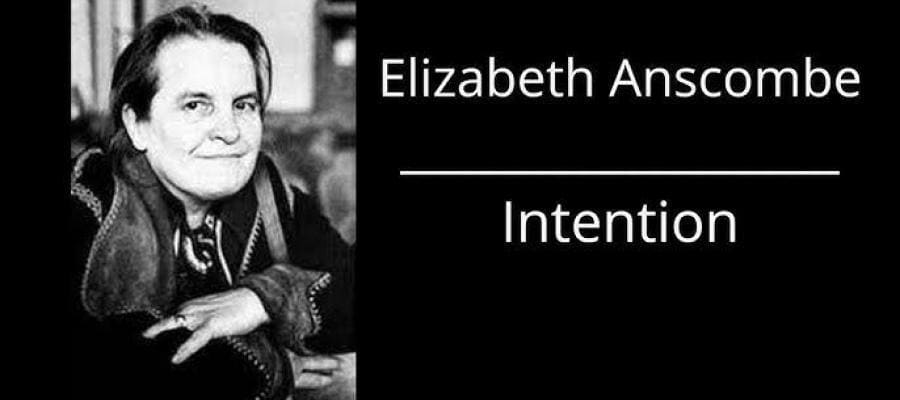
Elizabeth Anscombe was a hugely important 20th-century philosopher who worked on many topics: history, metaphysics, religion, language. But above all she was a pioneering figure in the philosophy of action, an area of philosophy that asks questions like what’s the difference between doing something on purpose and just having it happen. For instance, imagine you’re on a subway train. There’s a sudden jolt and some guy bumps into you; presumably you’re not too fussed about it. But if the train’s standing at the station and he bumps into you on purpose, that’s a whole different story. This fellow be may be thinking to himself something along the lines of “I don’t like that guy—I’m going to bump into him.”
Of course it may not really make sense to imagine him forming a sentence in his head about how much he hates someone. After all, in real life we don’t go around speaking sentences to ourselves all the time—“I’m going to make a cup of tea! I’m going to think about Anscombe! I’m going to say something to my friend!” But the thought doesn’t have to be in words; there just has to be a thought. That’s what distinguishes the guy who suddenly hates you from the guy who’s thrown into you by a bumpy bit of track.
But now imagine there’s someone else on the train—say, someone in a hurry to get to an interview. As soon as the train stops, she rushes out the door and bumps into you on the way. The first hater-guy was aggressive on purpose, but what about this person? It sure sounds like she intended to bump into you: she moved her body through space, in a particular trajectory, that trajectory collided with your body, and she followed that trajectory deliberately. In other words, she deliberately ran into you.
So here’s where Anscombe has a really interesting insight. She says that there are lots of ways of describing an action, and whether or not you did something intentionally depends on how you think about it. Her most famous example starts with a fellow putting water into a well, and that water goes into a house. He sounds like a helpful guy, doesn’t he. Except it turns out that water is poisoned—suddenly he’s not so helpful. But then we find out the people in the house are Nazis!
Confused? Well, Anscombe’s point is that we can describe what he’s doing in four different ways: he’s putting water in a well; he’s supplying water to the house; he’s poisoning people; he’s killing Nazis. Which one is his real intention? Is it all of them? Well, imagine he doesn’t know the people in the house are Nazis. In that case, he only intends to poison some random people, not to kill a bunch of Nazis—that sure seems very different.
So what does this tell us about the woman in the train? She also did something that can ben seen in many different ways: she ran toward a door; she rushed to get to her interview; she bumped into a literature professor. Her action looks very different depending on how you describe it. And in particular, she only intended some of it—she certainly never meant to spoil anyone’s day. Of course, our poisoner didn’t know who was in the house, whereas the woman on the train had all the facts in front of her: she saw you standing right there, so in some sense she jostled you on purpose. But what if she was just doing the best she could? After all, her main intention was to get that cool job she was interviewing for. Well, Anscombe rules that kind of thing out: you can’t intend to get a cool job, since getting a job depends on other people and isn’t entirely up to you.
So where does that leave us? In the capable hands of our Anscombe-expert guest, Rachael Wiseman, author of The Routledge Guidebook to Anscombe’s ‘Intention’.