
How We Know That We Know What We Know
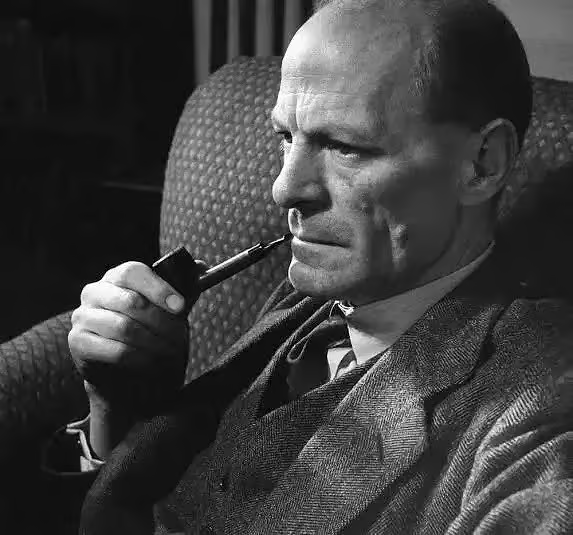
Gilbert Ryle was a British philosopher from the mid-20th century, famous for formulating the distinction between knowing-that (knowing that facts about something) and knowing-how (having the skill to perform some action). He also came up with the notion of a category mistake: a big source of confusion in philosophy, he said, is that people insist on putting concepts into the wrong mental buckets. Imagine a tourist coming to Oxford and asking where the university is. The tourist says “I see the library; I see the philosophy department; I see a bunch of students and professors; but where’s the university?” This tourist isn’t getting it, because they’ve put the concept “university” in the category of buildings. And a university isn’t a building.
More importantly, that’s what Ryle thought most people were doing when thinking about the mind. Suppose you were say to Josh, “I see your love for Proust. I see your capacity to think deep thoughts and make great arguments. I see your tendency to get creeped out by horror movies. But where is your mind?” For Ryle that’s exactly the same kind of mistake. And yet, he says, it’s why many of us continue to think that there is a thing that is a mind, just as there’s a thing that is a body. Ryle thinks we’re too influenced by Descartes, who says there’s a body, which is an “extended thing,” and a mind, which is a “thinking thing.” For Ryle, that’s a paradigm category error: a mind is not a thing (no matter how terrible a thing to waste). In reality, your mind is a set of qualities, capacities, and dispositions (your sense of humor, your skill at basket-weaving, your tendency to leap at the chance to eat French pastries) put together in a structure that makes things work, just as a university is a set of people, classrooms, and activities put together in a structure that makes things work.
But what about all those traditions that say you live on after you die? If the Christians are right, you will have thoughts and feelings in heaven, even if you don’t have a physical brain any more. And if you’re reincarnated, as others traditions hold, you’ll have a different brain, but it’ll still be you. So isn’t at least conceivable that your mind is a thing separate from your brain? And if so, and it’s possible to have your mind without your brain, can they really be the same thing?
Ryle’s answer to that would probably be to deny the premise: it isn’t possible for your soul to go flying up to heaven carrying all your thoughts and feelings and leaving your body behind. In reality, Ryle argues, thoughts and feelings are inseparable from your body: having thoughts and feelings just means that your body is liable to act in a certain way. For example, what it means to say you like coffee is just that you grab your coffee cup when it’s in reach, and after you drink the coffee, you smile.
Just how plausible is that theory, though? Suppose you’re hanging out with your Italian friends, who are huge coffee fanatics. You’re not a coffee drinker yourself, but you want to fit in with these awesome people, so you drink some coffee and pretend to like it. Maybe you even shout “DELIZIOSO!” after a terrible cup of espresso. So there you are grabbing the cup and smiling but not enjoying it at all. Surely there’s a difference between really enjoying coffee and pretending to enjoy coffee, even if the bodily behaviors are the same. There must be something going on behind our physical actions.
Our guest will help us get to the bottom of all this. It’s Michael Kremer from the University of Chicago. He’s written a lot about Ryle, loves coffee (probably), and knows how to avoid all those pesky category errors. (See what we did there?)