
The Dark Side of the Cosmos
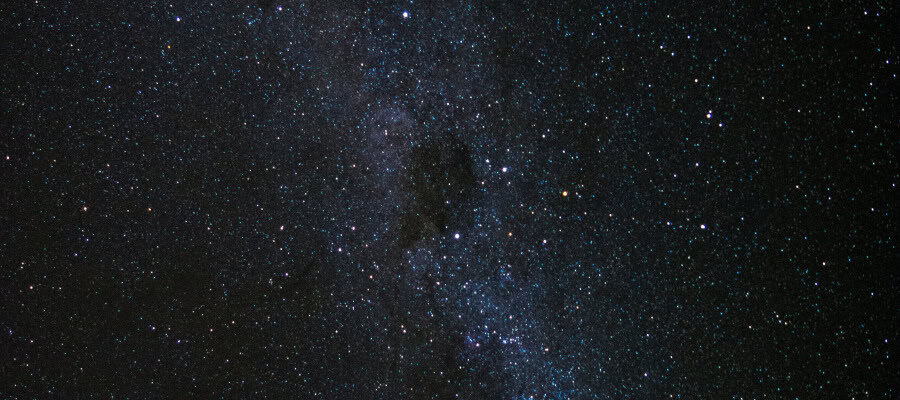
What a weird and wonderful cosmos we live in! Here’s an astounding fact. If you take all of the ordinary objects you can see, from tables and chairs to all the stars and planets in the universe, you will have accounted for less than 5% of the universe’s total mass-energy. The other 95%? That’s invisible stuff like dark matter and dark energy.
What a weird and wonderful cosmos we live in! Here’s an astounding fact. If you take all of the ordinary objects you can see, from tables and chairs to all the stars and planets in the universe, you will have accounted for less than 5% of the universe’s total mass-energy. The other 95%? That’s invisible stuff like dark matter and dark energy.
Dark matter and dark energy are so called because they neither absorb nor reflect light, which is why they’ve never been directly observed. Scientists estimate that dark matter makes up more than 25% of the entire universe. The rest—almost 70%—is dark energy. Apart from that, scientists know very little about these mysterious, invisible forces that dominate the cosmos.
A natural question to ask is why scientists are so confident that dark matter and dark energy really exist when no one has ever observed either one. Is the existence of dark matter and energy just a hypothesis or has the theory been confirmed by empirical data?
The science of dark matter and energy is still in its infancy, so there are many unanswered questions and many hypotheses about their exact nature, even if scientists are mostly confident that they really exist.
Take dark matter. All matter, whether dark or visible, has gravitational effects. The reason galaxies form and maintain their structure and steady motion is because of the gravitational pull of matter. However, the matter that has been observed is not nearly enough to explain the measured gravity of galaxies. So, there must be more matter than can be seen. Hence: dark matter exists. Scientists can estimate how much of it there is based on the gravitational effects they measure.
Much of science works in this way. A phenomenon is observed, some effects are measured, a cause of the observed effects is posited, then some experiments are done to confirm the hypothesis. As far as dark matter is concerned, there are various independent ways that the amount of it in the cosmos can be calculated and they all agree. Surely, this should give us confidence that it really exists, even if, for now, we don’t know much more about it than that.
Of course, throughout the history of science many mysterious entities that were posited to explain observed phenomena turned out not to exist. Take the now defunct theory of phlogiston, which was popular amongst scientists in the 18th century. They posited the existence of phlogiston to explain why combustible objects—those containing phlogiston— burned. Phlogiston was thought of as a fire-like element that was released during combustion.
Thanks to the steady progress of science and the discovery of oxygen, by the end of the 18th century, the theory of phlogiston had already been replaced. Looking back, we can see that phlogiston was just something scientists made up to explain a phenomenon that they didn’t yet understand.
The question then is, how do we know that dark matter is not just another phlogiston-like idea? Will some future discovery reveal that dark matter was just something scientists made up to explain a phenomenon they didn’t yet understand?
I will let our guest on this week’s show, astrophysicist Priya Natarajan, be the one to convince you that the evidence for dark matter and dark energy is solid. But I will leave you with what I take to be a more apt comparison than phlogiston— the theory of black holes.
It’s no accident that the names for these cosmic entities are similar. Although both invisible, dark matter and black holes were posited because of the odd gravitational effects they exerted on the visible matter around them. When the theory of black holes was first suggested, many wondered if there really were such elusive entities in the cosmos, or if it was just a crazy idea scientists came up with to make their equations work. Now, everybody accepts their existence as uncontroversial, even if there’s still much to learn.
What an exciting time it must be to working in this area of cosmology that deals with all this mysterious dark stuff, especially knowing that it makes up the bulk of our universe. It will be interesting to see how quickly the science progresses and how much our understanding of this weird and wonderful cosmos will deepen in our lifetime.