
A Big Bang Blog
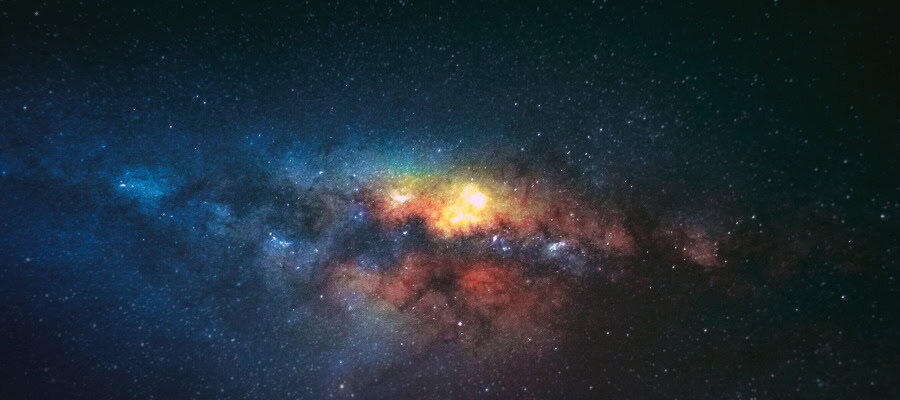
They say that the Big Bang gave birth to the entire universe. So you might think that the Big Bang must have been one hell of an explosion. But technically speaking, the Big Bang wasn’t actually an explosion at all. It couldn’t have been.
Our topic this week is the Big Bang – Before and After. It’s another episode in our series “A Philosophical Guide to the Cosmos.”
Now they say that the Big Bang gave birth to the entire universe. So you might think that the Big Bang must have been one hell of an explosion. But technically speaking, the Big Bang wasn’t actually an explosion at all. It couldn’t have been. An explosion involves a rapid expansion outward from a center. Like when a bomb or a grenade goes off and you get matter and energy being thrown outward in all directions. But despite popular misconceptions, nothing like that happened in the Big Bang. Nothing like that could possibly have happened. Not literally. Notions like “outward” or “center” only apply to things that happen in a place. The Big Bang didn’t happen in a place. Where did the big bang happen then? Nowhere! There was no place where the Big Bang happened. Of course, everything subsequent to the Big Bang happened somewhere. But not the Big Bang itself because the Big Bang is what created space in the first place.
Now commonsense has it that space isn’t created at all. Space is just sort of eternally there. And it’s not just commonsense that sees space that way. So did Newton. He saw space as sort of like this infinite pre-existing absolute container that encompasses all matter. Though modern physics doesn’t think of space that way anymore, it’s hard to get past that way of thinking. For example, if we put modern physics aside for a second and ask where space could possibly come to an end, the imagination boggles at the very idea. I mean what would be on the other side of the end of space? Even modern cosmology might seem to tacitly buy into that notion of infinite container space. After all, it says that universe is expanding. But what is the universe expanding into, one might ask, if not into some some pre-existing empty space?
The problem is that cosmology doesn’t really buy that particular conception of “expanding.” Indeed, I’ve heard cosmologist say that a better metaphor for what the universe is doing isn’t exactly expanding but “stretching.” It’s stretching because space is, in a sense, still being created—14 billion years after the Big Bang. And it’s being created everywhere—between galaxies, within solar systems, even within atoms. That’s why everything in the universe is sort of being “pushed” further and further away from everything else in the universe. And, thanks to dark energy, at an ever increasing rate, it turns out. The only reason that so-called bounded things like atoms and our bodies aren’t stretching out with the rest of the universe is that the various attractive forces acting on us swamp the “repulsive” ones.
Let’s shift gears and think about time for a bit. Cosmologists say that there was no time before the Big Bang.You might think that means that just as there was no space where the Big Bang happened, there was also no time when it happened. But it doesn’t mean that at all. The big bang happened about 13.7 billion years ago. At the same time, they say that the big bang “created” time. So how can there be a time at which the Big Bang happened? The answer is that the Big Bang can be regarded as sort of the absolute zero of time. It’s the point to which all the many relativistic timelines in the universe converge, the point before which they agree that there are no other times.
That’s clear enough, I think, but it does raise another question. If there was no time before the big bang, how could there have been a cause of the Big Bang? Ordinarily, we think that causes precede their effects in time. Nothing preceded the Big Bang. Ergo…. But if there was no cause of the Big Bang (in time) where exactly did it come from? Where could it have come from? It’s not just that scientist don’t know the answer to that one. It seems as though perhaps they can’t possibly know the answer. When we reach for explanations beyond Big Bang, we’re reaching beyond the limits of science.
Now one might be tempted to respond that, well, maybe our old familiar concepts of space, time, matter, and even cause and effect break down at the Big Bang, but one thing that science is really good at doing is thinking up strange new concepts to help us to better understand things that at first seem incomprehensible. The problem with this possible response is that concepts like space, time, cause, effect, matter, etc. aren’t just any old concepts. They are the very concepts we do science with in the first place. They are what Kant might have called the transcendental concepts, the concepts that underlie all further concepts.
Maybe, we just have to face the fact that there is a limit to the power to solve all the ultimate mysteries of the universe. I don’t by any mean mean to suggest though that we should necessarily fall back on religion, where science falters. Although some do think that. Still, I’m not necessarily willing to place all my bets on science just yet. But at the same time, I’m not willing to bet against science either. Put me down in the “let’s wait and see where this goes, column.”