Philosophers’ Corner

  • Can Technologies Be Monstrous?

    This year marks the 200th anniversary of Mary Shelley’s brilliant novel, Frankenstein. So it’s a good time to ask: can technologies be monstrous? Can human beings create devices and platforms that run beyond our intentions and out of our control? What dangerous technologies may be lurking on the horizon?

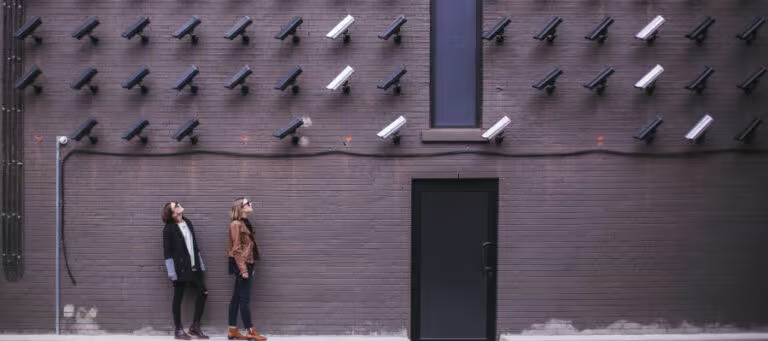
  • The End of Privacy

    Once upon a time, your home was considered your castle, a sphere of absolute privacy, where you could reliably escape prying eyes. No one, except perhaps the constable, dared even enter one’s home without permission.

  • Technology Ethics

    “Move fast and break things” is well known as Facebook’s former motto, but it may well be the motto of all of Silicon Valley. Put another way, the Valley builds first, and deals with the consequences later. But this approach is creating bigger and bigger problems.

  • An Egalitarian Case for the SAT

    The SAT has long been an important factor colleges consider when evaluating applicants, but it has also been the subject of abundant criticism regarding its ability to assess students fairly, without reflecting socioeconomic inequalities into college admissions.

  • Does Race Have Any Scientific Basis?

    Is race a social construct? Is there any scientific basis for race? If racial categories were drawn arbitrarily by white colonizers and imperialists, can we conclude that that racial categories are themselves racist?

  • The Irreverent Peter Sloterdijk

    From The New Yorker, this delightful long-form piece, “A Celebrity Philosopher Explains the Populist Insurgency,” discusses Peter Sloterdijk, one of Germany’s most famous and celebrated living philosophers.

  • Is Every Idea Worth Engaging?

    Is every idea worth responding to, or are some ideas so harmful that we should not engage at all? Philosopher Elizabeth Barnes explores this question in a recent article, arguing that it is sometimes worth it to engage with harmful ideas.

  • Dark Knowledge?

    A new intellectual counterculture has been coalescing in virtual space. The intellectual dark web is billed as island of free speech in a sea of dogma: a place where bold, creative thinkers can discuss their ideas at length and without censure by the mainstream media or suppression by a hidebound academic establishment.

  • Is ‘The Will of the People’ Sacred?

    One golden standard of successful democracy is whether its political decisions and institutions adequately reflect the will of the people. But what exactly is this will of the people? Is it the sum of constituent preferences or is it something beyond that?

  • Adorno and the Culture Industry

    A lot of the popular culture we consume these days is produced and distributed by large studios and record companies. Should that worry us? Are doomed to mediocre music, television, and film? Or even worse: are we doomed to songs, shows, and movies that secretly serve a hegemonic propaganda machine?

  • From Pessimism to Nihilism

    Young adult dystopian novels like Divergent and The Hunger Games may have ruled the marketplace in the 2010s, but now there’s a new trend in young adult literature. Stories of teens committing (or ideating) suicide have become the new obsession. But why?

  • Is Alexa a Setback for Feminism?

    Voice-activated personal assistants like Alexa and Siri are becoming increasingly popular. While the assistants each try to differentiate themselves in someway, there is one inescapable commonality: they are all female.

  • Racist Algorithms and Fair Sentencing

    Can an algorithm be racist? An algorithm used to determine bail sentencing assesses the risk that an individual will reoffend. Critics claim the algorithm is unfair because it incorrectly assesses more black individuals as high risk than white.

  • Humble Disagreement

    Should you cling to your beliefs even when others disagree? Or should you reconsider your beliefs whenever they’re challenged? Is it possible to disagree without being disagreeable?

  • The “Complicated” Causes of Gun Death (Part I)

    Imagine an organization—the Materials Rights Association (MRA)—that contributes millions to the campaigns of politicians who keep the laws that govern building materials safety lax. The MRA reaps huge financial rewards because cheap building materials, even if highly flammable, are desirable to its member builders.

  • Philosophy for Prisoners

    Can prisoners benefit from engaging in philosophical thinking? Kirstine Szifris spent six months teaching philosophy to prisoners and says it can can mitigate prison violence and help prisoners to engage in deep self-reflection, getting closer to the ideals of rehabilitation.