Anna Julia Cooper
February 1, 2026
First Aired: October 6, 2024
Listen


Born into slavery in the 19th century, Anna Julia Cooper received a classical education, attended the Sorbonne, and became the fourth African American in history to be awarded a PhD. Her first book, A Voice from the South, offered one of the first articulations of how Black women are impacted by race, gender, and socioeconomic class. She believed that uplifting Black women through higher education would improve life for all Black people. Josh and Ray explore her life and thought with Kathryn Sophia Belle, author of Beauvoir and Belle: A Black Feminist Critique of The Second Sex.
Part of our Wise Women series, generously supported by a grant from the National Endowment for the Humanities.
Ray Briggs
Should everyone get a liberal education?
Josh Landy
If you want to tackle racism, do you have to tackle sexism at the same time?
Ray Briggs
Can anyone be free until everyone is free?
Josh Landy
Welcome to Philosophy Talk a program that questions everything…
Ray Briggs
…except your intelligence. I’m Ray Briggs.
Josh Landy
And I’m Josh Landy. We’re coming to you via the studios of KALW San Francisco Bay Area.
Ray Briggs
Continuing conversations that begin at Philosophers’ Corner on the Stanford campus, where Josh teaches philosophy.
Josh Landy
And at the University of Chicago, where Ray teaches philosophy.
Ray Briggs
Today, we’re kicking off season two of our “Wise Women” series, generously supported by a grant from the National Endowment for the Humanities. We’re thinking about the life and thought of Anna Julia Cooper.
Josh Landy
Anna Julia Cooper is such a fascinating figure. She was only the fourth African American in history to earn a PhD, which she managed after being born into slavery, and then she lived into the 1960s so she witnessed reconstruction Jim Crow and the civil rights movement.
Ray Briggs
She also wrote a really important book called A voice from the south. It influenced a whole bunch of later thinkers like Frederick Douglass and WEB DuBois.
Josh Landy
Right, she anticipated a ton of things that Dubois went on to say later, like the idea of double consciousness, that Cooper said that in a racist society, black people end up seeing themselves through the eyes of their oppressors. That’s what Dubois called double consciousness. You see yourself your own way, but also someone else’s way, and that can be hugely demoralizing.
Ray Briggs
She also anticipated Dubois’ idea that liberal education should be available to everyone. She didn’t think it was enough to send black kids to vocational training, even if it would get them a good job. She thought they also deserve access to the life of the mind.
Josh Landy
Right, and she totally practiced what she preached. She was a high school teacher herself for many years, working at a public school in Washington, working at a public school in Washington D.C., she offered a classical education to generations of kids.
Ray Briggs
And she was really good at it. Many of her students ended up getting into prestigious schools like Princeton and Harvard.
Josh Landy
You know Ray, I have to say I’m with Anna Julia Cooper on this. I think everyone should get to learn Greek and Latin.
Ray Briggs
Everyone? What about people who hate Greek and Latin? What about people whose talents are in carpentry or engineering and not ancient languages? Don’t you want them to be happy in school and make a living afterwards?
Josh Landy
You sound like Booker T Washington. He famously argued with Dubois about that very question. And I think Dubois kind of mopped the floor with him, with his fantastic line, the true college will ever have one goal, not to earn meat, but to know the end and aim of that life which meat nourishes.
Ray Briggs
Ah, come on, Josh, that’s not fair. Look. Washington said, no race can prosper until it learns that there is as much dignity in tilling a field as in writing a poem. Are you such a snob that you don’t see the wisdom in that?
Josh Landy
Well, I do get that. And to be fair, Cooper did too. She was really keen to make the full range of knowledge accessible to anyone who wanted it. But she also said this, and I love this so much. If a boy hates Greek and Latin and spends all his time whittling out steamboats, it is rather foolish to try to force him into the classics.
Ray Briggs
Aha. So, it sounds like Cooper agreed with me. Not everyone should learn Greek and Latin.
Josh Landy
Well, Cooper thought everyone should have the chance to, and their chances shouldn’t be based on their race or their gender.
Ray Briggs
Cooper was really ahead of her time and thinking about how race and gender interact. She was actually really critical of some black leaders of her time for only paying attention to the problems they faced as men and just leaving women behind. She believed that black women deserve a public voice. They should not be confined to the home.
Josh Landy
And if those women did get out into the public sphere, they weren’t just doing themselves a favor. They were doing everyone a favor. In Cooper’s view, black women can see things about society that nobody else can. The entire society desperately needs their voices.
Ray Briggs
Well, that sounds like something philosophers still believe today. There’s a whole field of study called standpoint epistemology based on exactly that insight.
Josh Landy
Sounds like we have a lot to talk about with our guest. It’s Kathryn Sophia Belle, founding director of the Collegium of black women philosophers.
Ray Briggs
Among her many accomplishments, Anna Julia Cooper was appointed principal at M Street, the prestigious public high school for black education in Washington, DC. But her rise there was followed by vicious attacks.
Josh Landy
So, we sent our roving philosophical reporter, Holly J. McDede, to investigate. She files this report.
Tempestuous Elements
“You are directly defying a mandate. How can you suggest such educational opportunities are beyond Negro students intellectual capacity? As a bit of friendly advice: watch your back.”
Holly McDede
That’s from the trailer for Tempestuous Elements, a play about Anna Julia Cooper’s tenure as the principal of M Street High School in Washington, DC.
Shirley Moody-Turner
It’s really this kind of radical experiment in black community led education in the nation’s capital.
Holly McDede
Shirley Moody-Turner wrote about this in an opinion piece for The Washington Post titled “How the black funeral head of a top DC school was punished for leading.”
Shirley Moody-Turner
There was a black Superintendent of black schools in Washington, so it really had a high degree of autonomy in hiring its teachers, its staff, in deciding on its curriculum, and so it’s really this kind of utopian moment in black education.
Holly McDede
Moody-Turner is a professor of English and African American Studies at Penn State University. She also edited a collection of Cooper’s essential essays. When Cooper arrived at M Street in 1887, she taught Latin and mathematics, she gave lectures, and she wrote the book, A Voice From the South.
Anna Julia Cooper
“Today, America counts her millionaires by the thousands. Questions of tariff and questions of currency are the most vital ones agitating the public mind.”
Shirley Moody-Turner
It’s really seen now as this foundational text of black feminist thought.
Anna Julia Cooper
“Woman’s work and woman’s influence are needed as never before. Needed to bring a heart power into this money, getting dollar, worshiping civilization. Needed to bring a moral force into the utilitarian motives and interests of the tongue. Needed to stand for God and home and native land versus gain and greed and grasping selfishness.”
Holly McDede
But in the early 1900s amid the rise of Jim Crow segregation, things really start to shift. M Street goes through a restructuring and falls under the direct supervision of a white director of high schools.
Shirley Moody-Turner
And so that really changes—that kind of restructuring is intentional in trying to wrest control over M Street out of the hands of the black community, and the black community is aware of what’s happening and is trying to find ways to fight back and resist.
Holly McDede
Cooper’s students are highly successful. They outscore students from white high schools on citywide tests. They go to Ivy League colleges and universities.
Shirley Moody-Turner
So, she’s doing all these things, and it just runs really counter to what this new administration is trying to do, which is to derail the classical education at M Street.
Holly McDede
Pretty early into her tenure, the rumors start allegations that she cannot maintain control of her students, that she’s advancing students who do not deserve to graduate, and that she’s having an affair with one of the teachers.
Shirley Moody-Turner
Married women could not maintain their positions, and single women were under constant scrutiny, so she kind of is in this liminal space already as an unmarried but widowed woman. So those kinds of attacks really tried to exploit what her critics saw as a vulnerability.
Holly McDede
Ultimately, the DC Board of Education removed her from the position of principle, but the liberal arts curriculum focusing on math, literature, languages, science was saved.
Shirley Moody-Turner
I think very much it’s a part of what she sees as a personal and social transformation that engaging at the level of ideas brings one to certain truths about themselves, about society, it helps prepare them to participate in these broader conversations. Enough, so I think she thought that was really critical.
Holly McDede
Moody-Turner writes that it’s worth revisiting Cooper’s case as an example of black women “punished for leading.”
Shirley Moody-Turner
What’s also really fascinating to me about Anna Julia Cooper is there’s a survey of college Negro graduates in 1930 and they ask all of these questions about your education and what you would have done differently. And so, they asked, there’s a question like, What would you have done differently?
Holly McDede
And her response boiled down to…
Shirley Moody-Turner
Nothing—I wouldn’t have done anything differently. She’s like, I think that if circumstances were different, I would have adjusted myself to deal with those circumstances, just as I’ve done this time around. Like, what?
Holly McDede
Cooper would do exactly what she did the first time. That degree of confidence and self-assuredness threatened to derail her, but it also sustained her. For Philosophy Talk. I’m Holly J. McDede.
Josh Landy
Thanks for that fascinating and troubling report. Holly. I’m Josh Landy, with me is my fellow philosopher, Ray Briggs, and today we’re thinking about the life and thought of Anna Julia Cooper.
Ray Briggs
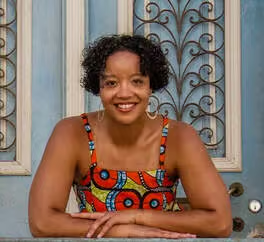
We’re joined now by Kathryn Sophia Belle. She’s the founding director of the Collegium of Black Women Philosophers and author of Beauvoir and Belle: A Black Feminist Critique of the Second Sex. Kathryn, welcome to Philosophy Talk.
Kathryn Sophia Belle
Thank you for having me.
Josh Landy
So, Kathryn, can you tell us a bit about the Collegium of Black Women Philosophers? What was it like to get it started?
Kathryn Sophia Belle
So, Collegium of Black Women Philosophers, I started in 2007 when I was still a junior faculty member at Vanderbilt University. At the time, there was no kind of unifying organization for black women in philosophy. When I decided to get my PhD in philosophy, I found out there were only 16 black women in the US with a PhD in philosophy, so I felt a moral and personal obligation to increase our representation in the discipline. When I got to Vanderbilt University, Charles Mills came and he said, Catherine, what’s going on with the black women in philosophy? And I was like, I don’t know. Somebody should start something. If they started, I’ll definitely join. And he’s like, Kathryn, you’re at Vanderbilt. They have all this money. You should use their money. And I was like, You’re right. I should use their money. And so, I put together a proposal, and we started in 2007. It was featured in The Chronicle for Higher Education and Diverse issues in higher education, The Philadelphia Inquirer and a number of other different outlets. And so, I started that at Vanderbilt University. I kept it going when I left Vanderbilt for Penn State University. And it’s been a wonderful organization.
Ray Briggs
I love that you saw the need for this thing and then just built it instead of waiting for it to be built. But earlier, Josh and I were talking about Anna Julia Cooper’s philosophy of education. So, Kathryn, what was Cooper’s main insight about education?
Kathryn Sophia Belle
So, Cooper had a great insight around both access to classic education as well as, you know, trade school and things like that. So, although she definitely was a fan of classical education, teaching Greek and Latin and the humanities and things like that. She also believed that if people did not want to do that and they wanted to do the trade education, they should be able to do the trade education. But beyond the kind of debate between classical education and trade schools, Cooper was very committed to making sure that not only black people had access to education, but women had access to education. So, she was a teacher and principal at M Street School, as has been mentioned. She also taught at the University for a while when the whole scandal happened with M Street, and she was pushed out of that position at M Street. She would return back to M Street as a high school teacher, but she also ran an adult kind of night school out of her home. So, she was committed to education for high school, for college, as well as for nontraditional adult learners, and she believed that education gave us access to be our highest selves, our best selves, both in terms of our interactions with one another, but also how we show up in community, how we show up as citizens in society.
Josh Landy
Can you say a little bit more about that? I’m really interested in how she thinks is the relationship between this liberal education and the opportunity to be one’s best self. How did she see that sort of causal connection as working?
Kathryn Sophia Belle
Well, I think because she herself was so interested in gaining access to Greek classes, to the mathematics courses, that at the time that she was getting her education, it was not automatic for girls to be able to have access to that. So, I think some of it came out of her lived experience and her own curiosity about it, but also the way she was able to see her life was improved and she was able to provide opportunities, not only for herself and her family, but also for the broader community. So, I think it came a lot out of her, because she was trained in a traditional liberal arts, classics education. I think that’s part of it, but part of it was also her lived experience and seeing the ways that she was able to show up in the world through the resources provided through the education and how her students were able to show up and go on to get opportunities through higher education as well.
Ray Briggs
She has this, like, great slash infuriating story and a voice from the south about, like, getting to sit in on classes for teachers when she was a little girl, and being super excited to learn, like everything the teachers were learning, and then wanting to take Greek, and being told that she shouldn’t take Greek, but some boy who had shown no aptitude for any of the classes should get to teach Greek because he was a boy. How did she kind of take that experience, I guess, into the rest of her life.
Kathryn Sophia Belle
Well, in that moment, she advocated for herself, because she was able to go on and get what was traditionally the boys’ curriculum, and this was, I believe, at St Augustine’s in North Carolina. But she continued to kind of be a trailblazer and open doors and, you know, shatter, so called glass ceilings on. Um, in terms of her education, you know, moving from St Augustine’s to going on to like Oberlin, the type of education that she provided as an educator and a principal at M Street School. So, I think that early childhood experience of being told that she couldn’t do something or shouldn’t do something, and her be being able to advocate for herself, to still have access to that motivated and inspired her to fight for that for her students as well.
Josh Landy
You’re listening to Philosophy Talk, today we’re thinking about Anna Julia Cooper with Kathryn Sophia Belle, director of the Collegium of Black Women Philosophers.
Ray Briggs
Should oppressed minorities strive to assimilate into the wider society, or is it better to stick together? Can you have racial solidarity without gender solidarity?
Josh Landy
Excellence, insight and intersectionality—along with your comments and questions, when Philosophy Talk continues.
Jamiroquai
‘So let the music come and save you, I found a God that I can pray to, Deep inside my soul.’
Josh Landy
Doesn’t everyone deserve an education that moves them to their soul? I’m Josh Landy, and this is Philosophy Talk, the program that questions everything…
Ray Briggs
…except your intelligence. I’m Ray Briggs, and we’re thinking about the 19th and 20th century philosopher Anna Julia Cooper. Our guest is Kathryn Sophia Belle, author of Beauvoir and Belle: A Black Feminist Critique of the Second Sex.
Josh Landy
It’s the first episode in Season Two of our “Wise Women” series, which is generously supported by a grant from the National Endowment for the Humanities. You can listen to all the episodes from season one on our website, philosophytalk.org/wisewomen.
Ray Briggs
Got questions about this groundbreaking African American thinker? Email us at comments@philosophytalk.org, or comment on our website. And while you’re there, you can also become a subscriber and enhance your education in our library of nearly 600 episodes.
Josh Landy
So Kathryn, before the break, you were saying that Cooper has a specific argument about the value of education for women. Can you say a little bit more about that?
Kathryn Sophia Belle
Yes, so in A Voice from the South, there’s an essay titled ‘The higher education of women,’ where Cooper provides what I would describe as a feminist argument for educating women. So, Cooper argues that one of the objectives of giving women access to higher education is to better equip them to influence humanity and to contribute to the questions, problems and debates on the world stage. So, Cooper says, and this is a quote, give girls a chance. Let our girls feel that we expect more from them than that they merely look pretty and appear well in society. Teach them that there is a race with special needs, which they and only they can help, and is already, already asking for their trained and efficient forces. So, for her, she saw a direct correlation between giving access to higher education to girls and then being able to really contribute on the world stage of what was going on, socially, politically, etc.
Ray Briggs
So, Kathryn philosophers nowadays talk a lot about intersectionality, but Anna Julia Cooper kind of anticipated that she talked about it about 100 years before it was cool. So, can you tell us a little bit more about like the concept of intersectionality? And we can talk about how she fits into it?
Kathryn Sophia Belle
Sure. So, the concept of intersectionality, the specific term intersectionality, is coined by Kimberlé Crenshaw in 1989. Kimberlé Crenshaw comes out of critical race theory, which is legal studies, legal theory. And so, she makes the argument that when we look at the laws relating to sexual discrimination and racial discrimination, a lot of times black women are going to fall between the cracks of those rules or those laws, because the laws focusing on women tend to code women as white women. The Laws focusing on anti-racism tend to code race as black male, and so black women, women of color, tend to fall through the cracks of those laws. So, when Crenshaw introduces and coins the term intersectionality, she’s looking at how legal theory and the law can actually account for can offer something that protects black women and women of color that tended to fall through the cracks of the laws focusing on black men or white women, that ends up getting expanded to thinking about intersecting identities along the lines of race, class, gender and other things, as well as intersecting systems of oppression.
Ray Briggs
So, the intersecting systems of oppression, I think, is what I was thinking of when I was thinking of Anna Julia Cooper, where she has this observation that if you’re going to educate black people, you cannot just educate black men. And she also has, like, some choice things to say about white women with their women’s liberation organizations that are like, sort of covertly white women’s liberation organizations. Not all women, this seems like really closely related, even if it’s not legal theory.
Kathryn Sophia Belle
No, it’s not so, it is closely related. It’s a precursor to, or what I described as proto intersectionality, right? And so, this is not unique to Anna Julia Cooper. You can go back to like Maria Stewart in 1831 and throughout the late 1800s and 1900s through to Anna G Cooper, all the way up until the 20th century, with Kimberlé Crenshaw. So, a lot of times you have black women at that time again, whether you talk about Maria Stewart or Ida B Wells who want to talk about race, they talk about gender, they talk about class, they talk about access to education, they talk about access to the political structure, voting rights and things like that. And so even though intersectionality is kind of the more popular term that we use now, we have precursors to that, like interlocking systems of oppression, which we get from Patricia Collins, or the triple oppression thesis, which was used, for example, by Claudia Jones in the 1950s. So there are a lot of precursors to, or what I’ve described elsewhere as proto intersectional analyzes that go back to Cooper. And even before Cooper.
Ray Briggs
It sounds like Cooper is part of a pretty long tradition of noticing these interlocking systems of oppression by various names. So, can you say something about what’s distinctive about the way that she treats them?
Kathryn Sophia Belle
So, she definitely is part of a longer tradition. And I actually get into this longer tradition in the first chapter of the Beauvoir and Bell book, because I think sometimes, we think that white feminism was a bandwagon that black women jumped onto. And so, one of the things that is important to point out is that there were black women who weren’t engaged in these kinds of arguments around different intersecting or interconnected identities as well as intersecting oppressions, even if they didn’t use that language. So, as you mentioned, well, she talks about, in A voice from the south, how black women are impacted by both the race question and the woman problem, and are as yet an unknown or unacknowledged source in responding to those systems of oppression, right? So, she names this in A voice from the south, and then she also gestured at some of her critiques of white feminism and white women in the kind of political movements of her time, right? So, she has an essay on this is, also in A voice from the south called ‘Woman versus the Indian,’ where she calls for the natural inherent rights of all people, the rights of humanity, and she specifically names groups like black people, like women, like Indians or Native Americans, as well as the poor right, like so even in that description and in ‘Woman versus the Indian,’ she’s giving a very intersectional analysis of, again, identities as well as systems of oppression and the need to have access to rights along those intersecting identities. She also argues in that essay that all prejudices, whether of race, sect or sex, class, pride or caste distinctions, are the belittling inheritance in badge of snobs, right? So, she’s very unambiguous in her disdain for a kind of belittling of anybody along certain intersecting identities and systems of oppression that target particular people at certain intersecting identities.
Josh Landy
I’m totally convinced by you that Anna Julia Cooper has some very reasonable criticisms of white feminism, both in its contemporary form, contemporary with Anna Julie Cooper and also predecessors. I’m also hearing interesting echoes of figures that we talked about on this show in season one of our Wise Women’s series, people like Mary Wollstonecraft and Margaret Cavendish. This idea that internalized sexism is sort of part of the problem, and part of the problem is just denial of access to education that causes women to, well, as Cavendish says, to be employed only in loose and petty employments. That Wollstonecraft says that, you know, women are sort of trained to believe that they should waste their lives on pretty dresses and things like that, and I hear a nice echo with Cooper’s let our girls feel that we expect more from them, that they merely look pretty. Is there some overlap? There? Are there some places where Cooper is agreeing with prior feminist philosophers? Or do you think she’s more blazing her own trail.
Kathryn Sophia Belle
So, I think she there are some echoes with prior feminist philosophers. But again, I would put her in the black feminist tradition, rather than, like a Wollstonecraft tradition, and part of it is for black women, it wasn’t a matter of like, let me sit around and think about which jobs will demand the least of me, right? So, for a lot of black women, working was not an option. You know, they had to be co-providers within their households. And so, the issue a lot of times with black women was what the type of work that they had access to, not only because they were women, but also because they were black, meant that oftentimes they were limited to domestic work and things like that, which meant they were also subjected to sexual harassment and sexual exploitation within that domestic work sphere, right? So black women talking about women having access to work, especially in this time period, the kind of post-antebellum, post Reconstruction period is the stakes are very different for black women. And it’s not about, you know, how can I do I sit around and look cute, or do I work outside the house? It really is about like, okay, I’m one of the people who has to be able to provide for my household, and what are the limitations on what I have access to because of racial barriers, not just gender barriers.
Ray Briggs
You’re listening to Philosophy Talk today. We’re talking about the life and thought of Anna Julia Cooper with Kathryn Sophia Belle, founding director of the Collegium of Black Women philosophers. One of the I’m trying to remember. Which essay at the beginning of A voice from the south is whether it’s the one on women’s education or the one before that, but she makes this point that letting white people have control of the resources and who gets heard is kind of not a viable path forward. It’s where she’s talking about, like, black clergy and sort of white clergy, gatekeeping, who gets to be a clergy member, and whether they’re kind of polite enough. And I, I sort of hear that also with, like, how she discusses women. So, if, like, women just have men gatekeeping all of their access to resources and can’t do things for themselves, it seems like she doesn’t think they can really get anywhere. Do you think that’s an accurate like report of something that she believes and says, and if so, would you like to expound on it?
Kathryn Sophia Belle
So, I would say Cooper is definitely critical of the white women organizations at the time, and she is also critical of black men in terms of their sexism at the time, right? And, of course, white men and their sexism as well. So, she is going to critique people like Martin Delaney. So that famous quote of you know, only the black women can say when and where I enter, is a response to Martin Delaney saying, like, when he enters, the whole race enters with him. And so, she’s saying like, well, no, the whole race does not enter with you as a black man. The black woman has to alter into the space so that the whole race can also enter with her as well. So, there are definitely very pointed critiques at specific black men as well as black clergymen in general, in terms of who had access to, you know, public speaking access, for example, or the education that came along was getting trained as a clergy person, right? So, there are some specific critiques of black men in terms of sexism, as well as critiques of white women in terms of their racism. So, she, and this is part of what the intersectional kind of standpoint, epistemological standpoint is, is being able to see both aspects of that and not just prioritize one over the other, or collapse one into the other, or assume, if you solve one, then the other one will magically go away.
Josh Landy
I love that line that you just quoted, where Anna Judy Cooper says, ‘Only the black woman can say when and where I enter then and there, the whole race enters with me.’ I think that that’s I mean, she writes so beautifully, and it’s such a powerful statement. I’m particularly interested in what Cooper appears to believe about the sort of special contributions of certain categories of people. So black women have a particular contribution to make. Women in general have a particular contribution to make. The African American population has a particular contribution to make. Can you say a little bit more about that vision that she has? I find it incredibly inspiring.
Kathryn Sophia Belle
So, I think for her, she definitely sees a connection between one’s lived experience and how they show up in the world and what they experience in the world, embodied and identified in particular kind of ways, and the insights and knowledge that come along with that, right? And so even though you have somebody like Dubois who talks about this kind of double consciousness as a negative, for Cooper, it’s not just a negative. It gives a special kind of third sight or insight into the world, because you’re able to see the things that other people don’t see or refuse to see or can’t see. And you see those because you experience them, and you name them, and you bring like an attention to them. And for Cooper, it means not just seeing it and naming it, but also doing something about it, right? And that is also what brings us back to the education part of it, right? It’s part of what helps us not just see and name things but be able to speak on the world stage in order to address them.
Josh Landy
And she has this beautiful vision of the way in which different races can live together in a really fascinating harmony that includes tension, right? She has that line that each race has its contribution to the harmony of the nations.
Kathryn Sophia Belle
Yes, so she talks about, and ‘Has America a race problem?’ If so, how can it best be solved there? She argues that progressive peace is achieved through fair conflict indifference, right? And in this way, I would say Anna J Cooper anticipates arguments that come later by people like Audrey Lord, who also wants to argue for the power and importance of difference, right? So, the goal is not to collapse every identity in every group into one another, but to celebrate the differences and draw on the strengths of the differences and see what we can learn from one another, right? And so, for her piece is not going to be a passive piece where there’s just, you know, everybody just pretends to get along. She says, you know, there’s gonna it’s important to have some fair conflict and some disagreement and allow for the differences so that, so that everybody can shine in and deliver your message and share their insight. And again, part of this is coming from their own lived experience, like when you’ve experienced certain things in the world, you’re able to articulate that in a way that people it’s actually almost the opposite of, say, a Rawls, what is it the veil of ignorance, right? Because Rawls, the assumption is like, okay, we can get behind this veil of ignorance, and we could imagine what it would be to be in a certain kind of position, and we can anticipate not wanting to be in that position and coming up with just and fair laws, because we don’t want to be in that position. But for Cooper, she’s going to say, like, okay, an upper-class white man cannot imagine what it’s like to be a formerly enslaved black woman who’s suffered from sexual exploitation as a domestic worker, right? Like you need the black woman who’s had that experience to be in that space, to articulate that experience, to communicate a kind of just and fair system in law, et cetera, that would address that experience, right? And so, so this is, I think, what she gets at when she talks about the importance of a kind of fair conflict and representation of different and not in a kind of tokenistic just having somebody in the room. But what does it really mean to talk to and be in conversation with people who have specific experiences so that they can speak to the best remedies for those experiences.
Ray Briggs
This seems like another argument in favor of black women’s education, of universal access to education, that she’s kind of an example of, that not only is it better for the person who is educated, but it’s kind of better for the world to get their voice right, because, like otherwise, we’re going to miss things
Kathryn Sophia Belle
Absolutely, so when we cut off a certain segment of the population from having access to education or whatever other kind of social goods we’re talking about, or political goods we’re talking about, it’s not just the people who’ve been denied that access to suffer, but everybody suffers, not to the same degree, but it but everybody suffers in some way from not giving everyone access to certain kinds of things. And so, she has an essay called ‘What are we worth,’ where she gives a theoretical reading of race and prejudice, grounding it in sentiment and in ideas. And so, she presents race prejudice as a sentiment governed by the association of ideas, and she explains that it’s impervious to reason, and it can’t be annihilated by rhetoric, right? And so, I mean, we can look at the contemporary kind of political landscape, not just in the US, but in other places where you can ask someone a very pointed question about, you know, do you believe we should have x? And they’re like, yes, we should have x. And then they say, well, this political person that you disagree with says that we should have x, and they’re like, no, no, no. Well, if they say that we should not have x, right? And so, it’s very unreasonable, but people will dig their heels in, in their unreasonableness around some of these questions.
Josh Landy
You’re listening to Philosophy Talk today. We’re thinking about Anna Julia Cooper with Kathryn Sophia Belle, director of the Collegium of Black Women Philosophers.
Ray Briggs
How can we organize in a way that doesn’t leave anybody behind? If racism is driven by irrational emotion, can arguments ever defeat it? Can we achieve peace if we’re just avoiding conflict?
Josh Landy
Serenity, strategy and solidarity—plus commentary from Ian Shoales, the Sixty-Second Philosopher, when Philosophy Talk continues.
Nina Simone
‘Then I’d sing cause I’d know how it feels to be free.’
Ray Briggs
How does it feel to be free knowing others may not be? I’m Ray Briggs, and this is Philosophy Talk the program that questions everything…
Josh Landy
…except your intelligence. I’m Josh Landy. Our guest is Kathryn Sophia Belle, Director of the Collegium of black women philosophers, and we’re thinking about the life and thought of Anna Julia Cooper. It’s part of our “Wise Women” series, supported by a grant from the National Endowment for Humanities.
Ray Briggs
So, Kathryn, you were just telling us how Anna Julia Cooper thought that racism is irrational, which seems pretty plausible, and that it’s not responsive to argument. So where does it come from, and why do people do this irrational thing?
Kathryn Sophia Belle
So of course, this is a very big question, because racism is going to manifest in different ways and different spaces for toward different ends, right? You’re going to get constructions of race and legal constructions of race in Virginia that are different from, say, Georgia or North Carolina or New Jersey or something like that. So, it’s important to be context specific when looking at the constructions of race again, going back to the legal theory, the legal constructions of race, but also the motivations for inventing a concept like race to justify other kinds of things. And so, this is where the intersectionality and the intersecting identities and oppressions come back in, right? Because racism often gets used to justify or warrant systems like the transatlantic slave trade, systems like colonialism, systems like imperialism, right? So, it’s rational insofar as it’s used very intentionally to justify certain systems of oppression and to convince people that those types of systems of oppression should be allowed for those people over there, but it’s irrational in terms of, like, a lot of times, I don’t think people believe the rhetoric that they spew in order to justify certain kind of systems of oppression.
Josh Landy
And as you said before, Cooper believes it’s impervious to reason. So that obviously raises a question, if racism is impervious to reason. What do you do? What’s the what’s the best strategy, according to Cooper, for combating it, for overcoming it.
Kathryn Sophia Belle
So, for Cooper, it’s about being connected in community. And you know, it’s the lifting as we climb phenomenon that you get from like the Black Women’s Club movement at that time, right? And so, the idea is that we cannot. Lie on our oppressors to also be our liberators, right? And so, part of that is, how do you resist systems of oppression, whether it’s in the form of slavery, like, remember Cooper was actually born into slavery and goes through life from the Civil War all the way up to the civil rights movement, right? So, part of it is, you know, you have to combat the systems of oppression within the system of oppression, right? Like and push against it from within the system of oppression, but then you also have to create community and opportunities for yourself that you cannot rely on your oppressors to provide for you, right? And so, this is what her having access to someplace like St Augustine’s was very important, right, for educating teachers, especially black teachers, to be able to continue to educate students, right? Or her being an educator and principal at M Street School was one of the ways that she combated that system of oppression, not to convince. So, rather than try to convince somebody that a black student is smart enough to get into the school, she actually educates them in a way that means that they can test into and show that they can get into that school. They get into the school, and they flourish in the school Now, having said that, she does also respond to some of these arguments, right? And so, for example, in the essay, what are we worth? She responds to this argument that Harriet Beecher Stowe brother, I forget what his name is, but Harriet Beecher Stowe’s brother, Henry Ward Beecher, yes, he writes an essay where he basically says like, well, if Africa were to fall into the ocean, you know, we wouldn’t lose anything, like they haven’t produced any art. They haven’t produced anything of significance or anything of value. And so rather than kind of arguing directly with him, she looks at concrete counter examples, right? And so, when Beecham says, you know, Africans have not contributed any poetry or inventions in art, she gives a counter narrative by highlighting the poetic contributions of someone like Phyllis Wheatley, the interventions of successful black farmers, the heroism of black soldiers, and the artistic work of sculptors like Mary Edmonia Lewis. So she’s like, okay, actually, we can name specific poets, artists, workers, farmers, that have contributed quite a bit. And so, I think Cooper is able to kind of do both. And she’s responding in some ways, to some of the irrational sentiment that’s out there that’s very racist, but she’s also about the business of, again, being an educator and uplifting the community through education.
Ray Briggs
So, I love this idea of uplift and not just trying to refute people who are not going to be helpful or sympathetic. Anyway, I kind of wonder about this problem of, like, making sure that you get enough solidarity. Because one of the things that’s going on with Cooper is that there are some leaders who are mostly in it to get what they can get, rather than to uplift, like the black people around that so, like, that’s a thing. But like, people who are like Cooper and really care about others are also a thing. How do you focus on the people who really care about others and make sure that everybody is just not? I don’t know in it for themselves.
Kathryn Sophia Belle
Well, I think a lot of times it can be both, and not either or. But I think oftentimes there are far more people who are in it for others, which is also for themselves, right? Like so contributing to the community of others also, again, improves, you know, my being able to be in community in a particular kind of way. So, it’s not an either or. It can be a both and. But I think we have far more examples through, again, people like Anna Julia Cooper, and you can look at the Black Women’s Club movement more broadly, of people who were very seriously committed to, again, building community, providing opportunities in community, providing access to education, providing access to certain kind of just life skills, whether it was childcare or, you know, preschool education or domestic skills and things like that. And so, Cooper, I think a lot of times Cooper is thought of as being focused on the kind of elite higher education end of the spectrum, but she also very much was supportive of just different life skills that were needed on the domestic front and other fronts as well. And so, I think you have more examples of people who were definitely dedicated to the community, more broadly, invested in the community, more broadly than people who were only invested in their own self interests.
Josh Landy
These are fantastic not just thoughts, but also practices in the direction of making things better for her community and thereby for the world. What specifically can we learn today from Anna Julia Cooper? What would she have to say about what people should be doing today in those important directions?
Kathryn Sophia Belle
So, I would say for Cooper, and this is another quote from the ‘What are we worth’ essay again, responding to like, how these systems of oppression and attitudes circulate. So, she says, short sighted idiosyncrasies are but transient phenomena. It is futile to combat them and unphilosophical to be depressed by them. Our only care need be the intrinsic worth of our contributions, and if we contribute a positive value in those things, the world prizes no amount of negrophobia. Can ultimately prevent its recognition, right? And so, it always comes back to like we need to be about the business of our people and in our community, and the rest of it will kind of not necessarily take care of itself, but, you know, the priority is being about the business of the people in the community. So, I think her insights today would be similar as they I mean, interestingly, what we’re dealing with today is another iteration of previous versions of intersecting, interlocking systems of oppression. And so, I think her insights would be similar, like it is very important to focus on access to education. It is important for us to kind of build resources for ourselves, understanding that we can’t necessarily rely on other people to take care of us. We’re going to have to take care of ourselves. And in taking care of ourselves, we’re often taking care of others as well, right? And so even you could think about somebody who comes later, we have the Combahee River Collective statement, which is published by Demita Frazier, Barbara Smith and Beverly Smith, and they’re the ones who coined the term identity politics, which gets a bad rep now, but what they meant by identity politics is like we’re operating in and respond in the systems of oppression, from our space of identity, from our intersecting identities, addressing these interlocking systems of oppression. And it doesn’t mean that we’re only interested in the oppression that we’re experiencing, but when we pay attention to our oppression, we’re also going to be intentional about paying attention to others. And so some of the examples that they give is like being involved in strikes for workers’ rights, or being involved in access to reproductive health care and things like that. And so, they’re like, we’re queer women. We don’t necessarily need the kind of access that we’re arguing for, but we recognize that women need this kind of access to reproductive health and resources and care and things like that. And so, I think Cooper is a precursor to those later arguments that we get, again, from the Combahee River collective, or from somebody like Kimberlé Crenshaw. So, I think there’s, you know, there’s still a lot of relevance in what she said as early as 1892 and she continued to write for decades after that. Yeah,
Ray Briggs
She kind of saw a lot of social change, and in some ways, not as much as you would hope in her lifetime. Do you think that there’s a difference between her earlier and later writings in terms of, you know, where she sees the needs for action, or do you think it’s kind of the same throughout?
Kathryn Sophia Belle
I think there is some evolution in her thoughts, certainly. So, I think, you know, again, a lot of what she wrote in 1892 is still very pertinent. And there are some core like themes and concepts there that I think we can continue to work with but there are also examples of like she did, a lot of like, op eds and kind of guest column type of things, and like the Washington newspapers and things like that. So, one of the things that she talks about, and this has come up recently as well, is access to, like, getting licenses for black barbers and hairdressers, right? And so, she talks about, like they come up with a certain kind of test exam that has to be taken in order to be a black barber or a black hairdresser. And she sees it as a way of trying to make it harder for black business and entrepreneurs to flourish. So, she saw that decades before, and we see like new iterations of it in contemporary times. Like one of the things, I think is important to remember is, like A voice from the south. Again, it’s published in 1892, so this is pre the Plessy vs. Ferguson decision. So, it’s like, kind of post-reconstruction, so there’s some disappointment around reconstruction, but it’s pre-Plessy versus Ferguson, which is 1896 which basically said that, you know, legalized segregation, right? That said separate, but equal was okay, right? And so, she lives through like the disappointment of a Supreme Court decision like Plessy versus Ferguson in 1896 through the Brown v Board of Education decision, right, which is 1954 in the US context, right? So, it’s so she definitely saw a lot in her time, and intended to be able to speak to what was going on real time with her, whether through again, the essays and speeches and a voice from the south, or through these different columns and op eds that she wrote.
Josh Landy
And she’s thinking, as you’ve been saying, about so many different kinds of issue at once, so reproductive rights and the rights of Native Americans, and the rights of the African American community and the rights of women and, and she has this fascinating line. She says, “when all the weak shall have received their due consideration, then women will have her rights.” I find this inspiring, but also kind of tiring, almost like, how can we fight battles on so many fronts at once? What? What would Anna Cooper say today to someone who cares about all of these things, but, you know, has a finite amount of energy and time. Should we pick a cause to devote ourselves to? Should we try to do a little bit for everything? What does she think when we’re trying to fight so many fronts at once?
Kathryn Sophia Belle
So, what tends to happen, I think, is like, you have people who are, say, the class people who are like, well every oppression is really about class oppression. And if you eliminate classism, then every other system of oppression will fall. And then someone else will say, well, no, the primary oppression is gender oppression. And if you live like gender oppression and everything else will fall. And then you have other people say, well, no, the primary one is racial oppression. If you eliminate racial oppression, every other one will fall. And what black women and women of color have insisted on for decades is that you can’t just fight one system of oppression, right? Like they’re interconnected. They’re intersecting, and they do have to be dealt with simultaneously. Now it may be a matter of picking where can you best put your efforts in order to bring down certain aspects of it, but I think you can’t focus on one issue and assume that the other issues will fall I think if you focus on one issue, it has to be from the standpoint of like, this is where I can, you know, one of the things that, and I’m very critical of before along a number of lines, but one of the things that I appreciate about her, she talks about how white women need to use their privilege. Well, how do you use white privilege? Well, and so if you’re somebody who has certain kinds of privilege and you can make certain interventions around certain kinds of oppression, then it might be, how did you best use the privilege you had in order to make certain interventions and certain aspects of oppression? But I think we can never only focus on one in hopes that the rest just fall apart. And the thing is tired and fatigued as we may be about these different aspects of oppression, the fact of the matter is, if we don’t deal with all of them, we are all going to suffer in different ways from them and by them, right? You know it’s like if you’re tired now, what do you think it will be like when, when it all goes down?
Josh Landy
Yeah, that’s a really good point. And all throughout, Kathryn, you have given us so much to think about and to be inspired by. Thank you so much for joining us today.
Kathryn Sophia Belle
Thank you for having me.
Josh Landy
Our guest has been Kathryn Sophia Belle, founding director of the Collegium of Black Women Philosophers, and author of Beauvoir, and Belle: A Black Feminist Critique of the Second Sex. So Ray, what are you thinking now?
Ray Briggs
Well, I’m thinking that Catherine has such a wealth of information about a tradition of black women philosophers, and I’m so excited to look more into this tradition and think about some of these other figures more.
Josh Landy
Oh gosh, totally agree. We are going to put links to everything we’ve mentioned today on our website, philosophytalk.org, where you can also become a subscriber and question everything in our library of nearly 600 episodes.
Ray Briggs
And don’t forget, you can listen to all the episodes in our wise women series at our website, philosophytalk.org/wisewomen. Now, a man so fast he speeds through every intersection—It’s Ian Shoales, the Sixty-Second Philosopher.
Ian Shoales
Ian Shaoles… Anna Julia Cooper is best known for her book, A VOICE FROM THE SOUTH, from 1892, which invented, or perhaps discovered black feminism. That book was just a feather in her quiver of arrows. Her work, as an educator, as a writer, as a thinker, is amazingly free of bitterness, and often witty, in a sardonic kind of way. When intended to persuade, her speech is mostly full of politely couched requests to pay attention, and give black women what they want and need, an education, a place in this culture, which in turn will be given back to culture in the form of a society that treasures citizens of every hue. Kind of a win win. She did have a special disregard, I must say, so far as I can gather, for stupid vicious white people. But you know, enough is enough. She was born into slavery, her mother being a domestic enslaved by a man named Haywood, who was probably AJC’s father, but it also could have been his brother. Mama was always too ashamed to name him to her daughter. Who was still a child in the wake of emancipation, which makes me wonder if the former master might well have denied paternity anyway, out of fear he might have to share property with a daughter who once had BEEN his property. The empowerment of black women became her life work, more or less. A lifetime later, AJC even wrote a book about the French Revolution, in French, her dissertation for her PHD from the Sorbonne, which claimed the French Revolution failed because it did not make slaves and people of color free citizens– meaning the citizens of Haiti, who were experiencing a revolution of their own. Her previous dissertation, originally written for Columbia University, was a French translation of an Old French satirical verse about Charlemagne having a who’s the coolest king contest with the Emperor of Constantinople. Spoiler alert– Charlemagne wins, but he comes across as a narcissist, bully, and drunk. Sorbonne said no to that one, but thanks to the impact of extreme Haitian racism on the French Revolution, received her PHD in 1925, when she was in her sixties. She had had to leave Columbia early, by the way, because she had adopted her brother in law’s five children, come to live with her after their mother’s death. She was a widow, alone, in a house that also would be a last ditch house for a school she fought for, which had lost its building and later, accreditation. It did not have accreditation, from what I’ve read, because the powers that grant money and permissions for such things had decided that it was a school for colored girls, and gee, don’t we already have one of those? Do we really need another one? A step up, two steps back. She passed away in 1964, aged 105. Somewhere in her long journey, she wrote, about the nasty white men comprising the caste we call slave owners, “Professing a religion of sublime altruism, a political faith in the inalienable rights of man as man, these jugglers with reason and conscience were at the same moment stealing heathen from their far away homes, forcing them with lash and gun to unrequited toil, making it a penal offense to teach them to read the word of God,—nay, more, were even begetting and breeding mongrels of their own flesh among these helpless creatures and pocketing the guilty increase, the price of their own blood in unholy dollars and cents.” Much much later in life, she wished to give her Charlemagne book to Oberlin, but it was rejected. Again, racism was probably to blame. Because the book made its way to the Harvard Library, and is still used in some classes. Is her message still valid today? Well, it seems to me Kamala Harris is delivering it in a way that doesn’t make me think, oh my god, do we still have to deal with this stuff? So far. But the subtext could very well be, “I’m not your possession, you creep, I’m your daughter.” Not an electable message, I guess, but imagine the embarrassed look on America’s face! I gotta go.
Ray Briggs
Philosophy Talk is a presentation of KALW local public radio San Francisco Bay area and the trustees of Leland Stanford Junior University, copyright 2024.
Josh Landy
Our executive producer is James Kass.
Ray Briggs
The Senior Producer is Devon Strolovich. Laura McGuire is our Director of Research.
Josh Landy
Thanks also to Pedro Jimenez, Merle Kessler and Angela Johnston.
Ray Briggs
Support for Philosophy Talk comes from various groups at Stanford University and from subscribers to our online community of thinkers.
Josh Landy
And from the members of KLW local public radio San Francisco, where our program originates. Support for this episode, and all the episodes in our Wise Women series, comes from the National Endowment for the Humanities.
Ray Briggs
The views expressed—or mis-expressed—on this program do not necessarily represent the opinions of Stanford University or of our other funders.
Josh Landy
Not even when they’re true and reasonable. The conversation continues on our website, philosophytalk.org, where you can become a subscriber and explore our library of nearly 600 episodes. I’m Josh Landy.
Ray Briggs
And I’m Ray Briggs. Thank you for listening.
Josh Landy
And thank you for thinking.
Guest
Related Blogs
-
September 30, 2024
Related Resources
Belle, Kathryn Sophia (2024). Beauvoir and Belle: A Black Feminist Critique of The Second Sex.
Cooper, Anna Julia (1892). A Voice From the South.
Moody-Turner, Shirley, ed. (2022). The Portable Anna Julia Cooper.
Get Philosophy Talk
