Impossible Worlds
November 2, 2025
First Aired: December 17, 2023
Listen


Philosophers often speculate about possible worlds: ways that things could be. Some of them also believe in impossible worlds: ways that things couldn’t be. Are impossible worlds places where strange things happen, or descriptions, or abstract objects, or something else entirely? How can you describe an impossibility without contradicting yourself? Could we imagine worlds where even the laws of logic are different? Josh and Ray imagine the unimaginable with Koji Tanaka from the Australian National University, co-author of The Many Faces of Impossibility.
Josh Landy
Could there be such a thing as an impossible world?
Ray Briggs
If there were, could we even imagine it?
Josh Landy
Would contradictions suddenly become true?
Ray Briggs
Welcome to Philosophy Talk, the program that questions everything…
Josh Landy
…except your intelligence. I’m Josh Landy.
Ray Briggs
And I’m Ray Briggs. We’re coming to you from the studios of KALW San Francisco Bay Area.
Josh Landy
Continuing conversations that begin at Philosophers Corner on the Stanford campus where Ray teaches philosophy, and I direct the philosophy and literature initiative.
Ray Briggs
Today we’re thinking about Impossible Worlds.
Josh Landy
Impossible worlds… You know, that always seemed like a contradiction in terms to me, I totally get it about possible worlds. Like, there’s a world out there where I teach philosophy and you teach French.
Ray Briggs
Ah, oui!
Josh Landy
Exactement! But okay, that’s possible worlds, right? Surely there isn’t a world in which you do teach French and you don’t teach French—that’s impossible.
Ray Briggs
Well, wait, you accept that there’s, you know, a possible world where I have three heads, right.
Josh Landy
Okay. Yeah.
Ray Briggs
Well, that’s already pretty weird. Why not also think there’s a world where I both do teach French and don’t teach French?
Josh Landy
Well, the problem isn’t that it’s weird. It’s that it’s contradictory. It violates the laws of logic. So that world can’t exist.
Ray Briggs
According to that impossible world contradictions are true. You know, that’s why it’s impossible. I said that contradictions are true in impossible worlds. I don’t think they’re true in real life.
Josh Landy
Oh, you’re breaking my brain here, Ray. If something is contradictory, how could it be true anyway? I mean, you can’t be older than your mother, wherever you are, even if you move to Mars.
Ray Briggs
But impossible worlds aren’t places you can visit. They’re more like stories and stories can contradict themselves.
Josh Landy
Okay, now you’re moving to my terrain. I love stories. And I love contradictory stories. One of my favorite examples is the Sherlock Holmes stories, where Watson sometimes has a world wound on his leg and sometimes doesn’t. I love that.
Ray Briggs
So if you love that, why don’t you love impossible worlds? you’ve just given an example of one, the world of Conan Doyle’s fiction. It’s here, it’s impossible. Get used to it.
Josh Landy
But okay, but the thing is, there’s no world of Conan Doyle’s fiction. There are just multiple possible worlds that conan doyle kind of confused with each other. He just forgot the originally gave Watson a war wound in his shoulder instead of his leg.
Ray Briggs
Okay, maybe that works for the Sherlock Holmes stories. But you can also tell stories that are inconsistent on purpose. Just think about this fantastic drawings by MC Escher, like the one where people keep going up and up and up a staircase, and then they end up exactly where they started.
Speaker 2
That’s one of my favorite pictures ever. But again, I’m not sure it depicts an impossible world. I mean, couldn’t we say it’s two possible worlds sandwiched together? Like if you cover up either half of the picture, all you see is people going up? It’s only when you put those two halves together that hey don’t make sense.
Ray Briggs
Yeah, Josh, you can get a possible world if you cover up half the picture. But the point is to look at the whole picture. That’s where there’s an impossible world. Besides, not all impossible. Fictions are so easy to separate into parts like that. Just think about Tamar Gendler’s “Tower of Goldbach” story.
Speaker 2
Right, that’s the one about God punishing mathematicians when they prove that every even number is the sum of two primes. God makes it so that 12 is suddenly no longer the sum of five plus seven.
Ray Briggs
Right, but he offers to relent if the mathematicians can find 12 virtuous people. And they managed to find five from one village and seven from another, but they can’t put them together to make 12.
Josh Landy
It’s such a great story. But I regret to say right, I don’t think it proves your point. The fact is, I can’t imagine that world. I can’t imagine the world of the tower of gold back a world where five plus seven is not equal to 12. In fact, that’s one reason I love the story so much.
Ray Briggs
Well, maybe our guest will help you to imagine it. It’s Koji Tanaka, a philosopher of logic from the Australian National University.
Josh Landy
In the meantime, we sent our Roving Philosophical Reporter Holly J.McDede, to think about the impossible worlds of patients with dementia. She files this report.
Bartleby, The Scrivener
At last I can see the purpose of my life Bartleby, and I am content.
Holly McDede
In Herman Melville’s short story “Bartleby,” we meet a clerk who one day refuses to do any new tasks. He says repeatedly, “I would prefer not to.”
Bartleby, The Scrivener
My mission in this world, Bartleby is to provide you with office space for as long as you may choose to remain.
Dasha Kiper
Fiction has the luxury to play with reality.
Holly McDede
Dasha Kiper, a clinical psychologist, says the hapless narrator and his desperate and futile efforts remind her of caregiving for patients with dementia.
Dasha Kiper
Instinctually, viscerally, I always thought—my mind would always flash on some of the literature that I read that I think that really captured the absurdity, and the banality of being a caregiver.
Holly McDede
Kiper says caregivers are navigating these impossible worlds where they can’t count on memory, logic or continuity. She writes about that in her book “Travelers to Unimaginable Lands: Stories of Dementia, the Caregiver and the Human Brain.
Dasha Kiper
It’s almost like a philosophical thought experiment. Because everything that the human mind needs that make it possible for us to sustain human relationships is now slowly being taken away by this disease.
Holly McDede
And she’s seen how this plays out. When Kipper was 25. She moved into care for a 98 year old Holocaust survivor in the first stages of Alzheimer’s disease.
Dasha Kiper
What really struck me as I was taking care of him was how much my own brain was kind of unraveling.
Holly McDede
Kiper also watched how the man’s son would have the same argument with his dad over and over.
Dasha Kiper
I would see his son going into the, you know, anger-argument-guilt, anger-argument-guilt.
Holly McDede
Even knowing about his father’s disease, the son would have returned to the familiar routine and the same family dynamics. In Franz Kafka’s “The Metamorphosis” the family also falls back to their usual ways in spite of the main character Gregor’s pretty dramatic transformation.
The Metamorphosis
Gregor Samsa awoke one morning to discover that he had been transformed into a giant cockroach.
Dasha Kiper
On the one hand, everything changed when their son transformed into a bug. And on the other hand, absolutely nothing changed. And I found that to be so emblematic of families with dementia.
Holly McDede
In another example from Kiper’s book, a husband begins to think that at certain moments his wife Elizabeth is no longer his wife, but an intruder.
Dasha Kiper
She would say, No, I’m, I’m your wife should give them all this evidence. And he would throw her out of the house, he’d become very hostile and defensive. And Elizabeth was really ashamed later on, to say how long it took her to stop arguing.
Holly McDede
Even when caregivers stop arguing against impossible worlds, they can still feel irrational emotions. Kipper points to another example where husband sees his wife having conversations with book jackets, sharing her childhood in Vienna with Marcel Proust, he would be envious of Thomas Mann.
Dasha Kiper
He was very protective of his wife’s inner world. And when he would ask about her world to try to be included in it, and he did this gently. She would get very angry with him like he was intruding, and he should really mind his own business.
Holly McDede
We’re biological creatures with social needs that are hard to push aside. Kiper says we expect caregivers to feel sadness, but we rarely acknowledge or see how their own brains are being tormented in the process too.
Dasha Kiper
This disease demands so much of our brain that I really believe we’re not always capable of. The barriers are so big and those barriers are not just logistic, they’re also neurological.
Holly McDede
Dasha Kiper says it’s a mistake to look at the disease in a vacuum where one brain has deficits and the other is perfectly healthy, reasonable and capable. When one person lives in an impossible world, the people close by dip into it too. For Philosophy Talk, I’m Holly J. McDede,
Josh Landy
Thanks for that fascinating report. Holly. I’m Josh Landy, with me is my Stanford colleague Ray Briggs, and today we’re thinking about impossible worlds.
Ray Briggs
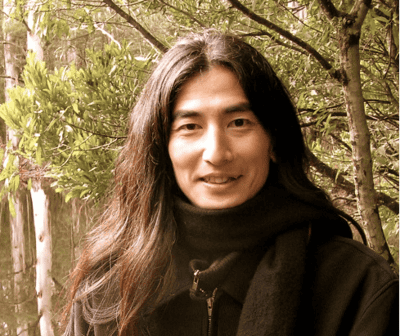
We’re joined now by Koji Tanaka. He’s an ARC Fellow at the Australian National University in Canberra and co-author of “Two Kinds of Logical Impossibility. Koji, welcome to Philosophy Talk.
Koji Tanaka
Thank you for having me.
Josh Landy
So, Koji, you’ve been writing about him impossible worlds for some time. Now, how did you first get interested in them? Was it from reading Lewis Carroll as a kid?
Koji Tanaka
Well, I was born in Japan. So I am a Japanese. As a typical Japanese, I’m a Buddhist, I was raised as a Buddhist. So after studying philosophy in Australia, naturally, I got interested in learning about Buddhist philosophy. And maybe four or five years ago, I was reading one with the passages of Abu this text, and I realized that maybe this text is dealing with logical impossibility. Um, so that’s how I got interesting. Thinking about impossibility.
Ray Briggs
So Koji, Josh and I were arguing earlier about whether there’s any such thing as an impossible world. I think there is and Josh thinks there isn’t. Which of us is right?
Koji Tanaka
I think you’re right,Ray. I think impossible, impossible for us to exist because I think the world we live in our world is impossible.
Ray Briggs
Our world is impossible. That’s that’s a big headline. Why is our world impossible?
Koji Tanaka
Yeah. So I do think the world we live in does exist, and therefore I do think that impossible worlds do exist.
Ray Briggs
Right, I’m not worried about the part where It exists, I’m worried about the part where it’s impossible. Why is it impossible?
Koji Tanaka
Well, so I think this depends on how you define impossibility. So So there may be three or four different ways of, of defining impossibility. And I think if you understand in the way that I understand that, then the world we live in, comes out to be impossible.
Ray Briggs
So what is your understanding of impossible?
Koji Tanaka
So the way that I understand the impossibility is that if you think about just just to give you a simple picture of what a word is, let’s say a word consists of facts. There’s just simply basically be present. They tell you what happens at the wars. And then there’s their laws. And the laws tell you what have to happen at the world.
Ray Briggs
So okay, so like effects would be like, I’m talking to Koji right now about impossible world.
Koji Tanaka
That’s right. Yes, seeing things which are true in the world or of the world.
Ray Briggs
And a law would be like, if I talk to Koji, and I press the right buttons on the on the radio soundboard, then the broadcast will go out to all of our listener.
Koji Tanaka
That’s right. Yeah, yeah, that’s right. Yeah, yeah. Or if you drop a ping in mid air, it’s all to drop to the floor, or something of that kind. So so a law essentially tells you what ought to happen. And and facts, I guess, are the things which do happen. And I understand the impossibility to be a discrepancy between the two. So the fact somehow basically disobey, what ought to happen. And I understand the impossibility to be this discrepancy between the two.
Ray Briggs
So impossible worlds are kind of worlds with lawbreaking in them. Is that right?
Koji Tanaka
That’s right. Yes. And I do think that the world that we live in, is a world like that.
Josh Landy
It’s a renegade world. But as I understand it, there are these different kinds of impossibility, right physical impossibility, an animal that talks metaphysical impossibility, something like time travel may be and then logical impossibility, where it’s the kind of thing ran I were talking about earlier, the Tarot Goldbach. Seven plus five equals 12, and doesn’t equal 12, which is the one we should focus on for the, for the purposes of our conversation.
Koji Tanaka
So in the literature on impossible wars, people do focus on logical impossibility. But the way I understand the impossibility can be generalized. So the way that I understand that does doesn’t really matter whether I’m talking about logical impossibility, or physical impossibility, because the what matters for me is, is that discrepancy between laws and, and facts are what happens. So if what happens, essentially, it goes against what ought to happen? Doesn’t matter what kind of laws we’re talking about. They it is impossible, so my account is generalizable, whereas most accounts aren’t
Josh Landy
You’re listening to Philosophy Talk. Today we’re thinking about impossible worlds with Koji Tanaka from the Australian National University.
Ray Briggs
Do you enjoy impossible stories? Do you try to make them make sense? Or do you revel in their paradoxes?
Josh Landy
In search of the round square—along with your comments and questions when Philosophy Talk continues.
Radiohead
January has April’s showers, and two and two always makes up five.
Josh Landy
Is it really impossible for there to be a world where two plus two equals five.?I’m Josh Landy. And this is Philosophy Talk, the program that questions everything…
Ray Briggs
…except your intelligence. I’m Ray Briggs, and we’re thinking about impossible worlds with Koji Tanaka from the Australian National University.
Josh Landy
Got possible questions about the impossible? Email us at comments@philosophytalk.org, or comment on our website. And while you’re there, you can also become a subscriber and imagine the possibilities in our library of nearly 600 episodes.
Ray Briggs
So Koji, earlier you were telling us that our world our actual world is an impossible world, and that it’s an impossible world, because the facts kind of break the laws, what are the law breaking facts that you’d like to point us to?
Koji Tanaka
So I do believe in true contradictions. And that means that the world we live in to contain contradictions. And so for example, the sentence like what is called the liar sentence, which says that this, this very sentence that I’m uttering is not true. And I do think that sentences like that are both true and false. So I do think that they are contradictions, or our movement do realize contradictory states. Now, I don’t have any new arguments to show that they are contradictory. But what I do think is that what this entails is that the world we live in, is impossible.
Josh Landy
I love that. I mean, maybe it’s because I’m a literature guy, but I love the idea that we’re already living in an impossible one. I mean, I feel like Barr has said it best. He said, You know, the We the collective have drempt the world but we’ve allowed there to be in it crevices of unreason, which tell us it’s false. And yeah, he points to Zeno’s paradoxes. He points to some stuff. And Kant, I mean, for example, that the world, both kind of has a beginning and kind of doesn’t have a beginning. But we could think of, you know, paradoxes of infinity, we could think of quantum physics, something can be a wave and a particle, the entanglement things can be a part and together, it seems like the world is really weird, why not? But I see I see Ray looking skeptical.
Ray Briggs
I don’t know Josh, like it. I will grant that koji is right, that there are true contradictions, which not everybody is willing to grant. But if there are true contradictions, what kind of laws of logic? Could there be that forbid those contradictions? Like if, if the world doesn’t obey them? How can they be laws of logic?
Koji Tanaka
So if you believe in true contradictions, then you probably want to be so called a para consistent logic Shang, and what that means is that if there is a contradiction, it does not mean that everything is true. So So most logicians do think that if there is a contradiction, if there was a contradiction, anything would be true. Now, I reject that as a para consistent position. However, being a product consistent position also means that I believe in the law of non contradiction. So the law of non contradiction says that every contradiction is false, or every contradiction is not true. But if there was a true contradiction, then then what that means is that the negation of a contradiction may or may not be true, even though the law of non contradiction is is varied is a valid rule of logic. So So what that means is that if there was a conditional contradiction, that confirms the law of non contradiction, as well as that disobey is the law. So that’s why I think that the actual water world we live in is impossible.
Ray Briggs
Okay, well, I see how you get there. I’m curious also about other impossible worlds. So even if somebody is not a paraconsistent logician, they probably think maybe the actual world is a possible world. But there are other impossible worlds. So why would such a person believe in impossible world? It’s like, what what are the reasons are there besides the actual world is impossible?
Koji Tanaka
Right, so even though you may not think that there are all wars, the world we live in, is contradictory. You might think, or you might think that I can, or you might, you might think, well, I can imagine a world could be contradictory. So for example, I can imagine a world where, you know, this may be a controversial issue, but two plus two is five, at the same time, it is full as well. Or you know, that you might think of a fictional award where where something like that was the case. And then, depending on what laws of logic you have in mind, the fact that the contradictory fact, may disobey the law that that are operating at a wall. So if you can imagine a world like that, then according to my account, that is an impossible world.
Josh Landy
Okay, so that’s a pretty good rule of thumb, right? If I can imagine it, then that’s an impossible world as it were exists. But can we imagine that that’s something I’ve thought quite a lot about, I don’t know where I stand on that. I mean, I love my fictional worlds that kind of don’t add up, like, I mean, I love my greet, for example, right? And in, in my greets incredible paintings you have, you know, a painting where it’s both day and night at the same time. Yeah, you have a painting with as a rock just hanging in the air, a huge rock, right? You have a bird made up of sky, all these things that are impossible. But am I really imagining that world? Or am I doing something else? For example? Am I imagining different pieces but not putting them together? So so the country the full force, the contradiction doesn’t really hit me. Like, let’s say, I’m trying to imagine that two plus two equals five world. But then in that world, you’re telling the story, once upon a time, there was a land with two plus two equals five, and then then one person came along, and another person and two more people, I think I’m gonna imagine for people. So are we really imagining those impossible worlds?
Koji Tanaka
Well, I think that depends on what how you understanding the laws that you think has to operate? Because according to my account, what counts as impossible is contingent on what what laws you are talking about, and what word you’re talking what kind of word you’re talking about. So if all All of those what happens at the walls do disobey the laws that you have in mind, then I do count that as impossible.
Ray Briggs
All right, so we’ve been talking quite a bit based on your account of what counts as an impossible world. And you mentioned that there were some others, could you give us one of the alternatives?
Koji Tanaka
So one popular way of understanding impossible wars, is that, let’s assume that there are certain laws operating at our world. Now, let’s imagine a world where the laws are a bit different. So I’m not a physicist, but I believe it’s true that in in our world, nothing can travel faster than the speed of light. But you I think, you can imagine a world where same boat can run faster than the speed of light. If anyone can break the speed of light, that I think would be Usain Bolt. And, and I think you can imagine a world like that. Now, you might then think that what that is an impossible world because the laws that the laws of physics must be different from our world. And you might count that is impossible to work on that is one popular way of accounting for impossibility.
Ray Briggs
So you think worlds are impossible if they break their own laws, and you could think of world is impossible if it rejects our laws. I guess you could also think a world is impossible if it breaks our laws, is that different from rejecting our laws?
Koji Tanaka
Yes, I think there are two different ways of understanding rejecting Why is going against. The other one is what I call being silent about the laws. So So what if the if what happens there are silent about the laws? Meaning that the basis the facts, say, Well, I don’t care what you say, what what you say, would be the case, I’m just I’m not gonna say anything about that. Then then the facts are silent about the laws. And I think there are two ways in which that can happen. Why is due that the fight somehow disobey. The other way is that the facts are basically silent about the laws. And either way, somehow there’s a discrepancy between the laws and what’s happened. And and when that happens. I think that’s, that’s impossible.
Josh Landy
You’re listening to Philosophy Talk. Today, we’re thinking about impossible worlds with koji Tanaka from the Australian National University and coaching we’ve got a question from Daniel on our website Daniel asks, Are there unthinkable worlds? If so, how could they be known? What do you think, Koji?
Koji Tanaka
Yeah, I think the I Will thinkable words is just that they are at the same time thinkable. So So you might think that that’s just going to be impossible. And if I’m thinkable what is impossible, Soviet, um, because if there’s an unthinkable word, I do think that that has to be thinkable to you ever to think that that is unthinkable. So yes, that’s, that’s better be thinkable as well.
Ray Briggs
This makes me worried as somebody who likes impossible worlds, but maybe not as close to home as the actual world. I want to say, All right, there are lots of unthinkable worlds, there are lots of impossible worlds. If I have to admit that they’re also thinkable and possible, as well as unthinkable and impossible. It looks like I’ve kind of brought the impossibility home to the actual world. Can I just leave the impossibility kind of further away in logical space without having to bring it home like that?
Koji Tanaka
Well, I think my view is that you can’t you because what counts as impossible is contingent on on a number of factors. And so so I don’t think that you can just keep impossibilities to the fringe. Because I think impossibility is basically among us. And, and it’s maybe in the world we live in, or it’s maybe a word, which is kind of close to our words, but not quite our word, or it could be farther away. But I don’t think you can quarantine impossibility to the fringe of this space of possibilities and impossibilities.
Josh Landy
We’ve been talking quite a bit about impossible worlds that are impossible because they violate laws of physics, or they violate laws of mathematics. Two plus two equals five, for example. But you know, some of my favorites are ones that violate if you want the laws of fiction or the I don’t know, laws of ontological levels. And the kind of thing I’m talking about are, are fictions that break the fourth wall fictions where you have characters saying, Hey, I’m a fictional character. And one of my favorites is Flann O’Brien’s novel at swim two birds where the characters rebel against their author and drug him so that they can go about their lives undisturbed. But there’s a bunch of other examples right where we’re Somehow impossibly, the characters know that their characters the characters know the author, the characters can interact with the author, attack the author apologize to the author, is this, would you call these impossible worlds? And is there anything particularly interesting about them that that sets them apart from the kinds of cases of violation of physics?
Koji Tanaka
Yeah, I never thought of impossibilities in fictions to these to be that interesting, I have to confess. So I haven’t thought too much about impossibilities, specifically in fictions. But But I do think that they are impossibilities in fictions, too. And in the case of where you are essentially interacting with the authors, I think, if you think that somehow the interactions have to go in a certain way, and if you think that what is happening there goes against that, then I do think that there is an impossibility there. So so it’s I’m not sure that whether the impossibility is in the fiction itself, or the in the interactions with the fiction, but I do, I’m happy to characterize that as impossibility.
Josh Landy
Yeah, well, I guess the kind of thing I have in mind with that example is the there are these different levels of reality. And you’ve got a creator who invented a whole set of creatures that, in principle, don’t know about the Creator, right. And so that there’s a kind of analogy there, to the way in which some religious people think about the actual world, that there’s a creator out there, who created all of this, that Creator knows everything about us, knows everything about our world, but we don’t know that much about him or her or it. And so similar thing applies in the self reflexive fictions and these fictions that break the fourth wall, the author is supposed to know about the characters, but the characters aren’t supposed to their, you know, often looks down into the fictional world, that’s fine. But the character is looking up. That’s a violation. And it’s kind of a violation that reminds us of the situation that maybe we’re in, right, where we’re, we’ve been created, maybe, and we, and right, and, and so these different levels of reality, and we can’t violate the rules that apply to levels of reality. Do you think that makes sense? Or am I just overreacting, like, like the literature professor that I am?
Koji Tanaka
No, I would buy into that. I might just, I probably should. So I’ve wrote it down on the actual publish that actually.
Ray Briggs
Yeah, please feel free. So I’m wondering now, whether you think that in addition to impossible worlds, there are possible worlds?
Koji Tanaka
Yes, I do think they are possible two words, which are not impossible. But But I guess, I do think that what which words, so if you have a set of words, and kind of think of a word could be like this, our world could be like that, which counts as impossible and which kinds as possible, is is contingent on what the perspective that I’m inhabiting. So so so I’m in a certain war that I live in, which gives me a certain perspective or perspectives. And then from that perspective, I look at all kinds of wars, and then what counts as possible and impossible depends on the perspective that you inhabit. Um, so so. So I don’t think that he is a war that is impossible. What I want to say is that he is a world. And from this perspective, I think that is impossible, even though from another perspective, that is possible.
Ray Briggs
Okay, so it sounds like worlds are not just possible or impossible. The way things are not just legal or illegal, sort of something can be legal here in the US, but illegal in Australia. I still, I’m still a little worried. So given the laws here in the actual world, are there any worlds that are possible according to those laws, even if the actual world isn’t?
Koji Tanaka
Yeah, so if the word what what happens at that word may be slightly different from what? What’s happened here? But nevertheless, what happens there is just still within the laws of the of our word, then that counts as possible, because they because what happens there does not violate the laws of our world. So from our perspective, that counts as possible.
Ray Briggs
Should I feel unlucky that I live in one of the impossible worlds rather than in one of the possible ones then?
Koji Tanaka
Well, I shouldn’t say that. We are lucky or unlucky. That it depends on the perspective I think that we are. I do think that we are lucky that we live in a world For the wild, but that’s I think, personal taste, I think.
Josh Landy
I know that one of the worries that people have about impossibility is the worry that sort of, you know, all bets are off the right anything goes. If if you’re allowing impossibility if you’re allowing the laws of physics, or any kind of the laws of logic, any kinds of laws to be violated now and again, well, what can you know, what can you predict anything can go? Is that right? Or is that kind of an overreaction? Is that Is that too, too strong a worry.
Koji Tanaka
So lots of people do think that a word like that is impossible. And and a lot of people do think that that’s the pragmatic, impossible word. I do recognize that that’s maybe impossible. But I reject the view that that is impossible, because there may be a law which allows you to be like that. And as a matter of fact, there is the most venerable system of logic called classical logic, which I think most logicians do, believing, according to that, a contradiction entails everything. So a word like that where anything is true, will be possible, according to classical laws of logic. So I think what, whether that’s conscious possible or impossible, I think that depends on the laws.
Ray Briggs
But if everything is true, how do I distinguish between sort of the stuff that I’m allowed to assert and believe? And the stuff that I’m not allowed to assert and believe? Like, I usually think there’s a kind of interesting difference between the sky is blue and down is up. But if they’re both just equally true, and equally false, isn’t that a disaster?
Koji Tanaka
Well, it’s, I think it’s to really wait. It’s a very strange world. But I don’t think that’s impossible. It’s just that it’s just that it’s bit hard to have a life in that kind of war. That’s probably true. But that does not make it impossible.
Josh Landy
Yeah, I just don’t want to buy a house there. You’re listening to Philosophy Talk. Today, we’re thinking about impossible worlds with koji Tanaka from the Australian National University.
Ray Briggs
Should we spend more time pondering the impossible? Would it make us more open minded? Or would we just lose our grip on reality?
Josh Landy
Impossibility, imagination, and improvement—plus commentary from Ian Shoales the Sixty-Second Philosopher, when Philosophy Talk continues.
Katy Perry
You’re hot then you’re cold, you’re yes then you’re no, you’re in then you’re out, you’re up then you’re down.
Josh Landy
What happens if it’s yes, and it’s no—is that just impossible? I’m Josh Landy, and this is Philosophy Talk, the program that questions everything…
Ray Briggs
…except your intelligence. I’m Ray Briggs. Our guest is Koji Tanaka from the Australian National University, and we’re thinking about impossible worlds.
Josh Landy
Koji, all of this is really fun to think about. But is it just fun? Or are there some real life benefits from thinking about impossible worlds?
Koji Tanaka
So I think the answer is yes. May not be impossibility as such, but thinking through impossibility, and what that what the impossibility means. I think that’s have a real life benefit. So I think what’s seems to happen in the world right now is that we are politically completely polarized. And we just can’t even have a debate about anything, because everyone is essentially asserting their value. But one way to argue against someone else’s view is to say that if your view while right, then all of this absurdity happens, or all of this impossibility happens. So you might think that if your view of impossibilities, right, then then all of this impossibility must be the case as well. But in order to do that, you can’t just treat when, when you say your view of impossibility was true. You can’t just assert that as an impossibility claim. If you want me to come along with you. Because if you just say that, Oh, that’s just impossible, I’m not going to talk to you about it, which is what happens now. But what you have to be able to do is that, okay, there might be something interesting about this, meaning that there might be some possibility involved in it. It just that when you come down to it, there’s impossibility involved. What that means is that you can’t just say that your view is impossible from the beginning. So I think that according to my view, what counts as possible and impossible is completed. relativized is completed contingent on our situation. So So you have to be able to understand where you are coming from. Meaning that you can’t simply say that your view is impossible, you cannot use a redescription of your view, as a as a claim that is impossible. You have to somehow take that as somehow impossible, then you can derive impossibility, then that’s the way you can at least have a dialogue. So So I think thinking through impossibility is very important.
Ray Briggs
So this feels related to some debates that I’ve heard philosophers have about how do you reason from a supposition? So there’s this one kind of view that if a supposition is impossible, you just can’t kind of reason within it. You just once you suppose an impossibility, okay, everything’s true, we’re done. And it sounds like you think that’s kind of not very politically helpful, but maybe not also very philosophically helpful. Can you say more about that?
Koji Tanaka
Yeah. So so so I think it is very common for philosophers. But also, this is very common in mathematics, to say that, if something were the case, then you can derive all of this absurdity. Or if you interpret the absurdity to be impossibility, what seems to be happening there is that when you say, if something were the case, that’s not being asserted as impossibilities to start with, what is impossible is what’s being derived from that supposition. So So what counts as possible and impossible, has to be contingent on the context in which that claim to me started.
Ray Briggs
So I want to think more about this argument form two. So this is also kind of a useful mathematical argument form. So I suppose something I don’t know whether it’s possible, I reason to a contradiction. And I say, Oh, it must not have been possible because the stuff I could derive from it was impossible. Do you think that that’s a good way of argument? Or should we revise our practices? So the mathematicians don’t argue in that way anymore?
Koji Tanaka
Well, I think that is a good. I think that is a good argument, argument form. And I think I’m think we do that all the time. But I think to think that that kind of argument form, cannot get off the ground. I think that is a mistake, because that’s where a revise all you got is simply to set our values, or we say, This is my value, and whatever else the value that the owner said, that’s got to be impossible. So if we want to have a dialogue, at least we have to be able to treat someone’s claim to be somehow possible in the way that when you have a supposition and say, I suppose this were the case, then you shouldn’t be asserting that as impossible to start with. You should be deriving impossibility as a result of that. In that context, you can then say, Oh, actually, my assumption got to be impossible.
Josh Landy
So it sounds like we’ve got two benefits on the table from thinking about impossible worlds and taking them seriously and trying to kind of dive into them. One is it’s good for debate, it’s good for exchange. Another is maybe there’s some little nuggets of gold amid a bowl of the thing you just consider to be nonsense. But maybe we could add a third there’s a narratologists named Maggie law, Ryan, and she has this lovely line about impossible fictions. She says they make us smarter, right. These impossibly diving into an impossible world can make us smarter. We have to, you know, get those cogs and gears turning to figure out well, exactly how is this world and possible and what is what kind of other sense could it make? Do you think that makes sense to Kochi that there could be something about our engagement with impossible worlds? That’s a kind of good exercise for the brain?
Koji Tanaka
Yeah, I don’t think so. Because Because you do have to stretch your imagination, I guess, to the limit, so to speak. Because what you are trying to imagine, is some a situation or maybe a story, where it just does not cohere with what you ought to be doing or what you ought to be thinking about. And so to go beyond that, I’m not sure whether I’m good at doing it, but I think to go beyond that, I think is a really good some intellectual exercise.
Ray Briggs
So koji way back at the beginning of the show, you mentioned that it was a Buddhist text that first got you interested in impossibility, and impossible worlds. Can you tell us more about that text and what it said?
Koji Tanaka
So the text is called muda Mazuma CARICOM and the author is Nagarjuna. And he was considered to be I guess, the first or second And century Buddhist philosopher in India. And there is a famous I guess it’s not so that I’m not sure the particular passage as such, but there is a his famous for that kind of argumentation that he seems to be putting forward. So, the way that he argues is that he has he suppose is for he has four assumptions, and say the word could be either this, this, this or that. And what he does is that none of none of the above or none of them is is the case. Now, there is a debate as to whether he is deriving a conclusion out of after rejecting all four, but some people do think that he is deriving a conclusion, what that means is that the conclusion has to be logically possible. But that conclusion has cannot be cast to be impossible in terms of how the reality must be. So, this is how I started thinking about impossibility.
Ray Briggs
So, he thinks there are four possibilities there the only four possibilities and none of them are true. What are the four possibilities?
Koji Tanaka
So, the four possibilities is that is the case. And so he has a different, he goes through different topics, and reviewed all four. But the forms of those, those four possibilities are that it is this, or for example, everything is caused by myself, for example, or everything is caused by something else. And then the third one is looks like a conjunction of the two. It’s It is everything is caused by itself and caused by something else. And the fourth one is basically neither. And he goes through different topics. So, so I mentioned the example of causation, or he goes through different examples to show that no of them are horse.
Josh Landy
That’s so interesting and reminds me of Zeno’s paradoxes to mention those again. So Xena, you know, one of Zeno’s paradoxes is, you can’t get to the next town, because you have to do that you have to go halfway first. And to get to there, you have to go quarter the way first and to get to the right. And so that’s, that’s one. He’s also got an arrow paradox, where, how can an arrow move, after all, it’s stationary at any given moment. And the beauty of these two paradoxes is you can solve the arrow, as long as there is no such thing as a smallest unit of time. And you can solve the bisection. The first one I talked about, if there is a smallest unit of time. And so this is just I mean, it’s mind blowing ly brilliant way of basically reminding us, we’re living in an impossible world. And I’m looking at Ray while I’m saying this, because I want you to convince Ray Kochi, we really are living in an impossible world. Can you do it?
Koji Tanaka
Can I convince Ray of anything? That’s that’s a hard question to answer.
Josh Landy
Do you have any more arguments to throw at us to convince skeptics that, that we really are the world we’re living in right now the the real world is in fact impossible?
Koji Tanaka
Well, I’m not sure that we don’t have a knockdown argument. But but but think of a possibility, where whatever the laws that you think are operating in our world, you are wrong about that. So that means that you should be able to think about what what our world is like, but slightly different laws. Now, you then you might think that, okay, I may have to accept that the world we live in. Maybe paraconsistent were no no contradictions and did everything or something of that kind. None. And if you can’t accept that, then I think you should be able to accept that. Okay, maybe our word is impossible.
Josh Landy
Well, Koji, it has been impossibly great talking to you today. Thank you so much for joining us.
Koji Tanaka
Thank you for having me, it was my pleasure to be here.
Josh Landy
Our guest has been Koji Tanaka, ARC Future Fellow at the Australian National University and author of “Logically Impossible Worlds. So Ray, did Koji convince you?
Ray Briggs
Well, I’m not totally convinced that the actual world is an impossible world, but I think it’s at least possible that it is
Josh Landy
Touché. We’ll put links to everything we’ve mentioned today on our website, philosophytalk.org, where you can also become a subscriber and check out our library of nearly 600 episodes.
Ray Briggs
And if you have a question that wasn’t addressed in today’s show, we’d love to hear from you. Send it to us at comments@philosophytalk.org and we may feature it on the blog.
Josh Landy
Now: the impossibly fast thoughts of Ian Shoales the Sixty-Second Philosopher.
Ian Shoales
Ian Shoales… I don’t know about impossible world but we probably live in a possible world deemed In fact, the best of all possible worlds by copy Leibniz in the wake of coining the word ‘theodicy’ meaning “justice for God.” Give God a break regarding creation. I mean, come on, can you do better? And this is an offshoot of Monadology, a kind of precursor to quantum physics. Monads are the immaterial building blocks of everything from sunlight to dinosaurs. They’re like metaphysical Legos, in that they can only be put together per instructions, intuited by fellow monads. You can’t turn a Lego Star Wars kit into a Lego Godzilla, and monads that make humans don’t make chairs. They all follow different rules, which exist in the mind of God, the first monad. There’s no free will, really, but God is perfect, and so would anything he slaps together. Therefore this is the best of all possible worlds. Leibniz may have been the smartest man who ever lived. He invented the world’s first calculator, and calculus for crying out loud. Well, so did Isaac Newton at pretty much the same time. Newton claimed that Leibniz stole the calculus from him. This led to all kinds of trouble for Leibniz, since Newton was firmly embedded on the smartest guy in the world throne, and had the might of England behind his every mutter. Or however he issued opinions. Newton was a prickly paranoid defensive vindictive fellow, not to put too fine a point on it. Leibniz had a sunnier disposition, but he was also kind of a suck up, it seems, looking for people to underwrite his output, which was staggering and diverse—half of his writing has yet to be catalogued. He supported himself for years by being a kind of smart guy for hire. He advised the Elector of Mainz, second in charge of the Holy Roman Empire, during the Thirty Years War, to encourage France to invade Egypt so they won’t pick fights with German speaking nations. Didn’t happen, but Napoleon picked up on that a little later on. So you can see how Leibniz might have made enemies. Being the smartest guy around, his words had the ring of authority which, when removed from the authoritarian ring – that is when the Elector of Mainz passed – subjected him to toxic negativity, as the kids say. But he remained cheerful, personable, throw out the opinion, move on to the next, a history of the Habsburgs, perhaps, or a way to make ships sail faster, maybe I could be a surgeon! Can’t be that hard to learn! He never had a magnum opus. Most of his writings came in spurts and dabs, but he was clear and plain spoken. As if his life wasn’t amazing enough, he would exaggerate his resume, so he came to have a reputation as a not entirely trustworthy person. He was also somewhat obsequious- or, if you prefer, charming and well mannered-around those who might give him money. He also became out of touch with the times, dressing in the court fashion of a Paris thirty years gone. All of which may explain the disdain many had, in the wake of Newton’s accusations, of Leibniz’ notion that this is the best of all possible worlds. Voltaire drew Leibniz as Pangloss in CANDIDE, the optimist who winds up feeling okay about rotting from syphilis, because syphilis may have been brought to Europe by Columbus but he also brought chocolate. Though Leibniz ended his days on the outs, he lived by his wits and was mainly rewarded. But if Voltaire is right, it might not be the best for everybody, or for us in general, or even me in particular. What with bad knees and stiff necks, not to mention serial killers and crypto, it is pretty slim pickings in the perfect world department. But come on, let it go. All possibilities are here in a whirl of becoming. This isn’t a utopia, but it is a playland of God’s devising, extrapolated from math and speculation. Maybe Leibniz was talking about monads themselves, for whom the world is always perfect really, like a model kit fully assembled with all the parts still there. And who’s got the instruction booklet? Monads, man. I tell you they got it made.I gotta go.
Josh Landy
Philosophy Talk is a presentation of KALW San Francisco Bay area and the trustees of Leland Stanford Junior University, copyright 2023.
Ray Briggs
Our executive producer is Ben Trefny. The Senior producer is Devon Strolovitch. Laura McGuire is our Director of Research.
Josh Landy
Thanks also to Jamie Lee, Elizabeth Zhu,, Emily Huang, Merle Kessler, and Angela Johnston.
Ray Briggs
Support for Philosophy Talk comes from various groups at Stanford University, and from the partners at our online community of thinkers.
Josh Landy
And from the members of KALW. Local Public Radio San Francisco, where our program originates.
Ray Briggs
The views expressed (or mis-expressed) on this program do not necessarily represent the opinions of Stanford University or of our other funders.
Josh Landy
Not even when they’re true and reasonable. The conversation continues on our website, philosophytalk.org, where you can become a subscriber and gain access to our library of nearly 600 episodes. I’m Josh Landy.
Ray Briggs
And I’m Ray Briggs. Thank you for listening.
Josh Landy
And thank you for thinking.
Doctor Who
I know this is gonna be hard to believe, Doctor, but for once I mean you no harm. Like Alice, I try to believe three impossible things before breakfast.
Guest
Related Blogs
-
December 15, 2023
Related Resources
Kiper, Dasha (2024). Travelers to Unimaginable Lands Stories of Dementia, the Caregiver, and the Human Brain.
Kafka, Franz (1915). Metamorphosis.
Melville, Herman (1856). Bartleby, the Scrivener: A Story of Wall Street.
Tanaka, Koji and Alexnder Sandgren (2024). The Many Faces of Impossibility.
Get Philosophy Talk
