The Reality of Time
January 1, 2017
First Aired: May 18, 2014
Listen


St. Augustine suggested that when we try to grasp the idea of time, it seems to evade us: “What then is time? If no one asks me, I know what it is. If I wish to explain it to him who asks, I do not know.” So is time real or merely an artificial construct? Is time a fundamental or emergent property of our universe or a part of our cognitive apparatus? Do we live in a continuum with a definite past and present, or do we live in a succession of ‘Nows’, and if the latter is the case, how does it affect our perception of memory or recollection? John and Ken take their time with Julian Barbour from the University of Oxford, author of The End of Time: The Next Revolution in Physics.
- Memory
- |
- Perception
- |
- Physics
- |
- Reality
- |
- Time
John opens the show by saying that nothing seems more basic or real than time, that indeed every moment confirms the existence of time. He brings up metaphysician John McTaggart’s view of time being unreal, and Ken wonders why something as obvious as the reality of time is being disputed or considered news. John explains that philosophers are not the only ones who are doubting – physicists, too, are considering the unreality of time. Ken wonders what it means to say that time is unreal, whether it is, for example, a denial that there is a past, present, and future. John considers a very detailed calendar: the events it represents do occur, and the calendar is a structure imposes strict order onto these events, a past, a present, a future. But perhaps we are mistaken in thinking of time in this linear way, so the view we have of how events fit together might be false. If we look at the vastness of the cosmos or at quanta, says John, our framework of time, of a before and an after, seems flawed. Ken considers how change fits into John’s argument – change is real, and does that not imply that real time exists?
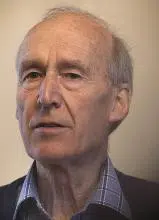
Ken and John are joined by guest Julian Barbour, Visiting Professor of Physics at the University of Oxford and author of The End of Time: The Next Revolution in Physics. John first asks Julian what got him interested in the thrilling subject that is time. Julian explains his fascination with astronomy at a young age, which then translated into almost acquiring a PhD in Astrophysics. He changed learning course in his late 20s, when he became more interested in fundamental physics.
The accidental stumble upon a newspaper article about the work of theoretical physicist Paul Dirac, who was one of the major discoverers of quantum mechanics and who wanted to make a quantum theory of the universe and questioned the famous four-dimensional symmetry of Einstein’s theory of general relativity, inspired him to pursue concerns about time.
John asks Julian why physicists are having such a problem with time: if physics is the science of explaining how events unfold in time, then how can it then turn its back on its basic concept and doubt that it is real? Julian explains that there are two main causes under the larger umbrella that is the several decade-long attempts to combine Einstein’s theory of general relativity with quantum mechanics. In 1905, Julian explains, Einstein resolved that there was no concept of individual time, that instead there was spacetime, something which has been supported by numerous experiments since. 20 years after Einstein’s theory, quantum mechanics, which has a rather Newtonian idea of time, was discovered, and the reconciliation of these two theories has troubled physicists to this day. Julian also brings up the work of Bryce DeWitt and the creation of ‘The Problem of Time.’
Ken says that we ordinarily think about time as having three phases, namely the past, present, and future. He asks Julian whether this temporal vocabulary is nonsense given that it refers to something that is possibly nonexistent. Julian denies this and explains his view that there are many ‘Nows,’ many instants that all exist. What right, he wonders, does he have to say that from the perspective of this Now, this vibrant moment, that Now, one which took place 5 minutes ago, does not exist any longer? At the same time, in this Now, he has memories of other Nows, Nows which are different. The crux of the question has to do with difference, not with moving between Nows. John asks whether future Nows are just as real as past Nows and whether that would undermine the idea that there is a future that is open and free. Julian explains it would not, bringing up the Many Worlds Interpretation from quantum mechanics and suggesting that there is no reason why there shouldn’t be many routes to take in the future.
Ken asks Julian to elaborate on the notion of time being either an emergent property or a secondary quality, that is, one that is in our minds. Is time a mental phenomenon or an actual, real thing? Julian explains that it is both: emergent in the sense of memories, a secondary quality when what is being considered is the flow of time. John then asks Julian whether on this view causation is also a secondary property, and Ken later asks how to reconcile being in different frames of reference, as Einstein suggested, with the universe having a determinate history, a view more embraced by quantum mechanics. Ken and John welcome audience participation, and topics such as McTaggart’s view, the arrow of time, the relationship between space and time, and whether time is merely a human conception, one not experienced by, for example, animals, are discussed. The conversation ends with the influence of Leibniz on Julian.
- Roving Philosophical Report (Seek to 5:55): Caitlin Esch talks to Jeffrey Hollis, member of the Antiquarian Horological Society in the UK, to get a clearer sense of how people throughout history and in different cultures have measured time. The etymology of the word clock and the history of telling time are contemplated, as are different types of clocks.
- 60-Second Philosopher (Seek to 46:25): Ian Shoales discusses how the fragmentation of time will be increased in the future: technological abbreviations of time will supposedly benefit shorter time and attention spans and lead to more positive back-and-forth collaboration.
Ken Taylor
Welcome to Philosophy Talk the program that questions everything…
John Perry
…except your intelligence. I’m John Perry.
Ken Taylor
And I’m Ken Taylor. We’re here at the studios of KALW San Francisco.
John Perry
Continuing conversations began at philosophers corner at Stanford where Ken and I teach philosophy.
Ken Taylor
And today we’re thinking about the reality of time.
John Perry
Well, Ken, nothing seems more basic or real than time. I mean, every moment confirms the existence of time yet many philosophers from Zeno of Aelia to Augustine to many others find it deeply puzzling and some, like John Ellis McTaggart even claimed with fancy argumentation that time is unreal.
Ken Taylor
No, this is supposed to be news, John, a bunch of philosophers doubting the reality of something that seems so obvious and irresistible to everybody else. That’s news.
John Perry
Well, the news is, it’s not just philosophers. It’s physicists, like Stephen Hawking, who wrote a book on the short history of time, but lately he’s been saying, Well, time, maybe it’s unreal. Yeah, no, it’s it’s that’s news.
Ken Taylor
Yeah, that’s news. But you know what? I still I don’t get it. What does it even mean to say that time is unreal? Is that denying that there’s such a thing as the past or the present or the future? denying that we’re, we’re not moving from past to present into the future? I don’t get it.
John Perry
Well, let me explain how I get my mind around it to the extent that I do. Imagine I’ve got a very detailed calendar on my wall. It’s basically a list of events, last week’s pizza party yesterday’s meeting with the dean, tomorrow’s dentist appointment. Now, no physicist is going to convince me that the things in the little boxes on my calendar don’t occur event happen, things change.
Ken Taylor
Well, wait, exactly you’re making My point isn’t that precisely what the physicist is supposed to do is supposed to give us a grand theory of how all the events in the universe, from the past down to the present into the future, unfold through time isn’t a physicist who denies the reality of time, so denying the reality of the events and the change that you were talking about? I don’t get it.
John Perry
Well, that seems to me where there’s a bit of room for maneuver. Because think about this super detailed calendar divided into years, months, weeks, days, hours, and even minutes. I mean, that’s quite a bit of structure that really goes beyond our experience of everyday events, right? The structure imposes a strict order on the events, and they fall either into the past or the future, or except for this particular moment,we call now.
Ken Taylor
But I’m not sure I’m following. A calendar, sure it’s a useful framework for organizing our experiences and our managing our plans and expectations and all that. But are you saying that it’s a good model? For what time really is? I’m not sure I follow?
John Perry
No, I’m saying that it may be a useful framework for those of us with a kind of EarthBound existence. But you know, once we thought the Earth was flat into the center of the universe, we had this framework that works well, for a lot of purposes. But maybe, maybe our concept of time is limited or even false in that way. So it wouldn’t be too alarming of a physicist to say, surprise, you have this completely wrong view of how these events fit together, your concept of time is just over simple and lacking. It’s really not real.
Ken Taylor
I guess I get I mean, physicists do that to us all the time. They’re always embarrassing common sense. So you’re suggesting that common sense ideas like before and after today, tomorrow, yesterday, and so on, they’re all just a framework that maybe helps us organize events from a human perspective, but aren’t really real?
John Perry
Right, when when we are rather than physicists look at the vastness of the cosmos, and the intricacies of quanta and try to come up with a theory that makes sense of all of it, it could turn out that our little earthly framework of of before and after and time doesn’t fit very well.
Ken Taylor
But that’s implies that our framework for segmenting and measuring time is something may be purely subjective with no objective reality. But then what about change, John? Change is real. That’s not just subjective. Some people say yes to subjective impressions, but then the impressions change. So you still got change. And once you’ve got real change in the universe, don’t you have real time I? I don’t get it.
John Perry
Well, I think we need some time to think about that. And then maybe we’ll change our minds and come to see the change is not real, either. Well, now you’re just talking in paradoxes. John? Well, today’s paradox is tomorrow’s grant proposal and maybe the day after tomorrow’s insight,
Ken Taylor
But I thought you didn’t believe in today or tomorrow.
John Perry
Well, I do for now, because just recently we sent our Roving Philosophical Reporter, Caitlin Eschm out to learn how people throughout history and across cultures have measured This thing or non thing we call time. She files this report.
Caitlin Esch
When you’re bored or in pain Time goes by so slowly.
The Simpsons
Boring!
Caitlin Esch
When you’re busy, happy or in love time moves fast.
The Simpsons
Oh, let the good times roll!
Caitlin Esch
People have been trying to measure time forever. Ancient Egyptians had shadow clocks, Romans had sundials. And in sixth century China, people used candle clocks that marks the passage of time by melting.
Geoffrey Hollis
If you come in my house, you’re faced with a very large standard, which is a church clock dated for about 1750 with a nine foot pendulum.
Caitlin Esch
Geoffrey Hollis says his clock rather dominates the house, I have a very patient wife, Hollis is a member of the antiquarian horological society in the UK, a group of hobbyists who study old timey devices that measure time.
Geoffrey Hollis
I’m just fascinated by the regularity of clocks, the different sorts and I think it’s something to do is an innate feature of mankind. We like regularity, we like order, nothing can beat the regularity of a clock.
Caitlin Esch
Hollis says early clocks didn’t have dials. They were more like bells.
Geoffrey Hollis
But actually is the earliest function of clocks. The word clock derives from the word bell, and they were introduced probably in the 12th or 13th century, to ring bells so that monks could keep accurately to their services.
Caitlin Esch
According to Hollis, it might go all the way back to St. Benedict.
Geoffrey Hollis
In 530 AD he introduced the idea of a regular cycle of prayer, monks had to pray seven times a day, and he set down the hours.
Caitlin Esch
So monks would hear a distant bell and then ring their own, almost like a game of telephone but with timekeeping bells.
Geoffrey Hollis
And this is where we get the well known nursery rhyme about Frère Jacques, Frère Jacques, dormez-vous? Dormez-vous? Sonnez le matine, sonnez le matine. Because it was a terrible thing if the monk in charge of the calling his colleagues fell asleep.
Caitlin Esch
By the 13th and 14th centuries, clocks were status symbols.
Geoffrey Hollis
Just as today, cities all around the world have to have museums and art galleries to attract people. In those days they had to have complicated astronomical clocks.
Caitlin Esch
An astronomical clock has wheels representing the movement of the sun, moon and planets. In addition to the time of day. Hollis says in battles, the victor would sometimes take the astronomical clock of the vanquished as a trophy.
Geoffrey Hollis
This was in 1382. Philip the Bold of Burgundy defeated the Flemish Burghers at Rosebeke and punish them by taking away their clock.
Caitlin Esch
Another key development was the pendulum clock invented by a Dutch scientists in the mid 17th century, the scientist was inspired by Galileo’s fascination with pendulums. Galileo had discovered that the time it takes a pendulum to swing is approximately the same no matter the size of the swing.
Geoffrey Hollis
The invention of the pendulum meant that ordinary people could now afford a decent timekeeper. And this radically change people’s approach to time. It meant that now people could really do things in common.
Caitlin Esch
These new timekeepers allowed people to work together more efficiently, and came in handy as people moved into cities and started working by the hour. These days, everyone has access to time measurement, or even clocks that are so precise, like the quantum logic clock, that if it ran for another three and a half billion years, it wouldn’t even be off by a second. For Philosophy Talk, I’m Caitlin Esch.
John Perry
I’m John Perry. Thanks, Caitlin. We’ll try to give a measured response to your interesting report. With me here at KALW is my fellow Stanford philosopher Ken Taylor.
Ken Taylor
And today we’re thinking about the reality of time. And we’re joined now by Julian Barbour. He’s a visiting professor of physics at the University of Oxford. He’s author of “The End of Time: The Next Revolution in Physics.” Julian, welcome to Philosophy Talk.
Julian Barbour
Hello, I think it’s good morning with you in California.
John Perry
Yes, yes. Thanks for joining us. Julian, in my amateur reading. A lot of contemporary physicists seem to find time kind of embarrassing an elusive irritant. Everyone wants him to talk about time, but they don’t have much to say you on the other hand, you’ve you’ve come at it head on. You’ve you’ve produced very readable books and good videos and you’ve been fascinated with time, or whatever it is, our concept of time is getting at for many years. How did you get interested in this fascinating subject?
Julian Barbour
Well, first of all, it was a fascination with astronomy at about the age of 10. They discovered the wonders of the universe starting with the solar system, and that I was basically then set to become an astrophysicist. And by the age of 26, I was in Munich in Germany. wanting to work on a PhD in astrophysics, but I was getting more and more interested in fundamental physics. And quite by chance, I read a newspaper article about the work of the Great British physicist Paul Dirac, who was one of the major discoverers of quantum mechanics. And he’d been trying to put together quantum mechanics with Einstein’s wonderful theory of general relativity to make a quantum theory of the universe. And he come to a rather surprising conclusion that the famous four dimensional symmetry of Einstein’s theory where space and time mixed up and are completely indivisible. He questioned that he said, his work had led him to question that. And he never no longer believed that it was a fundamental property, or he doubted it. And this made a big impression on me. And the next morning, I woke up and I said, Well, if the great Dirac is thinking like that, shouldn’t we start thinking what is time? I’m still thinking about it now over 50 years later.
John Perry
Well as philosophers we’re very, very glad that you are but can you give us in in a nutshell, to get us started? Some explanation about why physicists are having such a problem with time I mean, physics, one might have thought is the science of explaining how events unfold in time. How can it then turn back on its basic concept and doubt that it’s real?
Julian Barbour
Well, the there’s two things that go into it really, it the major doubt at the moment comes from attempts, which have been going on now for about 60 years to put together Einstein’s theory of general relativity, his theory of gravitation and quantum mechanics. Now, back in 1905, Einstein had this fantastic insight about the way clocks work and rods, when they’re moving at speed relative to you clock seem to go slow. And he’d mix together space and time into what’s called space time. And that was, there was no longer an independent time. And the concept of a now was different, you couldn’t say that it was now in Andromeda and now here in Oxford, now in California. And that has been supported by experiments ever since to tremendous accuracy. But then another 20 years later, quantum mechanics was discovered. And still to this day, quantum mechanics still has a rather old fashioned Newtonian idea of time that more or less it, it flows on continuously, and there is some more or less unique now. And putting those two ideas together has really defeated physicists to this day.
Ken Taylor
So it’s the physicists have gotten themselves in quite a pickle, right? Einstein is already sending Time Out the door, at least time as Newton understand it as the kind of absolute clock of the universe. And quantum mechanics kind of brings it back in. And anyone and you guys want to have your cake and eat it too. You want to have both your quantum mechanics and your relativity. And and and you don’t know how to do that. Is that right?
Julian Barbour
I would say that’s a pretty good summary of the situation. Yes, this this really became clear in 1967, with work of somebody called Brice To wit, who found an equation and he’d been badgered into it by John Wheeler, John Wheeler is the man who coined the expression black hole. And John Wheeler was desperate to get this theory of gravitation. So he pushed price to wit to find an equation. And when the wit finally got this equation, which was meant to describe how the quantum universe works, there was no trace of time in the equation that it just disappeared. And this is, and this has been called the problem of time.
Ken Taylor
People wonder who lost who lost this who lost that, and physicists good wonder who last time you’re listening to Philosophy Talk. Today, we’re thinking about the reality of time with Julian Barbour from the University of Oxford.
John Perry
Perhaps the concept of time has its limitations. But can we really do without it? Can we live our lives without thinking in terms of the past and the future? Would we want to?
Ken Taylor
The future and past. The now or the nows—plus your calls and emails ,when Philosophy Talk continues.
John Perry
Well, we know that time is tight. But does anyone really know what time it is? I’m John Perry. And I know what radio program it is. It’s Philosophy Talk, the program that questions everything…
Ken Taylor
…except your intelligence. I’m Ken Taylor, and we’re thinking about the reality of time.
John Perry
Our guest is Julian Barbour from the University of Oxford author of “The End of Time.”
Ken Taylor
Julian, I want to get philosophers often deny the reality of different kinds of things. But I want to see what you’re exactly saying about our ordinary concept of time. Look, here’s how we ordinarily think of it. Our conversation yesterday was in the future, tomorrow, it will be in the past, right now, it’s in the present it, are you claiming that we’re just talking nonsense. When we use this kind of temporal vocabulary? Is it just nonsense? Because it refers to something not possibly existence?
Julian Barbour
No, no, I’m not denying that. In fact, I would my own view on this is that all the there’s a whole lot of now is a lot of instance. And in a way, rarely, they all exist you I mean, why? This moment is very vibrant. I’m sitting here in Oxford in the studio talking to you. It’s very real. And I was talking to you in conventional way, five minutes ago. What right have I in this now to say that now no longer exists? From my point of view? I think they all exist. And there isn’t some sense of going between them. It’s just that in, in this now, I have what I call memories of other knows. And that leads me to think that there was a time that there’s something different out there. Well, they are different, because I was saying different things from what I am now. But it’s more to do with difference, not with moving between them.
John Perry
So if if all nouns are equally real, does that mean that ones we would call the future ones are as real as the past ones? Doesn’t that kind of undermine our whole idea of a future that’s open and the freedom we have to affect it one way or another?
Julian Barbour
I don’t think so. Because there can be lots of different futures. I mean, I drove here, buy a car this this afternoon, and I’ll go back again. And I still haven’t made up my mind, which road I’ll take back because there’s two very beautiful scenic routes. And it’s amazing, it’s really going to be at the last minute, something in my mind will say, I’m going to go that way rather than that way. And I think there’s no reason why one shouldn’t say that they’re both there. This is actually how many people interpret quantum mechanics that they’re all there. That’s called the many worlds interpretation.
Ken Taylor
Okay, so it would be one thing, so, okay, moment, the now’s are real. But I take it part of your view is that the perceived flow of time, from one now to the next now to the next, now, that flow is somehow a mere perception on our part. Now, there’s two, there’s still some different things you could be saying you can say that at the bottom, there is no time, but time is an emergent property. Or you could say at the bottom, there is no time. But the perception of time is you know what philosophers like to call like a secondary quality, it’s in our minds, but it’s not in the thing. Like some people think color is in our mind. But out there, there’s only lightwaves. Right? But there isn’t anything that resembles the color as the lock and other people say is it that time is an emergent but real property, the flow of time is an emergent, but real property? Or is it that the flow of time is like a merely secondary thing that’s only in our perception?
Julian Barbour
I would say it could be a bit of both. I mean, it’s emergent in the sense that in my brain, I have what I think of as memories, and they are there they make that sort of fits together, I can remember the details of the discussion earlier on in this program, and that that fits together. And when you make a question that that all fits together. So that leads me to believe in the passage of time. So it’s emergent in that sense. But I think, I think the appearance of the flow of time, after all, where do you really see the flow of time, most dramatically, it’s when you I think, move your hand in front of your face quickly. And in a sense, you see the whole movement, and you know that it begins on the left, and it goes across to the right, you see it all at once. And that I would say is that that could be very much like seeing green, a secondary quality and in the sense of Locke and Bishop Berkeley.
John Perry
So there’s usually often thought to be a close connection between time and causation. Hume had a famous theory of causation in which you define causation in terms of time but leaving that aside, while everyone thinks of it, they seem very strongly connected and causation seems to be at the heart of science, I mean, evolution and natural selection and all these frameworks we have for understanding things scientifically seems to depend on some notion of cause now as causation on on this view, just going to turn out to be a secondary property kind of something that if you destroyed all the brains in the world wouldn’t exist.
Julian Barbour
I, I think the most important thing is the notion of a law. I’m not I’m not a biologist, I wouldn’t want to get into evolution. But in in physics, I think the really key thing is, is a law. And normally, one says laws come with initial conditions. But if you’re talking about the whole universe, I think that’s a bit questionable. I think one just has to look at all the solutions that the law would allow. And then you would say, Well, I’m actually in this particular one, I’m this is sort of speak, so to speak, the, where I live in this particular solution that the law allows,
Ken Taylor
Let me ask you the question somewhat, really, is something always puzzles me about Einstein and all that. So P, observers in different frames of reference will have sort of different count different events is simultaneous or not simultaneous, right?
Julian Barbour
Yes, that is correct. Okay, I think—go on.
Ken Taylor
But then that always says to me, suppose I’m going to give a complete history of the universe, from my frame of reference, and you’re going to give a complete history of the universe from your frame of reference, those histories are going to be different if we’re in different frames of reference. And that seems odd to me, am I missing something? I mean, does the universe have a determinant history of one determinant history?
Julian Barbour
That’s certainly if you before you bring in quantum mechanics, that is very strongly the message which Einstein’s theory gives. And this is really one of the problems of trying to reconcile it with quantum mechanics, because quantum mechanics would prefer to have a history in many ways. And so I would say these are these are open this is what’s this space? Really, it’s, it’s nothing is, I would say, more uncertain than the nature of time at the moment. I mean, ask any two physicists what time is, and you’ll probably get two different answers.
John Perry
Let me go back to your example of your driving home. So the common sense way of looking at that would be, or maybe I shouldn’t call it common sense, my way of looking at it, which I like to dignify with a term common sense is that here we are at a moment in time, and Julian has, there are two possibilities. That is that the future is nothing more than a bunch of possibilities. And at some point, you’re going to make a decision to go the scenic route or the fast route. And then one of those possibilities will become in time, the actual part of the actual world and the others will be mere possibilities. Now, quantum physicists are some of them have a different way of looking at it. When you make the decision, and maybe in other certain cases, when wave functions collapse, the universe really divides and, and each of those things that we thought of as a possibility is really, equally real, even after you make your decision. But then, you know, does that mean that you are simultaneously driving home by both routes, but you just can’t access them both at the same time? I mean, how are we supposed to think of this dividing universe if it involves a dividing self that ends up driving home in two different ways?
Julian Barbour
Well, that’s what the many worlds interpretation of quantum mechanics, if you take it seriously forces upon you, and in fact, then this discussion might be going in many different ways. But the the point is, of course, you’re always in only one. So you don’t know about the other one. So that that’s the the way out you, you can’t you can’t be sure the other one isn’t just as real as you are. And of course, this is this is mind boggling. And a lot of people reject this as a possibility. And it’s it’s very open issue. I think one day maybe, but this is way in the, in the future, which I use. It may be that consciousness somehow when we, if and when we could ever understand it might give us insight into what is going on. But as of now, it is a distinct possibility. A lot of people who who’ve studied these issues think that you, you certainly can’t dismiss the many worlds interpretation out of hand, it’s it seems to be there in the mathematics. Certainly, there’s a one way to interpret it.
John Perry
If I dismiss it out of hand, I may at the same time be embracing it. It’s kind of hard to do anything.
Ken Taylor
You’re listening to Philosophy Talk, we’re talking about the real reality of time with Julian Barbour. We’d love to have you join this conversation. Bing from San Francisco’s on the line, welcome to philosophy talk, Bing.
Bing
Thank you for your time. What’s your comment? I’m wondering whether time might be kind of a human conception because I’m wondering whether whether we know and so other animals or and other living beings, such as trees and whatnot on Earth have an experience of time of the past and present and future?
Ken Taylor
Well, that’s a good question, Bing, I will say, Let’s distinguish having time consciousness. I mean, you humans have time consciousness and other animals may or may not have time consciousness. And there’s a question about where human time consciousness come from. But that doesn’t settle this issue about the reality of time. When you agree, Julian?
Julian Barbour
The reality of time and or what exactly we’re to think of it that that remains open. But it certainly I would think that what we call time is not just peculiar to human beings, because we once had a dog who was a smart guy, and he suddenly remembered things. So at least that left some trace in his brain from what had happened to him earlier. So I’m pretty certain that things that you would, that we would associate with time are present, really throughout the world. And one of the great mysteries, I mean, one of the marvels of the universe is how everything does fit together and and how we can make a coherent history of the Earth. That’s a great miracle.
Ken Taylor
Rarely, so but but can I go back just briefly to my thing about the observers in the different frames of reference, now, if they somehow managed to communicate, and they could share histories? I mean, would they would their histories have at least a similar time order? You know, event one happened before? Or would they disagree about what happened before one? And? And would they all would their histories all at least converge on the Big Bang happening at the same moment in there, you know.
John Perry
What, my understanding, which probably isn’t too great is that if, if A causes B, from any perspective, it will cause it from it will occur before it from all perspective what I’m wondering, yes, yeah. So is that kind of understanding at least correct?
Julian Barbour
That’s certainly correct. Within within Einstein’s theory, I should say that, to some extent, this business about the different notions of simultaneity that different observers have. That’s partly a theoretical construction. I mean, if one observer is if you have two observers at the same point, and one is moving relative to the other, they actually see more or less the same thing on the sky, it’s just distorted in a very characteristic way. So all the information they pick up is actually identical. It’s, and when you get beyond the special theory of relativity into the general theory of relativity, it’s it’s not quite so easy to pin that down. But there is a clear notion of causality within Einstein’s theory, at least, it gets more complicated when you get into quantum mechanics again.
John Perry
So we seem to have a dilemma if we stick with Einstein, we get something like causality, we have to give a little bit give up a little bit about time like simultaneity, but, but we get to keep quite a bit. If we go with original quantum mechanics, we get Newtonian space and time. But it’s not clear we have any events anymore, you know, cats all over the world that are alive and dead at the same time. And now with the new quantum mechanics, we get the best of both worlds we get no time. We don’t have any events we can understand either. You physicists are doing a great job.
Julian Barbour
Well, I have to say it’s it’s pretty chaotic at the moment, but that may be who can tell, maybe somebody will come along and have just a brilliant insight. And suddenly it’ll all fall into into place. You know, we may well be waiting for another Einstein.
Ken Taylor
G from Berkeley is on the line. Welcome to philosophy talk, G.
G
Yes. So my one of my favorite quotes ever that I recite all the time, it’s about the Buddha, it goes my teachings are like a finger pointing to the moon. Do not mistake my finger for the moon. And for me, I what that how that relates with time is I see time as a finger that humanity uses to orient itself towards truth towards reality as it is, and I see science and philosophy and art doing much the same thing trying to orient us to a meaningful definition of an objective reality so that we can correspond with it in a way that affirms life. I guess if you want to put it that way. I’m curious how that how, what y’all think of that?
Ken Taylor
Thanks for Thanks for the question. Julian, you got anything directly to say about that?
Julian Barbour
Well, I would basically agree I certainly I think every every scientist is trying to find truth and understand what is going on. And it’s a very beautiful comment from the bud Buddha.
Ken Taylor
Yes, but I one point I take it is this even if you turned out to be right, that there is no time that time doesn’t flow or something like that, that would that mean that we should actually revise any of our practices in terms of keeping and measuring time and narrating our lives as unfolding over time, would that force us to, like radically accepting the truth of there is no time? Would that force us to radically revise any of what we’re up to?
Julian Barbour
Well, let me say, first, whichever way we think about time, one thing that I think is really is really magical is the experience of now that completely unexpected thing that happens to you and you realize it’s now and I certainly am a great believer in appreciating the now copy do enjoy the day make the most of it that I certainly believe. Let me also say that, in recent years, I’ve become to think that maybe there is some sort of time a little bit like what people might think this is more recent development. So maybe it’s appropriate that I’m called Julian because Julian the Apostate was that Roman Emperor after constant I knew went back to paganism, slightly flirting with the idea that there is some kind of time it’s nothing remotely like Newton’s but it may be it’s there. So perhaps I’m keeping an open mind.
Ken Taylor
You’re listening to Philosophy Talk. We’re talking about the nature of time with Julian Barbour, author of “The End of Time.”
John Perry
They say time marches on, but does time have a direction?
Ken Taylor
The arrow of time—when Philosophy Talk continues.
John Perry
Time after time, one thing after another is that all there is to time is that all there is to everything. I am John Perry, this is Philosophy Talk, the program that questions everything…
Ken Taylor
…except your intelligence. I’m Ken Taylor, I guess is Julian Barbour from the University of Oxford. And we’re asking about the reality of time. You got an email there, right?
John Perry
Yeah, we got quite a few emails, we won’t be able to get through them all. But here’s a here’s one. phenomenologists according to Paul in San Francisco, I’ve been very interested in time. They believe in the flow of time or at least that it seems like Time flows as Ken said, this program started out in the future. Now it’s in the present tomorrow. It’ll be in the past. How does the British idealist McTaggart view of time relate to this comparison, Paul as well, I I’ve spent a lot of time with McTaggart. So I’ll say to me McTaggart, it’s got a kind of orthogonal problem to the one we’ve been discussing, but it may not turn out to be as orthogonal as one thinks. McTaggart says well look at a calendar. Think of the objective reality behind the calendar. That means that events occur in this in this in this order, before and after. But one thing that calendar won’t tell you is what’s now it won’t capture that flow of time. That’s what he calls the B series which counter gives us in the A Series is which is how we experience thing. And he says it’s who can’t be brought into a coherent connection and therefore they’re both involved in our idea of time and therefore time is unreal. So maybe McTaggart was was on to a bifurcation or notion of time. And now physics seems to be into two different ways that don’t fit together relativity theory and quantum physics does either a relativity or quantum physics a question for I guess have a have a theory of now of what it is what for an event in this great university present?
Ken Taylor
You have a theory of now, but it’s multiple nouns, which seems like not a theory of now.
Julian Barbour
Yeah, but I’m only this that me is only in one at the moment. I wouldn’t say that. But I have to say, listening to McTaggart. Perhaps we better start again on on the question.
Ken Taylor
What distinguishes this moment as now? Right? What makes this moment my Now there must be some special relationship that I have to it.
Julian Barbour
But I have to know well, now I think this is this is where the where consciousness does come into it. I mean, I certainly am aware of this now. And it is got lots of it to use a philosophical phrase. It’s got lots of attributes which distinguish it from any other now. And to that extent, it’s real. And I think that is very important.
John Perry
So for each consciousness, all the things that occur in the vicinity and at the same time as the consciousness are it’s now but that I don’t know if that’s going to work, but maybe we should get back to the arrow of time. Because this is one thing our listeners will have heard of, and it’s it’s a fascinating issue. It certainly seems that time has a direction from the big bang or God’s sakes. Let it be or was that the Beatles anyway, from the big bang through all the past to right now and on into the future. But physicists, I’m told have a problem finding this arrow or they might they don’t find it as you might think at the really most basic level of things. It kind of emerges from from complex phenomena. Can Can you tell us a little about the arrow of time and why you guys are having such trouble finding it?
Julian Barbour
Yeah, I can certainly say something about that, but but easier than McTaggart. Now, the the problem about the arrow of time, which was recognized about 120 130 years ago, above all, by the great Boltzmann was that the laws of nature so far as we know, both Newton’s and Einstein’s, they all seem to be what they call time reversal symmetric, they don’t distinguish a direction of time, you could think of it as a washing line, on which there’s no arrow pointed like that. And the various instance of time, the now is like bits of washing hanging on the line. But what is clear is that although the laws suggest there shouldn’t be any distinct direction, as you go along the washing line, the fact is that there is and the famous examples are to do with the increase of entropy, things tend to get more disordered. If you drop an egg, it will break and you can’t put it together again. So that that that was a great mystery over 100 years ago, and it is still a hot topic under mystery. And basically, the only suggestion people have come up with at the moment is that it’s something to do with the nature of the Big Bang, the Big Bang started in a very special way with a low entropy, a very ordered state. And since then, it’s been getting more and more disordered. So that’s the conventional thing. And that’s, that’s called the past hypothesis that there was a very special initial state,
Ken Taylor
Can I give you a Kantian thought, then this arrow of time is really just, it’s in a sense, subjective, but I don’t mean that arbitrary I mean, so kind of said, we have these categories of causation and interaction. And and to perceive the arrow of time is nothing but it’s up to perceive time moving, it’s nothing but perceiving causality, the arrow of time is just constituted by the antecedent bringing about the consequence, we have this kind of antecedent consequence machinery in our head, we cognize the universe is having a causal direction, and time is nothing but you know, kind of an expression of the causal direction of the universe. So it’s not that time moves in some way. It’s just a way of perceiving causation, the causal dependency relations, what do you think about that?
Julian Barbour
Well, I think I think you don’t have to go, I have difficulty with causation, I would say, you can just look around at the universe, the the astronomers look through their telescopes, and they see that the universe looks very different in what we all agree as the distant past. And its structure is just very different now. And we see this on on the earth, we see it in the fossil record. I mean, the evidence that there is a direction of change, basically, that things are getting more complicated and more interesting. That is really, I think, undeniable. Now, it’s all it’s all here in the present, all the evidence we have for the past of the Earth is really sitting in rocks and fossils unchanging. So it’s really in the structure of the rocks and fossils that we deduce this arrow of time this direction. I think that’s that’s a fact that’s independent of any ideas we have about causality.
John Perry
Well, that that seemed to lead up to your notion of a time capsule, which I found quite fascinating. Could you elaborate on that a little bit?
Julian Barbour
Well, this is I mean, if you think about 200 years ago, when people thought that the world was only just over 6000 years old, the geologists, they started looking carefully at the earth, they looked at fossils, they looked at rocks, and then they found all sorts of connections between things. there were similarities, the the fossils in different layers changed slightly. And they began to say to themselves, how could this come about? And they asked the question that really what the Greeks said about science, it’s to explain phenomena, you find something which is very striking. And you say, How can this be? And they said, after a bit, they said, well, the only thing this could have produced this is that there was some process that took place over a long period of time, in accordance with laws. And this is the outcome of the process. And they discovered the time they came to the conclusion that the earth was immensely ancient, much older than the physicists at that time thought. And if you stop and think about it, the evidence is essentially unchanged that they base that on is still there. Now. It’s in static configurations, it’s unchanged. And I would say this is very powerful evidence for the past and for the, for the existence of something we call time. But it’s all ironically, it’s in something that is essentially unchanging.
Ken Taylor
So you think that each moment and time as it were bears kind of a kind of witness to its relationship to other moments in time. And so that’s how we know how that’s how it’s possible for us to know anything about time. It’s not because it’s not because time flows it because each moment bears witness to other moments in time, it’s like a bunch of pointers to other moments in time is that
Julian Barbour
Exactly, I would say that the past is, is is a, a conclusion that we draw from the present, we deduce the existence of the past from the present, I would say this only two pieces of evidence really, that, that there is a sort of a past and, and the present is the one I already mentioned of moving my hand when I see my hand, when I see the motion, that tells me you know, it started there, and it ended there. And I saw it all. That’s one thing, one bit of strong evidence. And the other I think, is in all this incredible agreement between all the different things that science puts, finds. It’s just staggering. From astronomy, cosmology, DNA, it’s in the rocks. And everything conspires together to tell this one story, it grows to a thing of great consistency, to quote a line from Shakespeare.
Ken Taylor
George in San Francisco, you’re probably our last caller, welcome to Philosophy Talk.
George
Well, we wanted to make one suggestion, and that is the substitution of a single word, where we tried to describe time as the plight of an arrow, or as suggested by the flight of an arrow along that particular arc. Suppose we replaced the word arrow with the word displacement, when we think of time, and see how that challenges us to come up with another feeling about what time is.
John Perry
The displacement of time instead of the arrow of time?
George
Displacement of time instead of the arrow of time.
Ken Taylor
Thanks, George, can you can you make sense of that, Julian?
Julian Barbour
Well, I would say I would prefer to talk about displacement of things. I mean, I’m sitting in Oxford still at the moment, but I trust in an hour. So it’s time I will be back in my home in North Oxfordshire, and I’ve been displaced. So I would say that we talk about time, and we think of time because things change, change. Time, there was a great saying of and Mark who greatly influenced Einstein, it’s utterly impossible to measure the changes of things by time, much rather time is an abstraction at which we arrived from the changes of things.
Ken Taylor
Another great philosopher deserves a mention here as we’re about to, and this topic is live knits, right? You sound like a live knits, Ian. Time is just something and space is just about the order of relation among things. There’s no independent space, there’s no independent time. So you will have nothing.
Julian Barbour
Oh, absolutely, yes. No, I think he’s he’s a he’s a terrific philosopher. He’s had a huge influence on me. Because he wasn’t nearly as great a scientist in a way that Newton was. So we had a great debate with Newton. And initially he lost it. But I think in the, in the long run live nets will be the winner on on that issue.
Ken Taylor
Well, and that exhilarating note, Julian, this has been a great conversation, and it’s flowed like it’s taken off, it felt like it didn’t even happen in time. It was so wonderful. So thank you for joining us. Pleasure. Our guest has been Julian Barbour. He’s a visiting professor of physics at the University of Oxford, author of The End of Time, the next revolution in physics. So John, may I ask what you’re thinking, now?
John Perry
What am I thinking? Well, one thing I’m thinking is that that, in addition to his books and writings, he has a wonderful video that that we may already have on our website on the community of thinkers, but if not, I think we’ll definitely get it up. We definitely appreciate the efforts of this great physicists to, to communicate to us mirror philosophers about where physics is with time, on the other hand, hearing what a muddle they made of it, I feel better about philosophy of time.
Ken Taylor
You could you could have more conversation with Julian because he’s going to be on our live chat. Friday, May 23, at noon, as part of our community of thinkers go to philosophy talked about, oh, RG Friday, May 23. At noon on our community, you can dig in more to these really deep and trub puzzling questions. I mean, physics is, you know, people there are some physicists who say philosophy is useless. But you know, philosophers have been thinking about this very bolo for a very long time. And I was really pleased that Julian said liveness was a great philosopher. But you know, as I said, this conversation continues at philosophers corner at our online community of thinkers where I’m motto is Cody toe Ergo Blago. I think therefore I blog and YouTube and become a partner in that community by visiting our website, Philosophy Talk dot o RG.
John Perry
And I do want to say as a final word, thanks to all those emailers we didn’t get time to get to some excellent questions remained on the cutting room floor. Now here’s someone with very little time on his hands: Ian Shoales the Sixty-Second Philosopher
Speaker 1
Ian Shoales… Here’s some news from New York Times about how fragmented time will be fragmented even further in the future reporter Quentin Hardy points out, quote long documents printed off from PCs gateway to shorter emails and attachments and laptops. These became even shorter and faster to send texts on cell phones. The cost of nuance is apparently compensated for by more back and forth collaboration and urgency, unquote. He then quotes the chief executive of Evernote, a company that allows users to store photos, business cards and notes online or in the cloud. As they say, quote, we interact with personal computers daily for two or three hours at a time with laptops, he started interacting three or four times a day for 20 minutes each over phones made that into sessions of two minutes 50 times a day, unquote. By the time you start to pay attention, your time is already up. And in the world to come a smartwatches Google Glass and the Internet of Things in which your milk will send you a tweet when it’s about to go sour. This same executive predicts we will be having sessions of 10 seconds each 1000 times a day. Well, who am I to argue with the New York Times but anecdotally at least I interact with my personal computer daily for about eight hours. My laptop only when I’m not around my personal computer, my mobile phone now maybe an hour a week if that. I don’t live the newfangled way chained to the cloud, I guess. But then again, I’m old. And I say it’s too bad to watch anything on my smartphone much less a 10 second PowerPoint presentation. So if in the future, we will indeed be having sessions only 10 seconds each 1000 times a day. I will not be a participant. Come to think of it. I don’t know anybody lives this way. I’m sure they’re out there techy, entrepreneurial hipsters with a strong work ethic, ambition to burn good eyesight and the attention span of a kitten. But they’re off crushing their startup billions not interacting with the likes of me and have to ask what does this executive mean by sessions are their FTP sessions dog training sessions even Vatican Council sessions but when I think sessions I think time spent with a therapist with a coach or personal trainer and all night studio jam with Stephen Stills. It’s more than a meeting in other words less than a tropical getaway, whatever it is, if it only lasted 10 seconds in my opinion, it is not a session. That’s a blip, a stutter a yawn, a Burpo wrinkle a hiccup a big partner come again. didn’t quite catch that. Don’t call me again. You hear? How’d you even get this number. I’m hanging up walking away. There will be another session, my friend. It’s a waste of 10 seconds frankly. Also Newsflash, the data isn’t really in the cloud. You know, I’m not tech savvy. But I do know that what actually contains our data is a thing called a server. I think go to the filing cabinet and somebody else’s house that has my stuff in it. You can call it a cloud if you want. That’s not what it is. But okay, maybe we can book a branding session to talk about it should take all of I don’t know we can schedule three seconds. Then you have a seven second phone or a 10. I gotta go.
John Perry
Philosophy Talk is a presentation of Ben Manilla productions and the trustees of Leland Stanford Junior University, copyright 2014.
Our executive producer is David Demarest. The program is produced by Devon Strolovitch. Laura Maguire is our director of research. Dave Millar is our Director of Marketing.
Ken Taylor
Thanks also to Chris Hoff, Merle Kessler, Karola Kreitmair, Jimmy Tobin, Jill Covington, and Mark Stone.
John Perry
Support for philosophy comes from various groups at Stanford University and partners at our online community of thinkers.
Ken Taylor
And from the members of KALW San Francisco where our program originates.
John Perry
The viuews expressed (or mis-expressed) on this program do not necessarily represent the opinions of Stanford University, or of our other funders.
Ken Taylor
Not even when they’re true and reasonable. The conversation continues on our website, philosophytalk.org, where you too, can become a partner in our community of thinkers.
John Perry
I’m John Perry.
Ken Taylor
And I’m Ken Taylor. Thank you for listening.
Oh, and thanks for thinking too.
American Beauty
Hey Les—you got a minute? For you, Brad? I got five!
Guest
Related Blogs
-
May 19, 2014
Related Resources
Books
Barbour, Julian. The End of Time.
Frank, Adam. About Time.
Smolin, Lee. Time Reborn.
Web Resources
Barbour, Julian (Youtube Link). “Julian Barbour on: Does Time Exist?”
Callender, Craig. “Is Time an Illusion?”
Closer to Truth (Youtube Link). “Closer to Truth asks Sean Carroll: Is Time Real?”
Get Philosophy Talk

Leave a Reply
You must be logged in to post a comment.