Thanks to everybody who made our
First Annual Dionysus Awards Show such a success. It was a lot of fun. We got lots of great input from our listeners. If you haven’t heard the show, be sure to check it out. We’re trying to get it picked up as pre-Oscar special by stations throughout the public radio system. Wish us luck with that.
Anyway, I thought I’d follow up a bit on the discussion of one movie in particular — The Reader. David Thomson — who was originally scheduled to be our guest but had to cancel at the last minute – had suggested to us in our preparation for the show that we think about spending the entire hour talking about just this one film — I guess because he thinks that no other film from 2008 comes close the Reader in its depth and complexity. I’m not sure I agree with that and we didn’t accept the suggestion, in any case. But I did find the movie profoundly interesting and profoundly challenging. So I thought I’d ruminate about it a bit more in this blog entry as a follow up to our episode.
Although the commercial imperatives that drive a movie like this one are understandable — the novel was a best seller and an Oprah’s Book Club selection, for starters — you have to wonder who, exactly, wants or perhaps needs to see another movie about the Holocaust that embalms its horrors with artfully spilled tears and asks us to pity a death-camp guard. You could argue that the film isn’t really about the Holocaust, but about the generation that grew up in its shadow, which is what the book insists. But the film is neither about the Holocaust nor about those Germans who grappled with its legacy: it’s about making the audience feel good about a historical catastrophe that grows fainter with each new tasteful interpolation.
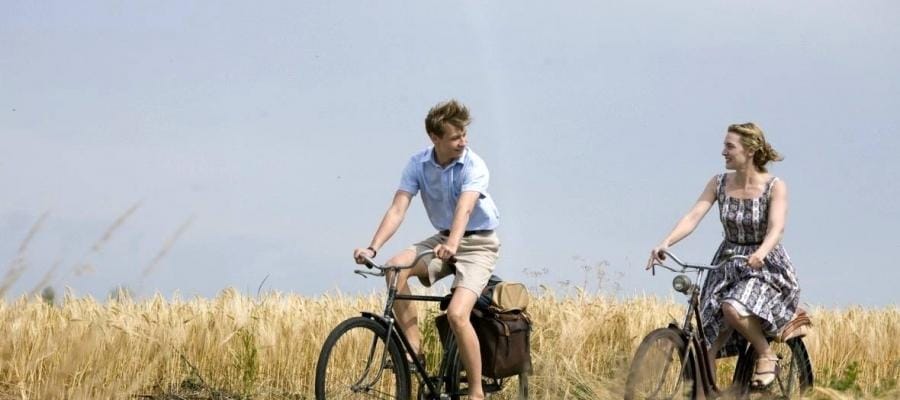
My reactions to this movie are completely at odds with this. In my view, the movie raises a number of profound moral questions and though it doesn’t decisively answer those questions — what movie could — it does explore — in a way movies seldom do (though novels more often do) — the space of possible answers to the questions it raises. Let me explain what I mean. Obviously Hanna, aka, Kate Winslett, is the moral center of this movie. By the way, about Hanna, Dargis says the following:
In the novel and the film — which monumentalizes every trembling lip and fluttering eyelash, turning human gestures into Kodak moments — Michael’s pain turns him not just into Hanna’s victim, but also a kind of survivor. Outrageously, Hanna is a victim too, because she took the guard job only to hide her illiteracy, as if illiteracy were an excuse for barbarism.
Dargis is surely right that both Michael and Hanna are represented as victims — he of her; and she of something more diffuse and less pointed. I suppose she is partly represented as a “victim” of the German attempt to understand and come to grips with the past. She is also, I suppose, partly represented as the “victim” of the Nazi system in which she was a participant. But I don’t think it’s at all right to say that the film “excuses” Hanna’s participation in the barbarism of the Holocaust because of her illiteracy. The movie does nothing of the sort. It is true that the movie doesn’t take the morally “easy” way out of simply condemning Hanna’s act. Certainly, that would be the more superficially morally satisfying thing to do — to offer (again) the simple, unambiguous, untroubled judgment that the Nazi’s, and all who aided them, were purely and simply evil barbarians.
Why would that be the “easy” way out, you ask? Well, my answer goes back to a claim made a few years ago,
on a show we did about evil, by our guest, Peter Van Inwagen. He argued, as I recall, that the psychology of evil is incomprehensible to us, that true evil is alien and “other.” I think something like that thought lies behind Dargis’s reaction to this movie. I say that because if you think that the Nazi’s were purely and simply evil barbarians, there is nothing much to be said or done about them except to note and condemn their barbarism. Certainly, no “explaining” or “excusing” is necessary. If we are in a position to unambiguously condemn, then there’s not much self-reflection called for in thinking about the Nazi’s. They were evil. We are not. They performed acts of unspeakable barbarism. We did not. That was them. This is us. We are different.
But I think the movie rejects this simple-minded picture and is trying to make the point on behalf of Germans who came of age after the war that such a proffered neat moral separation between those who lived through the war, and took part in the Nazi’s atrocities and those who came of age only after the war, and therefore had no part in those atrocities, is an illusion. The movie makes that point in several ways. First and foremost, there is the somewhat opaque, but in many ways ordinary inner psyche of Hanna. The remarkable thing about Hanna is that she is in almost every way unremarkable. In particular, she isn’t Van Inwagen’s alien other, peculiarly capable of unspeakable acts that those her came after are incapable of. No doubt, Hanna is a troubled and wounded person, with things to hide. But she’s more than that too. She is capable of joy and passion and a kind of love.
You could, I suppose, look upon her as a sexual predator. If Michael were a Michelle and Hanna a Hermann, we’d no doubt see Hermann as a child molester. Curiously, I find that I am not quite prepared to say that Hanna molests the young Michael — who is, after all, only 14, if I’ve got my math right — when they begin their affair. But it’s very clear that the affair with her leaves a scar on his psyche.
The fact that Hanna is in many ways an unremarkable person — neither heroic, nor particularly virtuous, but also not possessed with an utterly alien and incomprehensible psyche of the sort that Van Inwagen suggested is the hallmark of true evil — is by my lights what gives the movie true moral force. Hanna was put to a certain moral test. She failed because she lacked whatever inner psychic resources it would have required to pass the moral test. But I think that one of the deepest points made by the movie is that many of who were fortunate enough not to be put the test differed from Hanna in no morally significant respect. She and many in her generation were put to a moral test to which those in the succeeding generation were not subject.
That doesn’t mean that Hanna gets a free pass. She is not excused. Her atrocities are not explained away — despite what Dargis says. I think the movie makes that point forcefully and clearly. But at the same time, in recognizing that Hanna is just an ordinary person with an unremarkable psyche, the movie also raises a very deep puzzle about what exactly we are condemning when we condemn her. Of course, we condemn her acts. But we’d like to condemn more than her acts. We’d like also to condemn the inner psyche that produced the acts. That’s why the judge tries to discern whether Hanna “willingly” joined the SS. But if it turns out that Hanna’s psyche is not so unlike our own, is not so alien and other, what then? How are we really to distinguish ourselves from Hanna?
This has to do with the problem of what philosophers call moral luck. Hanna was unlucky in her circumstances — or in the combination of her circumstances and her character. Suppose that she had been born in Britain rather than in Germany. In such circumstances, the very traits that made her a willing SS guard, might have led her to willingly enlist in the British Red Cross. And then we might have praised rather than blamed not just her acts but the inner character that led to those acts. But the point is that it’s the very same inner character in the two cases. So on what basis do we condemn its expression through acts here, while praising its expressions through acts there?
I said earlier that the movie explores the space of possible answers to the moral questions that it raises. I’m thinking of a couple of different things. First, recall the scene near the end when Michael goes to New York to meet the jewish woman who wrote the book about the death march from Auschwitz. She is stern and steadfast in her refusal to grant any absolution to Hanna. And I do not think that the movie represents her as being somehow wrong in doing so. Rather, the movie takes note of and accepts that attitude as one entirely legitimate attitude among others that we might adopt. Michael, recall, makes no attempt to change her attitude toward Hanna. Indeed, he seems rather silenced in the face of such moral certainty. Just as the court offers no answer to Hanna’s biting question “What would you have done,” Michael has no response to the survivors refusal to offer any kind of absolution to Hanna.
Though the movie takes note of the fact of felt moral certainty and does nothing to challenge it, it also doesn’t rest with moral certainty as the final and sole legitimate response. Exhibit A for the movie’s refusal to rest with moral certainty is the complexity of Michael’s own attitudes towards Hanna. His welter of attitudes are as complex as could be. I’m not sure that I can even fully describe the totality of his attitudes. On the one hand, there is his deeply passionate affair with her, that both opened up a certain realm of human experience to him and left him scarred. The Hanna of his youth haunts his memory. On the other hand, there is his subsequent encounter with her and his startling realization that she took part, willingly, it seems, in the atrocities of the past. To the very end, he wishes to be assured that she has “learned something from the past.” This bespeaks a kind of enduring condemnation. But there is also more. There is, of course, Hanna’s refusal, driven by I am not quite sure what — a kind of shame, I suppose — to reveal that she is illiterate even when it might have saved her from years in prison and his silence in the face of that refusal. He cannot even bring himself to see her to speak to her about what he knows and she knows. And then there is the mercy he offers her years later, through his subsequent act of recording books for her again. Or is this a way of seeking absolution for himself? You could see his failure to come to her aid as a kind of moral cowardice, driven by revulsion and shame, perhaps. But if it is a kind of cowardice, it is the kind that disguises itself as “respect.”
So how, ultimately, should we understand the moral relationship between Michael – who I suppose is some sort of stand in for the generation whose moral task it was to narrate the history of Nazi Germany as somehow both a chapter in its own history and a chapter from which it is determined to make a decisive break — and Hanna — who I suppose is a stand in, not for the main movers and shakers of the Nazi era, but for the millions of ordinary Germans, inwardly indistinguishable from the average run of humanity, without whose cooperation the Nazi’s could not have carried off their barbarism? How are we to understand that moral relationship?
The movie doesn’t really tell us, I think, because it doesn’t really know. It leaves us with no simple answers. But I do think it leaves us with a profound question. Again, as a protective impulse, we may tell ourselves that evil is other, alien and distant. But the reality is that it lives just around the corner in the souls of people little different from ourselves. Only if we come to grips with that fact, I think the movie is trying to say, can we really come to grips with the past.
No related shows found.