
Atheism and the Well-Lived Life
An atheist is someone who not only doesn’t believe in God, but believes, with some confidence, that there isn’t a God. But ambiguity remains. Does that simply mean rejecting the classical Judeo-Christian all-perfect God? Or does it mean rejecting Hume’s much weaker criterion: that the world was created by some thing or things bearing some remote analogy to human intelligence?
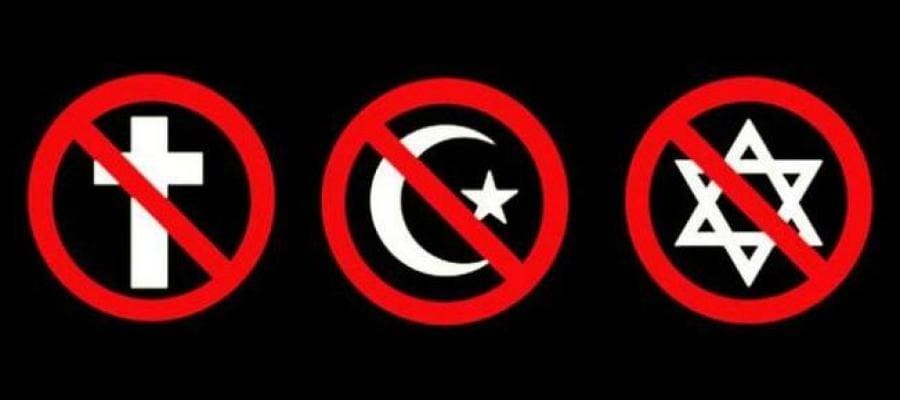
I’ll call the more radical view “strong atheism”. It says the world was not created by, and is not controlled by, any intelligence, or anything having any remote analogy to intelligence whatsoever. There is not one all-perfect God, nor are there several less than perfect gods. Not even the Great Pumpkin. To be a strong atheist is to reject supernatural deities of all forms and kinds.
Ken and Louise Anthony, our guest, both are, or are in the neighborhood of, being atheists of tis kind. The more interesting point for this show is that they find it a rewarding, sustaining, and even inspiring point of view. Let’s pose some questions, and imagine their answers.
At first glance, it seems odd to find inspiration in the non-existence of something. What’s it like to be converted to atheism? We have many accounts of conversions to religion. The world suddenly takes on new meaning; your sorrows are lifted when you learn that there is someone up there who cares. But when you’re converted to atheism, the world goes from meaningful to meaningless, from caring to uncaring, from hopeful to hopeless. It really sounds depressing — the source of despair, not inspiration. If Richard Dawkins are Christopher Hitchens set up a traveling revival show, to convert people to atheism, would the converts appear revived? Or sort of depressed by their new-found belief in the meaningless of everything?
But, our enthusiastic atheists will reply, conversion to atheism is not usually a sudden event. It’s a more gradual process, and it comes in two parts. First, it becomes clear to you that there’s no evidence whatsoever for God, and considerable evidence against anything like the Christian God, or any lesser version of God. That can be depressing, we all must admit.
But with more thought it becomes clearer that not as much depends on God as you might have thought. You still have fun. You still have friends. Certain things still are valuable, others less so. And, unlike what Ivan Karamazov thinks, not everything is permitted.
What about the afterlife? Isn’t it depressing to give up that belief?
Well, admittedly, there is no afterlife without some miracle worker like God to provide it. But as Hume said, all the years before I existed weren’t so bad for me. Why think the years after I die will be so bad?
But what about the question Dostoyevsky’s Ivan poses: Why isn’t everything permitted for the atheist? What sort of fact is it that something is wrong — say that torturing innocent children is wrong? It doesn’t seem like a fact of nature; nature seems all in favor of all sorts of undeserved pain. It doesn’t seem like a rule of etiquette. It seems like an objective fact about the world. Who could the fact-maker be, if not God?
But what’s implicit in this question is the Divine Command theory of right and wrong. Something is wrong because God says it was wrong. But that’s not the only theory of objective right and wrong. You might think there are just moral facts — like mathematical facts — without God having anything to do with it. You might think that morality derives from perfectly objective facts about pleasure and pain, life and death, human nature, reason, logic, cooperation and the like. The atheist has no shortage of answers to Ivan’s claim.
Granted all of that, doesn’t it still seem strange to define one’s life by a negative claim, by the non-existence of something. You can become the village atheist, and make it your mission in life to tell religious people what idiots they are. But that doesn’t seem very fulfilling.
To which Ken and Louise Antony will reply, no doubt, that they don’t define their goal in life to rag on the religious, but rather to explore the joys of positive atheism. I find atheism difficult to resist, but I’m not quite so sure I should be joyful unto the non-existence of the Lord. We shall see.