Can Money Buy Well-being?
February 15, 2026
Listen


Governments and central banks set economic policies that affect us all. But how do those policies influence our quality of life? And how can that quality even be measured? Gross Domestic Product (GDP) includes many factors that have little to do with the regular person’s happiness. What do people really need, beyond enough to live on? And how can we make sure they get it? Josh and Ray spend some quality time with Jayati Ghosh from UMass Amherst, co-author of Earth for All: A Survival Guide for Humanity.
This episode is generously sponsored by the Stanford Global Studies program.
Ray Briggs
How much money is enough?
Josh Landy
Is happiness more about what you have or more about what you can do?
Ray Briggs
Can billionaires and trillionaires ever be satisfied?
Josh Landy
Welcome to Philosophy Talk, the program that questions everything
Ray Briggs
…except your intelligence. I’m Ray Briggs.
Josh Landy
And I’m Josh Landy. We’re coming to you via the studios of KALW, San Francisco Bay Area.
Ray Briggs
Continuing conversations that begin at philosophers corner on the Stanford campus, where Josh teaches philosophy.
Josh Landy
And at the University of Chicago, where Ray teaches philosophy.
Ray Briggs
Today’s episode is generously sponsored by the Stanford Global Studies program, and we’re asking, Can money buy well being?
Josh Landy
Come on, Ray, obviously money can buy well being. You need it for the basic necessities of life, food, shelter, clothing, healthcare, education.
Ray Briggs
Okay, it’s true that in capitalist societies, access to those things often depends on having money. But that’s not how it has to be. In fact, that’s not how it always is. You can get a great education for free at your local library, and if you’re living in Sweden, you can get free health care.
Josh Landy
Well, okay, maybe you as an individual aren’t spending money when you go to the library, but somebody is. Someone has to foot the bill for all those sci fi novels you keep checking out. Oh yeah, the government, or exactly the government pays, which means that taxpayers foot the bill. So I think you’re agreeing with me. Ray, if you want people in society to have a decent level of well being, you’re gonna have to throw some money at the problem.
Ray Briggs
Well, I don’t think that’s always true. What about all the valuable work people do for free? Like, what like cooking for their families, inviting people over for game night, playing a free concert in the park. All that brings joy without costing a penny.
Josh Landy
Yeah, that’s all awesome stuff. Ray, but you can’t expect to base a whole economy on it. I mean, not everything is as fun as game night. How are you going to incentivize people to collect the garbage? It’s like I said, if you want to keep people happy in your society, you’re going to need to get money into their hands.
Ray Briggs
No, there’s so much that you’re ignoring. Josh. Even if somebody is making a decent wage, that doesn’t guarantee that they’ll live the life they want. There’s just so many things that money can’t buy. Like, let’s say you make a zillion dollars by climbing over everybody else and stomping on them, and then when you get to the top, you don’t have any friends.
Josh Landy
Well, I know what those guys would say, make new friends, invite everyone over to play with all your shiny toys. Problem solved!
Ray Briggs
Yeah, I don’t think that really works. And you know what? I don’t think you do either. Who wants friends who are just using you for your shiny toys? Aristotle would say they’re not even real friends.
Josh Landy
Oh, alright, fair enough, maybe if you’re a rich sociopath, all that extra money isn’t going to do you any good. But what about the rest of us? What about people who just want a few more bucks so we can, you know, buy that comfortable mattress, take that cool philosophy class or or go to that concert by our favorite band?
Ray Briggs
Yeah, sure, as long as your society allows you to go to that concert, why wouldn’t it? Well, haven’t you heard of apartheid? Under apartheid, even if you had the money, you weren’t allowed to go into some venues unless you were white, same in the US, pre civil rights, if you weren’t the right color, it didn’t matter how much money you had, you still couldn’t eat at every restaurant or shop at every store.
Josh Landy
Well, I agree that money isn’t the only thing that matters. I mean, you do absolutely also need to have a healthy society, but even in an unhealthy society, it’s better to have money than not. I mean, would you rather be rich and mistreated or poor and mistreated?
Ray Briggs
I don’t know, that’s a pretty unpleasant choice you’re giving me. All I’m saying is Money isn’t the most important thing in life, philosophy, poetry, family, the best things in life really are free. And I bet our guest will convince you I’m right. It’s Jayati Ghosh, professor of economics at UMass Amherst.
Josh Landy
But first, how do people in different walks of life see the relationship between money and well being? We sent our roving philosophical reporter, Sarah Lai Stirland, to find out. She files this report
Sarah Lai Stirland
As The Beatles sang in 1964, money can’t buy you love. But it can have all kinds of unexpected impacts on our well being, whether it be personal or professional. Here are a few people from the San Francisco Bay Area who shared how it impacts their lives and communities.
David Kaye
My name is David Kaye. I am formerly a radio announcer and engineer, formerly a software developer. I used to write medical software, and I pulled down about $200,000 a year, and I would wake up stressed out at four o’clock in the morning because of all the meetings I had to attend and code I had to debug, I didn’t so much. Did in the software industry and in the tech industry that I don’t have much interest in. Going back into it. Some years ago, I had been playing the button accordion while I was in between jobs. Once a while, I would busk at the BART stations and stuff. And I thought, well, maybe I can actually do this as a career. So I started busking in earnest. I’m actually able to cobble out a living. And actually managed to save maybe $500 a month or so, and it works out pretty well now I look forward to the days instead of dreading them, like I used to when I was making a lot of money.
Alastair Boone
My name is Alistair. I am the Executive Director of Street Spirit newspaper, which is a grassroots newspaper in the East Bay, California that covers homelessness and is sold on the streets by unhoused people who keep 100% of the profits they earn. Not having enough money to pay rent and have shelter leads to this situation where you have no space for anything else in your life, and so simple things like taking a shower or preparing a meal or having enough water, all of those things take up a lot more time when you’re on the street. Living unsheltered takes a massive toll on your well being, on your mental and physical well being, also the level of uncertainty about what’s going to happen in the future, and just dealing with the elements, you know, being really cold or being really hot, or breathing in bad air, not having consistent access to food. I mean, these are all the most basic things that are called into question that just takes up so much space in in your brain and in your mind, and it becomes much harder to keep putting one foot in front of the other and make progress.
Catherine Bracy
I’m Catherine Bracy. I’m the founder and CEO of TecEquity and the author of “World Eaters: How Venture Capital is Cannibalizing the Economy.” Contrary to popular belief, venture capital can oftentimes be worse for a company than if they hadn’t taken that investment in the first place. That’s often because venture capital requires companies to take on more risk than they might organically create. That means companies are often pulled away from the thing that is actually valuable, that they’re building, the market that they’re actually able to serve, stretches them into places that don’t make sense for them, and cause them to make choices that are not only oftentimes bad for society and their customers, but also threaten the viability of the business overall.
Monica
My name is Monica, and I have a family of three children and a husband. It’s always a question whether I have enough money for the future, because one of my children has special needs. My husband and I both wonder, will we ever feel like we can retire and be done working, and have we saved enough for my child to be cared for in the way that he needs to be to feel safe and loved when we can’t do it ourselves. My husband and I both frequently discuss when we’re making a financial decision whether it’s appropriate to spend the money, it diminishes the joy that I would have in spending a little money to treat myself when I think about this, is less that he will have.
Sarah Lai Stirland
For Philosophy Talk. I’m Sarah Lai Sitrland.
Josh Landy
Thank you so much for that excellent report, Sarah—that’s a fascinating range of opinion there. I’m Josh Landy. With me is my fellow philosopher, Ray Briggs, and today we’re thinking about money and well being.
Ray Briggs
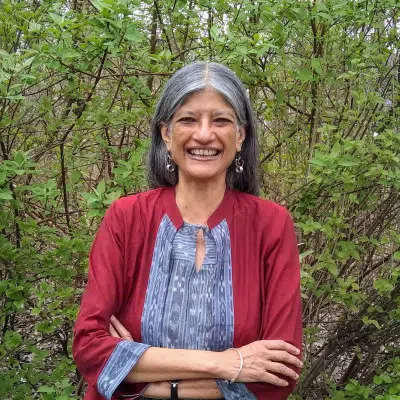
We’re joined now by Jayati Ghosh. She’s professor of economics at the University of Massachusetts. Amherst, though she’s joining us today from Delhi, India. She’s co author of “Earth For All: A survival Guide for Gumanity.” Jayati, welcome to Philosophy Talk.
Jayati Ghosh
It’s a pleasure to be with you.
Josh Landy
Jayati, you’ve been writing about money and well being for many years now. But how does this question show up in your own life?
Jayati Ghosh
Well, I can think back to just a few years ago, when the covid 19 pandemic happened suddenly and the lockdown. Was imposed in Delhi with very little notice at that time, I have an I had an elderly mother who was staying with me, and we had been able to hire someone to help care for her. And this woman was completely out of her mind, because she could not go back to be with her own family who would need looking after as well. And of course, we offered her more money, and we said we would look after them as well if we could through money. But that was not what she wanted. She really wanted to go and be with them, and that would have made so much difference for her.
Ray Briggs
Oh, so. Jayati, some economists measure how well a country is doing with a statistic called the gross domestic product, or the GDP, which is basically the total market value of all the goods and services sold in the country. Do you think that’s actually a good measure?
Jayati Ghosh
No, I think it’s a terrible measure. It’s just carrying on because people don’t realize how bad it is in every possible way, whether it’s measuring the wrong things or leaving out the important things or even making assumptions that are not really valid about what the actual number is. So tell us more about what’s wrong with it. Okay, well, the way it was designed was way back just after the Second World War, and it was really meant for war economies. The people who designed it then were thinking about governments and countries that have to deal with war, so how much can you produce, and how can you produce it, and how quickly is something produced? And so they were valuing only according to things that could be produced and sold. So GDP only measures whatever is sold in a market.
Josh Landy
So that seems to leave out an awful lot of things, right? So it leaves out, for example, how happy people are in other ways, right? It leaves out all those wonderful game nights that people are throwing each other for free. It leaves out, you know, people’s sense of hope for the future and and presumably also what we were talking about earlier, Ray and I about capabilities, right about the kinds of things that people have the opportunity to do. Are there other things that the GDP measure omits that you think are particularly important?
Jayati Ghosh
Oh, absolutely, because what you described is really about life as a whole. But GDP even leaves out crucial things about the economy. It leaves out all of something you mentioned earlier, all the unpaid care work that people do within their households and communities, and which also has an economic impact. And it brings in all kinds of things that shouldn’t be in there. It includes things like weapons of mass destruction, if you’re creating them, that creates a lot of GDP. But also, if you’re in a financial world where you’re creating a financial bubble, that seems like it’s a lot of increase in GDP, but it can actually lead to a big mess.
Josh Landy
So we’ve talked about one reason to worry about the GDP, that is to say it omits all these crucial things, some of which are really important economically, like the care economy. And of course, it leaves out a whole bunch of things that have to do with people’s actual quality of life. Another worry that people often raise is the distribution question, right? Because presumably, if three people made all the money, right? Let’s say that the economy increases overall, the GDP increases, but, but that all of that new money is is sort of being funneled to three people, then presumably just one figure, GDP won’t measure how the average person in society is doing? Is that an accurate way of phrasing that kind of worry?
Jayati Ghosh
Well, yes, but you know, even if you measure average, like you take the per capita GDP, that’s still not good, because it is so influenced by all the money people make at the top, as you mentioned. So distribution is absolutely crucial. And in fact, what we discovered, I was involved in a group that looked at inequality, is that since 2000 if you look at all the wealth and the GDP that has accumulated in the whole world since 2,041% of that went to just the top 1% of people in The world,
Josh Landy
tTat’s really striking,
Jayati Ghosh
Isn’t it? And the bottom 50% got only 1% of all the increase in wealth. So bottom half of the global population got only 1% of all of the increase in wealth in the world for the last quarter century.
Josh Landy
You’re listening to Philosophy Talk today, we’re asking whether money can buy well being with Jayati Ghosh from UMass Amherst.
Ray Briggs
If your country gets richer, how does that help you? Do you care about having a lot or just having as much as your neighbors? Are some things in life more important than money?
Josh Landy
Wealth, well-being, and wisdom—along with your comment and questions when Philosophy Talk continues
Notorious B.I.G.
It’s like the more money we come across, the more problems we see.
Josh Landy
Does more money mean more problems, or just more Lamborghinis? I’m Josh Landy, and this is Philosophy Talk, the program that questions everything…
Ray Briggs
…except your intelligence. I’m Ray Briggs, and we’re thinking about money and well-being with Jayati Ghosh from UMass Amherst. Today’s episode is generously sponsored by the Global Studies program at Stanford University.
Josh Landy
Got questions about money and the well-lived life? Email us at comments@philosophytalk.org or you can comment on our website. And if you want to hear more about philosophy and well-being, check out our library of more than 600 episodes. Everything in the entire archive is now free. Just go to your favorite podcast app and click subscribe.
Ray Briggs
So Jayati, we’ve established that GDP is not a good measure of how well the average person is doing for multiple reasons. What would be a better measure?
Jayati Ghosh
Well, there are lots of measures that are available, but if you’re looking specifically at the economy and work, one of the things I find is what the most useful is to look at what I call the labor market indicator, which is a mix of the median wage, which is to say the middle of all the wages in the world. So half the people are getting less than that median wage into the kind of work you get, the employment rate. How many people are actually getting work? And that’s useful, because you need to know how many people are working for money, whereas how many people are working for free or not just getting work at all. And you need to know really, what are the level of wages they’re getting, and how half of the people are getting less than that.
Josh Landy
Okay, so that’s one measure. We have a question from a listener about a different kind of measure. This is a listener called Warren, who writes this around 1965 a researcher named Hadley Cantril developed a simple survey question known as the Cantrell ladder, which is effectively rate your life on a scale of zero to 10, where zero is the worst life you can imagine, 10 is the best life you can imagine. When researchers aggregate such measurements made at random times in a random sample of people in a population, says Warren, they can report a quality of life index which weights low quality of life more than high quality of life. Such an index ensures that efforts to increase the index over time won’t leave behind those with the poorest quality of life. So Jayati, what do you think of this type of assessment, the Cantril ladder?
Jayati Ghosh
Yes, this is similar to a bunch of other measures along these lines that have been suggested, like gross national happiness, which is used in Bhutan, or another happiness index that has been used in some Latin American countries. The thing about that is, though, that it is subjective, and you do get people who are inherently more able to be happy in their surroundings. Can we often find that sometimes those who are materially much worse off and in often very difficult circumstances have greater tolerance capacity for that, so they don’t complain as much, right? So the difficulty, then is to kind of combine the two. How do you make sure that just being more tolerant of a worse situation does not lead you to leave out people who are actually materially much worse off and very materially poor and insecure?
Ray Briggs
It seems to me like my survey answer is I see why those aren’t a great measure of how well I’m doing, because I could just tolerate a bad circumstance. But it seems like my wages aren’t a very perfect indicator of how well I’m doing, because it doesn’t show how much I can buy with those wages. So if there’s good food available to me for cheap, then maybe a wage goes further than if there’s not, or if there’s sort of good education and health care available for free, the wage means something different. How do I sort of adjust for that?
Jayati Ghosh
Well, there is an idea about assessing basic needs. And the thing is, basic needs can vary by society as well, but all the things you mentioned, nutritious food and being able to afford nutritious food, access to basic health and education, access to a non polluted existence. I’m in Delhi, so I really feel that right now, these are all things that you could include and in a measure. And there have been attempts to measure these.
Josh Landy
I want to go back a moment to the Gross National Happiness Index. There’s such, such a lovely coinage. It’s so much better than the GDP. I really love this line from Bobby Kennedy from 1968 where he says, GDP measures everything except that works, which makes life worthwhile, which seems to be so dead on. And so you have these, these indices, the Gross National Happiness Index, which. The Better Life Index that I think in a in a positive way, don’t try to reduce everything to a single number, at least if I understand it correctly. So they are looking at not just income. They’re looking at job security, work life balance, access to health, care, education, democracy. Do you think that having a set of measures is ultimately more productive than just having one measure, like a single number, like GDP?
Jayati Ghosh
Oh, I think it’s absolutely essential to have a set. I mean, basically you have to have a dashboard approach. It’s like, you don’t drive a car knowing only one number, like how much petrol you have in your tank. You need to know lots of things. You need to know the speed you’re going at and whether the car is heating up and so on, right? So just like that, you cannot run an economy without realizing some of the basic things, and those could vary depending on what kind of country and economy you are.
Ray Briggs
So I am curious about trade offs between the sort of subjective and objective measures when those are coming apart. Like, how do you figure out which one to trust? Is it always the objective one?
Jayati Ghosh
I would say, Well, I’m an economist, right? So I like all these objective indicators, but I would say that the objective ones you can’t ignore, so you can’t say, oh, this person is really happy. But on the other hand, they have a life expectancy of 40 years, and they’re undernourished and their children can’t go to school. To me, no, that would not be good enough. So I would say that there are maybe four or five basic economic type indicators along with the subjective one,
Josh Landy
That makes a lot of sense to me, and I wonder how they apply to cases like Scandinavia, right? So I was reading that Finland came in number one in the World Happiness Report, like, four years in a row, or something like that. And, you know, even though its economy didn’t grow very much, but that, I guess, I don’t know if that’s just self report or if that’s a sort of little basket of indicators. So I’m curious why, why do these high tax, high services countries like Scandinavian countries or Switzerland, Australia, why do they seem to do well on these happiness measures?
Jayati Ghosh
Well, there are many good reasons for that, because, in fact, the more you are able to tax and provide good quality services that are accessible to everyone, the less you generate inequality and unhappiness, resentment envy at one end, and exploitation and abuse of wealth and power at the other end. So less unequal societies are generally happier societies. They also are able to provide much more in terms of public services and public spaces, which are very important for us. We are social beings. We like to have public parks and places that people can meet and places that they can enjoy themselves together, which are not denied to some people.
Josh Landy
I also read a really interesting theory by philosopher Frank Martella, who says there’s a kind of benevolent spiral at work in countries like that, where you start with a strong welfare state that generates more equality, the equality generates increased trust in each other, and that makes people more willing to pay taxes, which in turn strengthens welfare state. So so in a country like that, you get this benevolent spiral, whereas in a country like the United States, perhaps you get the opposite. You get a vicious circle where nobody trusts each other, and so no one’s willing to pay taxes to improve the lot of other people. What do you think of that way of thinking about the success in terms of happiness of countries like Finland?
Jayati Ghosh
Oh, absolutely. I completely agree with what you’ve said. And in fact, what we are seeing in much of the world today is exactly the opposite tendency that you described for the US. It’s happening in India. It’s happening in Europe that as people see a lot of the essential services decline because governments aren’t spending enough money on it, they start denying that the government does anything for them, and they say, Why should we pay taxes? Because, you know, the quality of the transport is so terrible, or the roads are so bad, or whatever it or the health care is so bad, and that is a vicious circle, and that is what’s giving us so much social polarization and so much anger, a word, towards a created other. It could be migrants, it could be a minority, or it could be another race. A lot of that is happening because of this inequality.
Ray Briggs
You’re listening to Philosophy Talk today. We’re thinking about money and well being with Jayati Ghosh from UMass Amherst. So Jayati, we’ve got an email question from Wendy. Wendy writes, happiness is a temporary feeling. Caused by external events, while joy is a deeper, longer lasting feeling that comes from within. Wendy adds, greed is a strong, selfish desire to have more than you need, especially Money, power or possessions. With greed, the gains, if any, are motivated by external needs and tend to be short term, they do not satisfy the deeper form of happiness that can be called Joy. What do you think of that? Jayati, do you think Wendy’s right?
Jayati Ghosh
Yeah, I’m not sure about you know the difference between happiness and joy. I would kind of put it the other way, that joy is the temporary thing, but happiness is a more permanent one. But that’s just how we interpret it. But I think she’s right that a lot of the other stuff is externally driven. Greed is often because all of us have a little tendency inside us, and when we see others around it, doing it, profiting and not caring about people around them, there’s a tendency to bring that out in ourselves. So yeah, I think a lot of the negative stuff that happens within us is something that is often created by societies that provide more to those who are greedy.
Ray Briggs
So I have this puzzle about greed that I’m never sure what to think about it. So I’d like to persuade people who are hoarding wealth at the top that this is bad for them, because I think it would definitely benefit others, but I kind of think it might benefit people who are at the top of society to just just be less at the top of a more equal society. Do you think that there’s anything to that?
Jayati Ghosh
Well, you only have to watch Game of Thrones or one of those things to realize that life is not fun at the top. But I would put it differently. I would say the real problem is not whether those few people at the top are happy, it’s the fact that they, with that huge wealth, get immense power, and then it’s all about fighting to retain that power and doing all kinds of terrible things to retain and expand that power. And we can see it all around us. I don’t have to give you examples anymore, right? So I think the real problem is not whether those people are happier because they’re super wealthy and super powerful, but what that drive is doing to the rest of the economy and to how governments function and how people then get the basic needs that they need and deserve.
Josh Landy
I mean, I agree about that, although I also like Ray’s way of thinking, because there is that question if, if it’s true that in fact, the reason that some folks, even even after they’ve amassed untold wealth, continue to devote almost all their time to amassing even more untold wealth is that they’ve got an unfillable hole in their soul, right? I mean, there’s that part of Plato’s dialog, the Gorgias, where Socrates says to calculus, you know, all these, these, these powerful people, they’re not really happy. You know, they look like they’re happy. They don’t really have so if that were true, then maybe that could be the beginning of a solution. Because, right, if we could, if we could show those people in fact, they could live a better life in a more equal society, a better life because we’re everyone’s made happier by helping other people, then that couldn’t that be progress? Or is your futureity more we, you know, we just have to ignore that and basically do the kind of work that we can.
Jayati Ghosh
No, I don’t think either. I think it’s not just about, you know, persuading the rich to come to become nicer or better human beings or something, or it’s really about making sure we have an economy and a government that is responsive to the average person and most people’s needs, and that does not give excessive power to a very small group of very wealthy. So that means regulations, that means policies, that means institutions that make sure that everybody gets access to the basic needs that we’ve talked about, and that nobody has enough power to make major changes to how governments do things.
Ray Briggs
So Jayati, I want to ask about a particular policy that sounded pretty good to me when I first heard about it, but you’ve argued is not always as good as it sounds, which is taking all the unpaid labor that we were talking about so like, particularly domestic labor that women do for their families, and just compensating for for it with money. So that would be a way to kind of improve the lives and options of people who do that labor, maybe making them more equal, but you’ve argued that that doesn’t always help. What are the drawbacks of that strategy?
Jayati Ghosh
Well, it’s complicated, but one issue is that just transferring money is living up to this whole idea that money is everything. It, it’s we are falling into the trap of saying, Yes, money and GDP, which is about monetary exchange, is really all that matters in an economy. And we’re leaving out the huge value that comes from the unpaid labor, a lot of it, which comes with emotions, because you care about the people you care for. We’re leaving out that huge value for human societies and for people individually. But there is also the other aspect, which is that many governments who say, let’s do this, well, let’s just give some money cash transfers. It’s a big win, win. For many governments nowadays, they think, yeah, great. You know, we’ll provide money to people. Is that it often comes through a reduction of public services. So you don’t provide universal public services of good quality. You provide some limited services and make them pay for the rest, and then you say, Fine, we’re giving you money. So now you know you’re just the same, which is simply not true. It’s not a substitution. I have no problem if it’s an addition, but if it’s substituting for good quality public services. No, I don’t think that works.
Josh Landy
What are some other domains that you think we should be thinking about? Jayati in terms of areas that powerfully concern wellbeing, that really sit outside of financial questions.
Jayati Ghosh
Well, let me put it another way. One of the problems with looking at just Money and Finance as indicators of either the whole society’s well being or progress or individual’s worth is that we end up valuing a lot of things we should not value. So I mean, right now in the US, there’s a lot of talk about the Epstein files right now that tells us about what a whole elite that is centered around money can do, and that’s really terrifying, because that is creating a sense of power and impunity which can have all kinds of disastrous consequences. So I think the negatives of focusing on money as an indicator of value are really way bigger than just leaving out stuff. It is that we not not only do we leave out a lot that is of huge value, like unpaid care work. But also we value a lot of people and activities that should not be valued, whether they are, you know, gigantic scale scamsters, or they are people working in certain sectors where the purpose is to perhaps defraud in order to generate more wealth, and it leads those people into activities and things that they do which are really socially undesirable but are celebrated because they bring in more money.
Josh Landy
You’re listening to Philosophy Talk today. We’re asking whether money can buy well-being with Jayati Ghosh from UMass Amherst.
Ray Briggs
Why aren’t billionaires and trillionaires ever satisfied short of revolution? How can we persuade them to share their wealth? What would it take to guarantee a decent level of well being for everybody?
Josh Landy
The greatest good for the greatest number, plus commentary from Ian Shoales the Sixty-Second Philosopher, when Philosophy Talk continues
M.I.A.
All I wanna do is— And a— And take your money.
Josh Landy
Is all you want to do just take the money? I hope not. I’m Josh Landy, and this is Philosophy Talk, the program that questions everything….
Ray Briggs
…except your intelligence. I’m Ray Briggs. Our guest is Jayati Ghosh from UMass Amherst, and we’re thinking about money and well-being, for an episode generously sponsored by the Stanford Global Studies program.
Josh Landy
And we’ve got an email from Harriet who thinks that money can buy happiness. Harriet writes, preference satisfaction alone is intrinsically good, and money is the permanent possibility of preference satisfaction. I have no sympathy for whiners. Certainly there are a few things. Money can’t buy, health, longevity, relationships, etc. But give everybody enough money and financial security, and at least 95% of the population will be as happy as can be. The rest can be medicated. What do you think about that, Jayati?
Jayati Ghosh
I think she’s got it all wrong. I’m sorry. The problem is that money alone, a lot of it, if you give everybody lots of money, it really depends on how it’s distributed and what it’s worth. So what are the services that you can buy and what are the goods that you need that you can buy? And so what does enough mean? And is there ever an enough? I think you talked about how people can just buy more and more Lamborghinis, or buy the newest version of the Lamborghini or etc. Can I give you a little example? Because I think people in the US often don’t realize. Is how you don’t have to have a revolution. You can actually have societies that are just organized differently, absolutely. So, you know, academics in the US, I think, get paid quite a lot, okay, but everybody around me is always complaining and not just complaining, worried, worried about their mortgages, worried about health care, worried about all kinds children’s education and so on. Academics in Europe, in most countries in Europe and mostly, they’re public universities. They’re not private. Mostly they get, like a small fraction of what US academics earn, okay, but none of them seems particularly unhappy or bothered, except in the countries where public services are declining. So I asked a French colleague who was very well known and could get a job in, you know, as a top professor in any of the big name universities in the US. I asked him, Why does he continue in a public university in Paris? And he says, well, because, you know, everything in life is so much easier. First of all, it’s Paris, sure, but you know, healthcare, basic, we have good pensions relative to our income, a whole lot of other stuff is cheap, and so living is much less costly, and it’s a much better quality of life, because I can still meet with my school friends who are not academics, who can afford the same restaurants and cafes I go to, and we can still have fun in a whole range of other places, which are public spaces, parks and museums and and so on, which would not be available to me if I went to the US, where I would be earning maybe five times what I’m earning now.
Ray Briggs
Yeah, I find it very interesting Harriet’s idea that money is the permanent possibility of preference satisfaction, because there’s a sense in which, you know, taking a job as an academic in the US satisfies my preferences among all the available options. But then there’s a problem about which options are available to me, and I’m not sure that money can measure that, because money is what I pay for some of the options that are available to me over others.
Jayati Ghosh
That’s so right Ray, you got it exactly. And what public provision does, universal good quality public provision does is that it really expands all your opportunities to be thinking beyond those basics. So you’re not worried about mortgages and you’re not worried about child education, you’re not worried about health care and you’re not worried about pensions. I mean, think of that. That’s already like a recipe for happiness, isn’t it?
Josh Landy
I miss the old country. But Jayati, we sometimes use the powers vested in us by public radio to make our guest a tsar of something. And we’re we’re going to make you czar of world development. What’s the first thing you’re going to do to improve the general level of well being around the globe?
Jayati Ghosh
I think the first thing I would try to do is get everybody to put out these five indicators that every government says they’re going to track, monitor and deliver on and what are not the GDP. One would be the labor market indicator that I talked about already. Another would be access to affordable, nutritious food. Can you afford a nutritious diet for you and your family? A third would be access to good quality health care throughout your life cycle, from birth to death and in between, and a fourth would be much more public spaces available for all the creative things that people want to do in life.
Josh Landy
I mean, all of that sounds absolutely wonderful. I’m just curious, sort of, what the what the ideal is for you. I mean, I can imagine at least two different kinds of model, right? So one kind of model is the Marxian utopia, where it’s essentially largely equal, from each according to his abilities, to each according to his needs and all that stuff. Or, you know, there’s another model where, you know, there’s there’s a strong safety net, and there’s public parks, and there’s regulations, and things are going very well, but there’s some inequality, which some people would argue fosters healthy competition and innovation. What’s your picture of the ideal society?
Jayati Ghosh
Yes, I mean the some inequality is always, you know exactly how much is some so that’s the big question. But I think for me, the ideal society is one with universal provision of basic needs and public services that reach everyone without discrimination. And as I said, Life Cycle social protection, so that enables everybody to meet, you know, to develop their own capabilities, and creates opportunities for them to do what they want to do and value in life.
Ray Briggs
I love that as an ideal, and I would love. Like to know how to get closer to it in a kind of global economy where, as you said at the beginning of the show, just elites are seizing more and more of the resources. How do we use the power we have to improve things?
Jayati Ghosh
You know, I think we kind of get hopeless because we don’t have much of a longer term memory of how things were, even in some of these rich countries. I mean, it’s hard to believe, but in the 60s and early 70s and 70s, the marginal rate of income tax on the highest income was 95% okay, the richest people paid 95% of their incomes as income tax in the US. So we’ve had different situations in the past. I’m not saying it was all wonderful even then, but it is possible we have societies around us that are developing much more equality because of this. It really requires people to demand this. Of our leaders, we kind of assume that this is all has to happen, that the world we created, which is entirely a result of regulations and policies that governments have brought in, that it can’t be changed. It can be changed, but governments don’t change because they suddenly become good. They change when they have to, because people force them to. So this just requires a public movement.
Josh Landy
I want to ask a slightly less economic question, like slightly more philosophical question, if that’s all right, there are some philosophical systems that promise a good life to everyone, regardless of income level. So think of Diogenes, who who lived in a barrel, for example. So, and there are some systems that even say that the poor are happier. Think of Christianity, perhaps Buddhism. So, you know, in your opinion, Jayati, how do you think about these philosophies? Because you might think these philosophies are a wonderful thing, because they grant dignity to everybody, or you might think there’s a slight worry, because maybe, you know, by by getting people, encouraging people to be okay with their current situation, they sort of blunt the force of will to change the system. So what do you think about, you know, those, those kinds of philosophies,
Jayati Ghosh
you know, Buddhism, I think it is more complex. Buddha talked about moderation in all things, right? So he didn’t say you have to be poor, but he said, You have to be I guess, you know, The Economist version of this would be this concept called satisficing, that you should have enough to satisfy your wants, but then you should also be able to develop those parts of your mind and your creativity and your imagination in ways that give you more pleasure and give you more excitement. So that doesn’t necessarily depend on material progress or material improvement in your life, but you cannot do that without having enough to satisfy your basic needs.
Josh Landy
Well, Jayati, I have to say that I during this conversation, I felt my well being increase every second and all for no money. So I want to thank you so much for joining us today.
Jayati Ghosh
Thank you. It was fun.
Josh Landy
Our guest has been Jayati Ghosh, professor of economics at UMass Amherst and co-author of “Earth for all: A survival guide for humanity.” So Ray, what are you thinking now?
Ray Briggs
I’m thinking that providing for everybody’s basic needs sounds like a great idea, and it shouldn’t be that hard. I’m on board with with a lot of the proposals that Jayati has made. I’m on board with not thinking that money is everything, and I’m on board with making companies answerable to all different kinds of stakeholders.
Josh Landy
Yeah, and geez, I, you know, I come from Europe, and I grew up, you know, in the 70s and 80s, and I remember a very different way of being. I’m totally with Jayati. If that was possible, then can it be possible? Again, we’ll put links everything we’ve mentioned today on our website, philosophytalk.org and while you’re there, you can subscribe to our free podcast and question everything in our library of more than 600 episodes.
Ray Briggs
Now, a man who puts his money where his motor mouth is: it’s Ian Scholes, the 62nd philosopher.
Ian Shoales
Ian Shoales… If you spend enough time googling the relationship between gross domestic product and cryptocurrency, will discover your eyes glazing over and your brain turning into a kind of pudding that cannot be measured or monetized. One realizes that more things don’t count in the GDP than do interest, credit ratings, short term loans. Nope. Statistics do not have a home in the GDP. Fund a statistical study that might be included, but not the results. Money is counted if you buy something, or you can count what was bought, but not money. But if you buy something with Bitcoin, GDP gets confused. Its value goes up and down. You can buy a pizza with it, for example, and discover that you’re paying twice as much just between order delivery and consumption. But we hope eventually to create value through mining, wish fulfillment and the lavish application of. Adderall. I think that’s how it works in our dreams. How do we measure value? I guess in dollars. We certainly don’t measure dollars in Bitcoin, though, Bitcoin, crypto in general, can be tokenized. That is turned into an actual coin. But if you want to de tokenize your token, I learned it involves going to your original blockchain. Kids. If you forget your password, by the way, you’re screwed, and you will never see a particular precious pile of Bitcoin again. Part of the fun of crypto is figuring out how to spend it and when it will become the money the future, damn it, that’s the dream. Let’s face it, I have skimmed many articles about how crypto is affecting the GDP. It turns out it’s not crypto per se, which lands there. It’s crypto mining and data storage centers which require energy and labor, which costs money, which are part of the GDP, but not crypto itself. It’s like fairy tales. The books are real enough, but the jury’s out, and actual fairies. If like Bitcoin, they exist, they can create their own value. So on a daily basis, everything looks like it’s moving into various stages of unreality. How does this affect the GDP? Well, good question. Movies, for example, once occurred in movie theaters, and the same way money occurred in banks. Now, theaters are gone, cassettes, DVDs, and movies are streamed, a magical process that occurs on local televisions. Movies are still part of the GDP, but they seem to be transitioning into a service like getting a massage. At some point, I reckon they’ll just disappear or become something else. Mark Andreessen, the billionaire, helped bring Netscape to the world, and where is it now? Recently said in the podcast hosted by his venture capital conglomerate called a 16 z, I guess because Netscape 3000 was taken, that a new AI technology is going to change movies forever, handing the making over, to quote, the filmmaker with no visual skill or access to a set or to a camera or to actors, but with an idea. It’s going to start with shorts and animated things and so forth, but it’s going to work its way up to full movies. I think that’s a reason for profound optimism, unquote. But who’s going to feel this profound optimism? Probably not actors or cinematographers or set designers or costume designers. Their wages won’t be showing up in the GDP, except money is except money as we know it may be disappearing, unless you consider crypto money, which it might be in Fairyland here, I don’t know. Does it matter? AI is coming and writing as we know it will probably disappear, and movies as we know them no longer exist. How does this relate to GDP? From what I’ve read, guys like Andreessen and Peter Thiel are kind of nouveau libertarians of the future who want to create fiefdoms for themselves and their wealthy ilk, throwing shiny circuses at us in the grim valley below, affordable with our good credit, trying to sell us non existent movies that we’ll then have to pay to make ourselves seems part of the brand. There are no used cars in the GDP. Also, many things that once were no longer are like fedoras, yellow cabs, steam engines, big light phones, good old Republican values, metrical and Kingston Trio records. So how will this work on movies made without studios or actors, script or film? Well, it will be streaming, which is almost like showing a theater, except it’s television. Isn’t it like putting lipstick on a pig, really? Except no pig, no lipstick and no tokens. Podcast, though they’re here to stay, they’re the Bitcoin of broadcasting. I gotta go. You. The
Josh Landy
Philosophy Talk is a presentation of KALW San Francisco Bay area and the trustees of Leland Stanford Junior University, copyright 2026.
Ray Briggs
Our executive producer is James Kass. The senior producer is Devon Srolovich. Special thanks to Merle Kessler, Angela Johnston, Karen Ajluni, Steve Choy, and Linda Fagan.
Josh Landy
Thanks also to Emma Lozmanplum, Michael Aparicio, Tom Lockhart, Matt Porta, John Lehman, Nancy Smith, Robert Smith, Henry Rutkowski, and Elizabeth Rightmeyer.
Ray Briggs
Support for Philosophy Talk comes from various groups at Stanford University and from the members of KALW local public radio San Francisco, where our program originates. Support for this episode comes from the Stanford Global Studies program.
Josh Landy
The views expressed (or mis-expressed) on this program do not necessarily represent the opinions of Stanford University or of our other funders.
Ray Briggs
Not even when they’re true and reasonable. The conversation continues at our website, philosophy talk.org where you can become a subscriber and question everything in our library of more than 600 episodes. I’m Ray Briggs
Josh Landy
And I’m Josh Landy. Thank you for listening.
Ray Briggs
And thank you for thinking.
Wanderlust
Just remember: money buys nothing. Nothing important. No, no, money literally buys nothing. I think you mean metaphorically. No, literally nothing. Literally money buys most things. No, nothing, right? Are you saying that? Well, I’m saying them literally. You would, you know, but you I’m saying literally money buys nothing. I don’t know what it buys nothing. You’re right, money, money pays for nothing. That’s right.
Guest
Related Blogs
-
February 12, 2026
Related Resources
Dixson-Decleve, Sandrine, Owen Gaffney, Jayati Ghosh (Author) et al. (2002). Earth for All: A Survival Guide for Humanity.
Ghosh, Jayati, ed. (2021). Informal Women Workers in the Global South Policies and Practices for the Formalisation of Women’s Employment in Developing Economies.
Rawal, Vikas, Jayati Ghosh, and C.P. Chandrasekhar, eds. (2022). When Governments Fail A Pandemic and Its Aftermath.
Get Philosophy Talk

Leave a Reply
You must be logged in to post a comment.