John begins by questioning whether power is out of balance in government today. Ken thinks there's no question: the executive is running wild, the legislative never gets anything done, and the judiciary is out there making all the laws with court decisions! So given that power is out of balance, is it necessarily a bad thing? John claims it is, using traditional arguments against tyranny and the consolidation of power for the support of separation of branches of government. Ken discusses how even Plato believed that the birth of a tyrant begins by small increases in one man's power, often with the approval of the people. The founding fathers supported the separation of powers so wholeheartedly that they didn't think a bill of rights was necessary--John and Ken discuss how much the view of government has changed since those days, and introduce Kathleen Sullivan, the Stanley Morrison Professor of Law at Stanford University and the author of most widely used textbook on Constitutional Law.
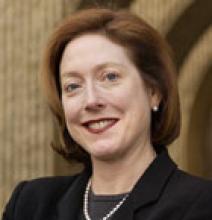
John asks Kathleen whether separation of powers is really necessary given the fact that we can vote a president in or out every four years. Kathleen says separation of powers is absolutely necessary, even though it makes government a bit inefficient, the founding fathers were rebelling against monarchy and wanted to ensure that radical changes could not be made easily in their system. Ken continues to question why elections can't be sufficient enough to check government power, and Kathleen responds with a thoughtful argument which uses a diet as an analogy for what separation of powers is meant to do. John brings up the point that original ideas of separation of powers didn't consider political parties to be a big issue, and Kathleen talks about the historical changes which have brought us to associating separation of powers with limiting the power of one party.
Ken wonders whether party loyalty trumps branch of government loyalty--that is, are people in the judiciary or the legislative branch more jealous of party power or institutional power? Congresswoman Anna Eshoo, who kindly invited Philosophy Talk to Washington D.C. to have this conversation, responds to Ken's questions. John asks whether Anna thinks that given the dominant Republican power in government, party loyalty will break down in an attempt to balance power and create a more just system. Congresswoman Eshoo believes that something like that is happening, although maybe not in so many words. Ken returns to the discussion of political parties, and Kathleen Sullivan and Congresswoman Eshoo discuss the interaction between party loyalty and separation of powers with examples from recent political events. Ken tries to draw a distinction between the formal idea of separation of powers and the pragmatic realities of the system.
John and Ken move on to discuss with the studio audience whether the system in this country has unintentionally promoted an imbalance of power, and whether this is a good, bad, or indifferent thing in terms of our lives. Afterwards, prompted by questions from the live studio audience, Ken asks Kathleen Sullivan about whether she would make any big changes to the current system if she could rewrite the constitution regarding separation of powers, and Congresswoman Eshoo discusses the stability of the current government. Questions from the audience range from topics concerning the apathy of the United States' electorate, to the history of tradeoffs between liberty and security, to the gerrymandering of districts which makes elections less democratic than intended.
- Roving Philosophical Report (Seek to 4:36): Polly Stryker interviews everyday people outside of a ferry in Seattle and on the streets of San Francisco about the separation of powers, the branches of the government, and whether or not they think this structure is effectively working these days.
- Sixty Second Philosopher (Seek to 49:50): Ian Shoales rips through the history of separation of power and its intellectual background at lightning speed.