Show

Latin-American Philosophy

Week of: 
September 18, 2011
What is it: 

Latin American Philosophy began centuries before anything of much philosophical consequence happened in North America.  Yet in our own time, Latin American Philosophy is undergoing a protracted identity crisis.  Is it just transplanted European philosophy?  A reaction to analytical philosophy?  A reflection of the themes of liberation theology?  John and Ken explore Latin America's philosophical traditions with Joseph Orosco from Oregon State University, author of Cesar Chavez and the Common Sense of Nonviolence.  This program was recorded live at OSU in Corvallis.

Listening Notes: 

Aren’t philosophical questions timeless and universal? How can we even make sense of a regional philosophy, like the show’s title suggests? John and Ken begin puzzling through these questions. Although a universalist view hinges on the timeless universality of philosophy, a pragmatist perspective treats philosophical discourse as arising out of the lived experiences of culturally and historically situated people. Ken asks how Latin American philosophy is conducted in actuality. Is it similar to American and European philosophy, or is there something distinctly regional about it? John answers that both are present; universalist strands are found in metaphysics and epistemology, but social and political philosophy is especially tied to Latin-America’s distinct history and struggle with colonial tyranny. 

This show’s guest, Joseph Orosco, joins the conversation. He begins by answering a question from John about the importance of pre-Columbian philosophy. Although much of their work was destroyed by conquistadors, ancient Aztec philosopher-kings wrote “flower poems” about their teachings. Joseph confirms that this influence still reverberates in indigenous populations today, where there is an emphasis on ideas about the precariousness of life and how to live with one another and the Earth. 

After the break, John, Ken, and Joseph delve into more depth about the ways in which Latin American philosophy is distinct from its European cousin. Enrique Dussel, Joseph Martin, Joseph Enrique Rodo, and Jose Vasconcelos are all mentioned as key thinkers. Joseph explains how the relationship between Latin America and the United States has been one of subordination, and Latin American thinkers have been influenced by Western imperialism to think about nonmaterialistic alternatives towards democracy. There is also a suspicion towards severe individualism evident in Latin American philosophers’ stress on community and nature. By pointing out the difference between calling a single historical event either the Falkland War or the Malvinas War, our hosts and guests elucidate an easily observable differences in regional perspectives. 

The show concludes with an audience member’s, and Joseph’s, comments on Garcia Marquez’s magical realism as part of the Latin American experience. The past, Joseph notes, is sometimes not really the past, but part of what is right in front of us. What we see is not the whole story of existence. 

  • Roving Philosophical Reporter (Seek to 5:49) : In an interview with Caitlin Esch, Javier Lada discusses his life as an immigrant farmhand turned college graduate. Lada now applies his education by serving as a community organizer fighting against unfair exploitation of workers.
  • 60-Second Philosopher (Seek to 49:12) : Ian Shoales starts by commenting on the trope in Latin American literature of pretending a book exists and then writing a book review about it. He then speedily speaks about how our society can use such pretending to our advantage.

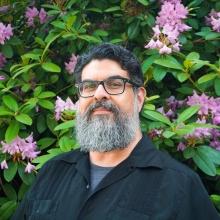
Joseph Orosco, Associate Professor of Philosophy and Director of the Peace Studies Program, Oregon State University

Related Resources: 

Merlesques: bonus audio from the live recording

Web Resources

(2008). “Bolivar.” BBC Radio 4: In Our Time. 

Oliver, Amy (1998). “Latin America, philosophy in.” Routledge Encyclopedia of Philosophy. 

Orosco, Jose-Antonio (2011). “Jose Vasconcelos, White Supremacy, and the Silence of American Pragmatism.” Inter-American Journal of Philosophy.

Tuck, Jim (2008). “Nezahualcoyotl: Texcoco’s philosopher king (1403-1473).” Mexconnect.

Vargas, Manuel (2010). “Culture and the Value of Philosophy: The Latin American Case.” Comparative Philosophy.

Vargas, Manuel (2005). “Eurocentrism and the Philosophy of Liberation.” APA Newsletter on Hispanic/Latino Issues. 

Books

Dussel, Enrique (2003). Philosophy of Liberation. ISBN: 159244427X.

Gracia, Jorge, and Elizabeth Millan-Zaibert, eds. (2004). Latin American Philosophy for the 21st Century: The Human Condition, Values, and the Search for Identity. ISBN: 1573929783. 

Leon-Portilla, Miguel (1990). Aztec Thought and Culture: A Study of the Ancient Nahuatl Mind. ISBN: 0806122951. 

Martín Alcoff, Linda, and Mario Sáenz (2003). Latin American Perspectives on Globalization: Ethics, Politics, and Alternative Visions. ISBN: 0742507777. 

Mendieta, Eduardo, ed. (2003). Latin American Philosophy: Currents, Issues, Debates. ISBN: 0253215633.

Nuccetelli, Susanna (2001). Latin American Thought: Philosophical Problems and Arguments. ISBN: 0813365538. 

Get Philosophy Talk

Live

Sunday at 10am, PST, KALW, 91.7 FM, Local Public Radio, San Francisco

Streaming

Broadcast live on your iPhone or Android using the Public Radio Player

Podcast

Individual episodes, multipacks and The Complete Philosophy Talk on sale now through Iamplify.   Individual episodes available through Itunes and CD Baby.

Subscribe

Subscribe to our free weekly download service, and our monthly eNewsletter

John Perry and Ken Taylor

Talk to Us

Sidebar Menu

Upcoming Shows

  • June 23 : Nations and Borders
    One’s country of birth has a profound effect on life prospects. It's often best to go elsewhere. But moving is not always so easy. Borders and...
  • June 30 : Whodunit: The Language of Responsibility
    Who is responsible for the broken vase in the foyer? How harshly should criminals be punished for their crimes? Did Justin Timberlake mean to disrobe...
  • July 07 : Ancient Wisdom for Modern Times
    If the Ancients found themselves transported to the modern world, they would have much to learn about science, technology, and human thinking. But is...
  • July 14 : Atheism and the Well-Lived Life
    Atheists don't believe in God – does that mean they don't find life meaningful? Are atheists doomed to be grouchy nihilists, finding meaning only in...
  • July 21 : Freedom and Free Enterprise
    “Freedom” means the human capacity to choose among options, based on one’s own preferences and reasoning. It also stands for the political status to...

Support Philosophy Talk

DONATE TODAY

Philosophy Talk relies on the support of listeners like you to stay on the air and online. Any contribution, large or small, helps us produce intelligent, reflective radio that questions everything, including our most deeply-held beliefs about science, morality, culture, and the human condition. Make your tax-deductible contribution now through Stanford University's secure online donation page. Thank you for your support, and thank you for thinking!