Hypocrisy
Jul 08, 2012Hypocrites believe one thing, but do another. Jefferson opposed slavery, but owned slaves. Jesus professed universal love, but cursed an innocent fig tree.
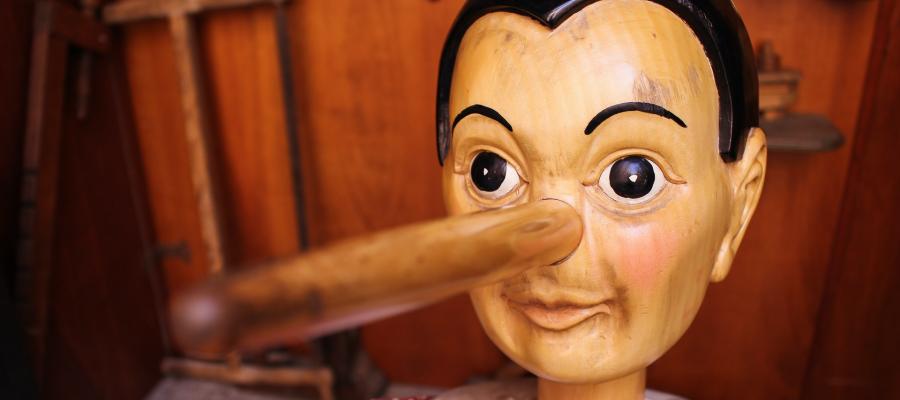
This week’s episode is about Hypocrisy. There’s certainly a lot of hypocrisy around, especially in politics. But how bad is it? Is it a simply necessary evil for an effective politician? Or is it really one of the worst kinds of vices?
I suppose we ought to start by trying to get clear on what exactly hypocrisy is. The word ‘hypocrisy’ comes from a Greek word meaning “playing a theatrical role”. So, we might start with:
A hypocrite is someone who pretends to be something he's not.
That definition probably fits a lot of cases, but I don’t think it's quite right. Consider a courageous abolitionist before the Civil War who travels into the South, where he pretends to be a good ol' boy in order to get slaves so he can smuggle them up north. He pretends to be something he isn't; but would you call such a hero a hypocrite? It depends on what his motives are, and whether he believes he ought to have the values he just pretends to have. Our courageous abolitionist surely doesn’t never think he ought to adopt the values of the slaveowners, so he’s not a hypocrite. So here’s a second try.
A hypocrite is someone who pretends to be something he's not, and knows he’s not, but thinks he ought to be.
But now imagine another character, a guy who volunteers at a soup kitchen. His motive isn’t feeding the poor; he doesn’t care about the poor. Moreover, he doesn’t even think he ought to care about the poor; he thinks such traits are weak and unworthy. He volunteers in order to meet vulnerable women whom he can take advantage of. Like our courageous abolitionist, he doesn't believe in the values he pretends to have, in this case feeding the poor. If we think this fellow is a hypocrite, we need a new definition. Perhaps we should merely say this fellow is a cad. A cad and a hypocrite both act on bad motives, while pretending to have good motives. But the cad doesn’t even realize that the motives he pretends to have are better than the ones he actually has.
So let’s turn to the question of whether, if hypocrisy is in some situations a bad trait, just how bad is it? In some situations is the hypocritical thing to do the right thing to do? In particular, is this often the case politics?
Consider two politicians who both pretend to worry about the plight of the poor in order to win votes. One of them thinks it would be silly -- immoral even -- to worry about the poor. According to our definition, this politician is a liar and a cad, but he’s not a hypocrite. The other one doesn’t care much about the poor either, but let’s say he thinks he'd be a better person if he did. So he is a hypocrite -- but I'd prefer him to the first because at least there’s some chance that the feelings he pretends to have will eventually take hold.
One might suppose the word ‘hypocrite’ isn’t quite right for the second fellow. It sounds like he just suffers from weakness of will. He thinks he ought to care about the plight of the poor, and he even pays lip service to the cause, but he’s too weak or selfish to actually do anything about it.
But here’s the crucial difference -- his lip service to the cause is precisely what makes him a hypocrite. If it were merely weakness of will, he could admit that he ought to be doing more to help the poor than he actually does. But instead, he pretends to be doing something about it, when really he knows he’s not. So he is a hypocrite, and like most hypocrites, weak-willed.
Is hypocrisy a good thing in a politician? Well, perhaps we ought to agree that being a hypocrite of this sort is better than being a cad and a liar. Faint praise, to be sure. But is there any way to avoid it in the world of politics? Success in politics require getting more votes than one’s opponent. Won’t a hypocrite always have an edge in this endeavor?
Photo by Jametlene Reskp on Unsplash
Comments (20)
Harold G. Neuman
Thursday, July 5, 2012 -- 5:00 PM
I read your post carefully,I read your post carefully, trying to absorb all that was being proposed. Then, encountering the final paragraph, I almost choked on my Port Republic Lager. You see, to me, a "cad", "liar" and "hypocrite" are all the same. I suppose, in our situationally ethical world, DEGREE matters---in some personally defined, situational way. And there is the 'rub', as they say. There are either lies. Or there are not. We either care. Or we don't. History appears to show that we do not care. That it does not matter. I must have missed something? Did anyone else?
My best regards to Mirugai---if you are still out there.
Neuman.
Guest
Friday, July 6, 2012 -- 5:00 PM
Regarding Jefferson's slaveryRegarding Jefferson's slavery hypocrisy I have this thought:
Jefferson lived during a time when many of the wealthy or affluent American's owning vast estates were built and maintained with the labors of human slavery. Jefferson believed in the equity of all human beings no matter the color of skin but was caught in the hypocrisy of knowing right and doing wrong; caught between believing in the inalienable right of equality and the inequitable livelihood of not only himself but his family and nation at the time.
Jefferson lived at a time when the question of slavery was being contested to the degree of civil war and found himself on the turning point that led us not only to our national independence but also the abolition of slavery.
Jefferson led the way to freedom while living in the most inequitable times of our past.
I would not call Mr. Jefferson a hypocrite but rather a champion of freedom, a true hero to us all.
Imagine that an American would have to defend him at all,
=
Guest
Friday, July 6, 2012 -- 5:00 PM
Hypocrites are 10 for 12, or,Hypocrites are 10 for 12, or, a dime a dozen. We have come to accept liars as business-as-usual...apparently, because there is no other MO with which we are comfortable. This did not, I suspect, happen over night, rather, it has insidiously worked its way into our collective consciousness. Popular culture, and such like. Nothing is ever as complicated as is seems. Nor as simple. Historionic effect---or something like that.
Guest
Monday, July 9, 2012 -- 5:00 PM
Upon some reflection, I mustUpon some reflection, I must offer the following assesssment. Hypocrisy is meaningless in this twenty-first century world. Why? Well, because, 1) It has become a universal approach to most anything, from political chicanery to religious dogmatism. 2) Those (many, now) who cannot get their own way by truth-saying, will do anything it takes to gain their edge (see also: #1), above.) 3) There are no unremitting penalties for being a hypocrite (or for being a pathological liar, for that matter.) All one need do is watch the popular television series that thrive on deceipt and sensationalism. Is this the descent of man? It certainly seems to be. I guess my worldview is out-dated. OK, then. I'm good with that.
Guest
Tuesday, July 10, 2012 -- 5:00 PM
"Do I contradict myself? Very"Do I contradict myself? Very well, then I contradict myself, I am large, I contain multitudes"? Walt Whitman
Guest
Thursday, July 12, 2012 -- 5:00 PM
I think we generally regardI think we generally regard it as "do as I say, not as I do."
Hypocrisy is a light bulb that goes of when we reach about 16 or 17. We use it as a defensive reflex; "You're such a hypocrite!" "You used to smoke!" "You swear/curse all the time!"
Some of our best examples come from American literature. We have the Scarlet Letter and the Crucible, both of which deal heavily in Puritanism.
Harold G. Neuman
Monday, July 16, 2012 -- 5:00 PM
I have seen no comments onI have seen no comments on this post so far. Is there some problem? Just asking...
mirugai
Monday, July 23, 2012 -- 5:00 PM
As has been said many times,As has been said many times, "Hello Neuman." Thank you for your regards. I have been following the blog, but have been traveling and have put my philosophy writings aside for a bit. Here is a piece I did on making the martini. When you are frustrated by hypocracy, and seek some solace, a good martini can work wonders. Regards to you, and the regulars.
THE MARTINI
?The simplest drinks are the hardest to make ? well.? Mirugai
?The ice makes the cocktail.? Chalik
When we say ?martini? we mean a cocktail served up, in a martini glass (not a giant one), with the ingredients gin, dry vermouth, and perhaps a marinated olive. Such a drink made with vodka is NOT a martini; you might call it a ?vodka martini,? but it is not a ?martini.?
GIN
Gin is to be 80-90 proof, no more; the 100 and higher proof gins (such as Bombay Sapphire) are too hot, and they make the botanicals too harsh tasting. There are as many flavors of gin as there are herbs and botanicals to blend and infuse in the alcohol. Juniper berries are most often cited as an essential element; taste one sometime and see if you like that flavor; alone, I don?t, but quieted in a blend, it is OK. I don?t like lemon verbena either (again, harsh and acidic); you probably do, so those with l.v. are probably more to your taste than mine.
For the cocktail ?gin and tonic? (with lime), the gin should have an herb and floral profile very different from a gin used in a martini, which has a much less complex goal.
So for martinis I prefer the less complex, less floral, less herby gins. Boodle?s is my favorite martini gin; Gordon?s is much cheaper and is my second favorite. Beefeater is fine, too.
Keep your martini gin in the freezer, and don?t let it sit out for any period of time.
So, you have to taste a number of freezer gins to find the one you like best, keeping in mind that it should be rather neutral (comparatively speaking) because the vermouth will contribute herby, winey, floral overtones.
DRY VERMOUTH
Dry vermouth is a fortified white wine, aged with various herbs and flowers. You have to taste a number of them to find the flavor profile with which to complement the gin. Right now, I like one from Cinzano, called Extra Dry. Others are Noilly-Pratt, Martini, and Vya, Gallo, Lejon. But whatever d.v. you select, remember to never let it out of the refrigerator after it is opened. Just about every martini you drink, at a bar, restaurant or at someone?s home, tastes like shit because the d.v. they are using is 1. years old, and 2. kept in some warm cupboard where it goes bad in a few days. What do you think an open bottle of white wine (with added herbs) will taste like after a year at 75 degrees? Shit ? it will taste like shit! This terrible flavor kills all the good intentions of your beautiful gin.
There is a lot of controversy and bullshit about how you want to use so little d.v. ? some say to use an eye-dropper for one drop, or just put a drop in the glass, swirl it, and throw it out. My feeling is that good d.v. can really complement and add to the profile of the gin, and the key is to find just how much to use by tasting various ratios and seeing what you like best. I use a little squirt with my thumb over the bottle top. But don?t be afraid to blend it to your personal taste as to the amount you use; when you make one at home, where you are assured you have good stuff, to your taste, you can use more; when you are out, given the poor quality of most d.v., a drier (i.e., one with less d.v.) drink might be more successful. Always tell your host you want your drink ?ice cold,? to blunt the off tastes of crappy d.v.
OLIVE
The olive adds a hint of pickle juice, and if it is a good, fresh one (again, not one that has been in the jar for six months, in or out of the refer), it continues to pickle in the cocktail, and the little bite complements the drink.
They cannot technically be called a martini, but I often will substitute for the olive, a small pickled onion, or a tiny, tiny sliver of lemon peel.
THE GLASS
A martini glass ? and not one of those oversized ones; the drink is rather small so it can stay chilled while being drunk; the big glasses let the cocktail get warm, and that kills it.
Always have two martini glasses on hand in the freezer. And if guests will be drinking martinis that evening, have two glasses per person in the freezer in advance. When one martini is finished, wash the glass and put it in the freezer; a second drink is made with the second glass from the freezer.
ICE
Cracked ice is best; old ice that has picked up the smells of the refrigerator destroy the cocktail?s hopes. If you have an icemaker in your fridge, or if you make your own cubes, remake your ice supply every week. If you don?t believe me, just taste the ice you have in your freezer right now. Do it! See?
MAKING THE DRINK
Put in a cocktail shaker: 1 ½ oz (a jigger) of gin from the freezer; a squirt of d.v. from the bottle in the fridge; half fill with ice. Cap the shaker. Shake violently for 10-12 seconds.
Take the glass out of the freezer and pour the cocktail through the shaker strainer into it. Ice shards are just fine; they add the tiny bit of water and the cool that smooths everything out. Put the shaker with its ice back in the freezer.
Plop in the olive, or skewer it with a toothpick into the glass.
Try to let as little of your hand come in contact with the glass as possible, to keep it chilled. Drink it before it warms up. You can refresh a slightly warmed drink by, first, straining all the water out of the shaker (with ice left in it), and reshake the drink for 6 seconds.
Gary M Washburn
Friday, November 28, 2014 -- 4:00 PM
~~Jeremiah Burroughs, an~~Jeremiah Burroughs, an English preacher at around the time of the American Revolution, was enough of a Calvinist to divide the world between 'Saints and Worldlings' apparently quite sincerely. The point is, the view is objectively hypocritical whether it is sincerely believed or not. For millennia elites have been finding rationalities for denying the worthiness of those who produce the goods and services they need to sustain their elitism. It is not a matter of personal quality that should decide the merits of the views expressed. Courts of law have for centuries recognized that the manner of presentation can be as prejudicial as the verity of the evidence offered. And so an elaborate structure of rules of evidence apply and are more or less strictly enforced. I wouldn't expect politicians to face imprisonment for violating the right of the people to a common sense standard of truth and sincerity, the whole process, after all, can be said to be one of prejudicing the public toward one's side or against the opposition, but it seems patently obvious that some guidelines and enforcement procedures need to be set in place in the current miasma of wildly unworthy opinions expressed. A few weeks ago a guest on Moyers and Company bemoaned a well entrenched tradition of politicians hesitating to answer a difficult question while the wheels almost visibly turn in his head in consideration what his major donors would let him get away with saying in public. My remedy would be, among other things, to ditch the current debate structure for one closer to a trial format. Instead of giving speeches at each other, the candidates should offer witnesses on each issue which they question and cross-examine, with a trained judge overseeing the proceedings to assure, perhaps not strict rules of evidence, but a certain degree of decorum pertinence consistency and reasonableness. Gimmicks gimcracks and sleights of hand, or mind, not admitted.
N. Bogdanov
Tuesday, December 2, 2014 -- 4:00 PM
John, I enjoyed how you builtJohn, I enjoyed how you built up our understanding of hypocrisy from a set of understandable and relatable examples. However, something that occurred to me as I was reading through this post and the above comments is that all of our understandings of hypocrisy seem to pivot on belief states; that is, one can be classified as a hypocrite, or not, just by virtue of the sorts of beliefs she holds?without any reference to action. How do the actual actions we take come into play in determining whether or not we can be called hypocrites justly? Is it that we are to take our actions as representative of certain beliefs, and go from there?
?Is hypocrisy a good thing in a politician?? My gut reaction is no. But on the understanding of hypocrisy developed above, it seems as though we might be able to distance ourselves from its negative connotations by seeing it as a vehicle for the politicians? navigating the split world of being both a public servant and a private individual. On this view, it would merely serve to characterize that a politician?s personal views are out of line with what she takes to be the views a servant in her office ought to have. As long as she is aware of this, and acts appropriately in her public role, then hypocrisy doesn?t seem so bad. (But, if I were to question any part of this paragraph, it would be the second-to-last sentence. How would this even work?)
mrush@csub.edu
Wednesday, December 3, 2014 -- 4:00 PM
I don't understand theI don't understand the adjective " expedient" when it comes to hypocrisy. Could you explain? I often allow myself a hypocritical position because the point of view of the receiver was too narrow to understand an authentic position. For example, I allow myself to be a hypocritical catholic so that my children can grow within an established religion - Catholicism - knowing full well that the liberalizing of their religious view will happen, and they may come to join me - more authentically - with a different viewpoint . In time. Is this what you mean about expedient? If so, why is that something to not embrace and rather trivialize ?
RichardCurtisPhD
Thursday, December 4, 2014 -- 4:00 PM
I thought it was curiousI thought it was curious that you guys never noticed that what was being advocated is simply Neo-Conservatism. No one ever mentioned that word or that this is just a version of Leo Strauss' philosophy. It is a vile philosophy of deception, but it can be dressed up nice. The guest was a very affable guy, and good fun as a guest! But what he was advocating is totalitarian by its very nature -- elites rule in secret via lies.
What makes his presentation appealing is that he packaged it in a way conflated the descriptive and normative. Ken objected to it as normative, and rightly so. John saw a useful insight in what seemed descriptive (we have this problem now so this is what we should do). But Ken rightly noticed that when pressed on whether that was just practical now or principled, he said principled. He, in principle, thinks rulers should rule via deception.
I think he was a bit dishonest in not acknowledging that his view is in principle anti-democratic, but Straussians are not known for being straight-forward are they?
RichardCurtisPhD
Thursday, December 4, 2014 -- 4:00 PM
I think they do mean what youI think they do mean what you say -- that is an example of an expedient hypocrisy. I think the problem is that your children may grow up to see you and perhaps the Church as merely hypocrites. If that happens they will not join you in your version of the faith -- they will reject it. Why not be authentic about your own beliefs? There are plenty of Catholics (including priests and theologians) who reject some Church teachings as outmoded, unpractical, dogmatic or unethical. This is the general problem with hypocrisy as well, as Ken said it poisons human relationships.
Gary M Washburn
Friday, December 5, 2014 -- 4:00 PM
A good exposé of StraussianA good exposé of Straussian mischief-making, in philosophy if not politics, is a book by John McCumber, Time in the Ditch. Straussian dogmatism has no place in our schools and should be given no sheen of respectability in our discussions. What rankles me is the claim of superior scholarship rigor and innovation. There is little new in the 'movement' with such shades of earlier prejudices as Gregory the Great's 'occult dispensation', or Jeremiah Burroughs' division of the world between 'saints and worldlings'. In a footnote to his History of England, Hume quips about how the leaders of the Commonwealth gathered together on Wednesday evenings to brag about how they were elevated to sanctimony. I wonder what Straussians do when alone together?
Or
Sunday, December 7, 2014 -- 4:00 PM
As I understand it, hypocrisyAs I understand it, hypocrisy should be considered a tool rather than a personality built-in trait or characteristic. As a tool one can choose to use it or not to pursue an ending without it actually meaning anything about who one really is. You could use this tool as if you were in the theater playing a role and then go back to being you, the real one, yourself. In this case hypocrisy would not be ?bad;? it would actually be useful. The question to me really is whether you should unveil it to your audience or whether you should conceal that you are using hypocrisy as a tool ? then, we would be facing a right or wrong type of question (is it right or wrong to lie, to hide).
rsilvers
Monday, December 8, 2014 -- 4:00 PM
Hypocrisy is an outcome ofHypocrisy is an outcome of two items: belief and action. Moreover, the impetus for the action may be worthy of esteem or of opprobrium. But it is hard to conceive of hypocrisy ever being a virtue.
I hold a belief that P is a good/moral/ethical act, that ~P is a bad/immoral/unethical act. Nevertheless, I choose ~P. I could be a hypocrite, or I could just be, as Ken termed it, "weak-willed." Alternatively, I could have an ulterior motive and choose ~P in order to attain that ulterior motive -- which could be worthy of esteem or not.
I would define hypocrisy as in believing that P is good/moral/ethical, that ~P is bad/immoral/unethical, choosing ~P, and making this choice either due to weakness of will or for some ulterior motive worthy of opprobrium.
Rep. Foley could have believed P and even acted in one sphere on that, but, acting in private on ~P just to please himself is hypocrisy. There is nothing good about it.
Pres. Bush's promise of "no new taxes" does not make him a hypocrite. Two possibilities: either he truly believed that he would hew to that promise but then circumstances changed and he, wisely, broke that promise; or, he made that promise to increase his chances of winning the presidency -- because we voters are too naive and want our politicians to make such promises -- which would, in his mind, allow him to do more good for the country. This could be similar to Pres. Obama's promise to close Gitmo.
But in no way is hypocrisy a virtue. Machiavelli stated that politicians need to be ready to lie or prevaricate or to act expediently -- they cannot be Kantians -- but they could not be habitual and there was as much need for such expedience dealing with foreign leaders as with the citizens of one's own principality. In a way, Machiavelli advocated a distinct moral/ethical system for politicians compared with individuals.
emmakevin
Monday, December 15, 2014 -- 4:00 PM
Green Coffee Beans Max is aGreen Coffee Beans Max is a True Fat Burner Supplement which consists of 100% Pure and Natural weight loss ingredients. Get 3 Month Free Supply. Available Online ! Green Coffee Bean Max gives you the big opportunity of losing weight. Its revolutionary formula makes you burn fat, increase energy and metabolism. Within a few weeks you will notice change in your weight, without any side effects. Buy Green Coffee Beans
Gary M Washburn
Friday, December 19, 2014 -- 4:00 PM
And I don't like green beansAnd I don't like green beans and spam, Sam I am!
Harold G. Neuman
Friday, April 3, 2015 -- 5:00 PM
A short time ago two (twoA short time ago two (two weeks, maybe), there appeared a story in our local newspaper. I imagine it surfaced in others, but do not know for certain---it may have been mentioned by someone else herein-if so, please forgive the redundancy by yours truly. Seems that one would-be presidential candidate, name of Cruz might have to apply for healthcare under the Affordable Care Act. This coming from an avowed anti-Obama senator and one who has also vowed to scuttle the healthcare law as we know it. I suppose if the situation warrants, one does what one must-hypocrisy notwithstanding. In another editorial letter, a gentle reader asked where the birthers are now, inasmuch as Mr. Cruz was (allegedly) born in Canada? A third reader was spot-on with his own response. Ted Cruz was born (allegedly) of American citizens, ergo, he is an American-born citizen regardless of where that birth occurred. And so, kind commenters, there it is. I have no dog in the hunt nor any particular axe to grind. In the world today, there are lies, damned lies and statistics. And too, there is hypocrisy.
Guest
Friday, June 24, 2016 -- 5:00 PM
AI would like to thank youAI would like to thank you for the efforts you have made in writing this post. I am hoping the same best work from you in the future as well. In fact your creative writing abilities has inspired me.
Financial Advisors in Washington DC